Residents React as NSCDC Raids Alleged Juice Factory Operating in Badagry Home
Kehinde Adeleye
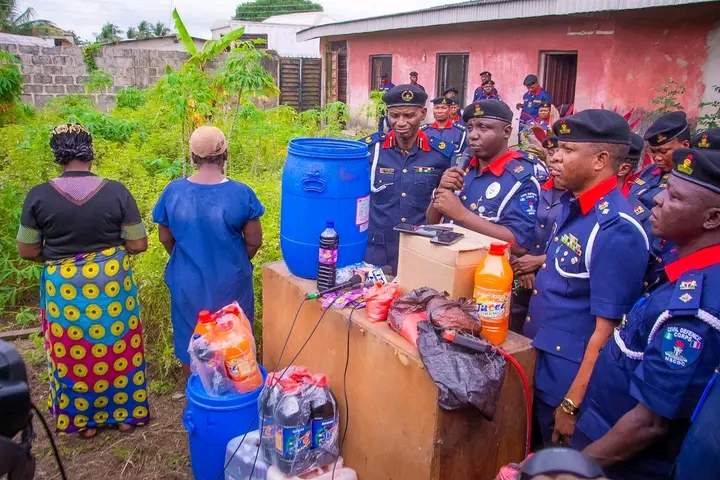
Residents and social media users have expressed concern after the Nigeria Security and Civil Defence Corps, NSCDC, raided an alleged illegal juice production facility operating from a building in a residential area of Aradagun, Badagry, Lagos State.
The raid, which led to the arrest of two women, has drawn attention to the potential risks to residents and consumers after NSCDC operatives allegedly found a dirty well being used as a source of water for production and an unclean industrial storage tank at the premises.
The facility, located on Talabi Onilegbale Street, Olorunda Local Council Development Area, was raided at about 9pm on September 19, 2026, following five days of surveillance after intelligence was received about activities at the location.
The NSCDC said the building was being used partly for production and partly as a residence.
Cartons of a drink branded Barkas Juice and rolls of product labels were reportedly found inside the bungalow, while a truck loaded with the products was parked at the premises, allegedly awaiting distribution.
The corps said the factory was not registered and alleged that the product, manufactured under Titi Alubarika Trading Stores Ltd., carried a purportedly fraudulent National Agency for Food and Drug Administration and Control, NAFDAC, registration number, 01-2166L.
NSCDC spokesman, Oluwaseun Abolurin, speaking on behalf of the Lagos State Commandant, Adedotun Keshinro, said the alleged production raised public health concerns.
“Adulterated fruit drinks are being produced in this factory and supplied to Edo State and other parts of the country. The products were found packed in cartons and also loaded in a truck,” Abolurin said.
He said the corps contacted NAFDAC to authenticate the registration number displayed on the product and was informed that the drink was not registered.
The NSCDC also alleged that the product contained high levels of sugar, additives and dyes, although no laboratory findings were provided to independently substantiate the claim.
The operation reportedly faced resistance from some youths in the community, prompting the NSCDC to strengthen its security arrangement with the involvement of the Nigerian Army.
Abolurin, however, said support from members of the community contributed to the success of the operation.
The primary suspect, Morenikeji Alawiye, gave a different account to The Guardian, saying the facility was established by her grandmother and had operated for almost 20 years.
Alawiye acknowledged that the factory had previously been shut down but said she had been working to regularise its operations before her arrest.
She said the family initially produced bottled and sachet water before experiencing difficulties and claimed she had contacted an uncle working with NAFDAC to assist with the approval process.
According to her, an aunt had also connected the business with a prospective customer in The Gambia who was interested in having the product manufactured for export.
Meanwhile, the development has triggered reactions from members of the public, with some expressing concern over the alleged conditions under which the drinks were produced.
Samson Ayuba, reacting to the NSCDC Lagos Command’s report, wrote: “We are in serious trouble in this country. Every day, new problems that could kill us keep unfolding. 🤦♂️”
Naomi Besan Cishak said: “Congratulations for discovering this killer drink.”
Iduh Sunday also commended the security agency, writing: “Big Kudos to NSCDC Lagos Command.”
Another commenter, Agape Isaac, said the development had reinforced his preference for preparing his own drinks at home, writing: “Thank God for my rechargeable juicer blender. Nothing concern me with soft drinks.”
The two women remain in custody as the circumstances surrounding the alleged production, registration and distribution of the drinks are investigated.