Dirty Lagos: Why Are Refuse Heaps Taking Over the Streets?
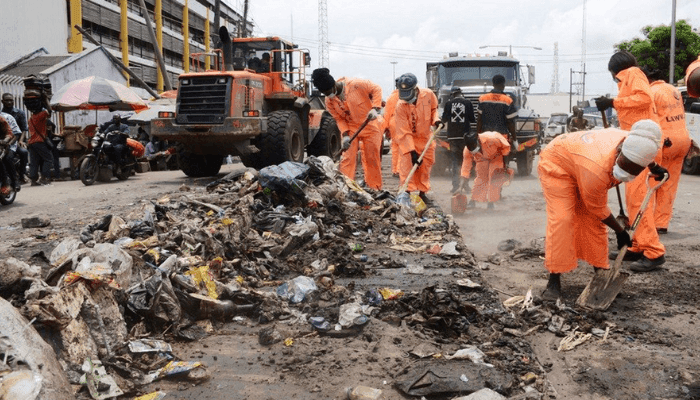
For many residents, “Dirty Lagos” has become more than a social media catchphrase. It is now a growing reflection of what many commuters, business owners and visitors encounter daily as heaps of refuse dot major roads, markets, residential streets and drainage channels across Nigeria’s commercial capital.
From Agege to Oshodi, Ajah to Ikorodu, Mushin to Mile 12, and even parts of the Lagos Island business district, overflowing communal bins, illegal dumpsites and littered road medians have become increasingly common, raising questions about whether Africa’s largest city is gradually losing the battle against waste.
The concern comes despite repeated assurances by the Lagos Waste Management Authority (LAWMA) that waste evacuation has improved significantly in recent months.
Only days ago, the agency announced that it evacuated more than 18,660 metric tonnes of municipal solid waste within one week, recording 1,866 truck trips across the state’s disposal facilities between July 28 and August 3.
LAWMA also disclosed that operations at the Olusosun Disposal Facility increased by more than 76 per cent, following the rehabilitation of its access road and the opening of additional waste disposal platforms.
According to the agency’s Managing Director and Chief Executive Officer, Dr. Muyiwa Gbadegesin, the improvement has reduced truck waiting time, increased turnaround and strengthened waste evacuation across Lagos.
On paper, the figures paint a picture of progress.
On the streets, however, many Lagosians say the reality tells a different story.
The growing disconnect between official statistics and what residents experience daily has fuelled criticism that while refuse may be leaving disposal sites faster, it is still accumulating in many communities before it gets there.
Environmental experts say the problem is far more complex than waste collection alone.
Lagos, home to more than 20 million people and one of Africa’s fastest-growing cities, generates thousands of tonnes of municipal waste every day. Rapid urbanisation, population growth and rising consumption mean the volume of refuse continues to outpace the capacity of existing infrastructure.
Another major challenge lies in the city’s dependence on landfills.
For decades, most of Lagos’ waste has ended up at disposal facilities such as Olusosun, Ewu-Elepe, Badagry and Oke Osho. Although the state government has repeatedly promised to transition towards recycling, waste-to-energy projects and resource recovery, many environmental stakeholders argue that the shift has been slower than expected.
Today, recyclable materials worth billions of naira continue to end up in landfills instead of being converted into energy, compost, construction materials or new consumer products.
Experts believe that with adequate investment, Lagos could transform its waste into a thriving circular economy capable of creating thousands of jobs, generating electricity and reducing pressure on landfill sites.
Instead, refuse continues to pile up in several communities, especially during the rainy season, when blocked drainage channels contribute to flooding and environmental pollution.
Residents also blame indiscriminate dumping by some members of the public, irregular collection schedules in certain areas and inadequate enforcement against environmental offenders.
Plastic bottles, food waste, nylon bags and construction debris frequently find their way into canals, roadsides and drainage systems despite existing sanitation laws.
While LAWMA has announced plans to expand Transfer Loading Stations, increase waste recovery facilities, introduce waste-to-energy projects and deploy additional compactor trucks, many Lagosians believe the city needs more than improved evacuation figures.
There are also growing calls for aggressive waste sorting at source, stricter enforcement of environmental regulations, improved public awareness campaigns and stronger collaboration with private recycling companies.
Urban planners argue that Lagos cannot continue relying primarily on landfill disposal if it hopes to become a cleaner and more sustainable megacity.
For many residents, the issue is no longer about the number of truckloads LAWMA evacuates every week.
It is about whether roads remain lined with refuse days after collection is due, whether drains remain free of waste during heavy rainfall and whether neighbourhoods are becoming cleaner rather than dirtier.
As Lagos continues to expand, the challenge before the state government is becoming increasingly urgent.
Can the city keep pace with the volume of waste it generates, or will “Dirty Lagos” become a lasting description of Africa’s commercial capital?
The answer may depend not only on how quickly refuse is evacuated, but also on how effectively Lagos transforms waste from an environmental burden into an economic resource.