Lagos Sends Drivers Back to Class for Road Safety
The Lagos State Drivers’ Institute (LASDRI) has continued to strengthen its training and retraining programmes for drivers and driving-school instructors, positioning education as a key part of the state’s road-safety strategy.
For many Lagosians, the journey to work, school or the market can begin with a simple hope: to arrive safely.
Every day, millions of people share the city’s increasingly busy roads with buses, cars, trucks, motorcycles and pedestrians. A split-second decision by one driver can determine whether a journey ends normally or becomes a tragedy.
That reality is driving Lagos State’s renewed emphasis on driver education, with authorities insisting that safer roads will require more than road construction and traffic enforcement; they will also require better-trained drivers.
The Lagos State Government has renewed its commitment to improving road safety through continuous training and professional development for driving school operators and instructors.
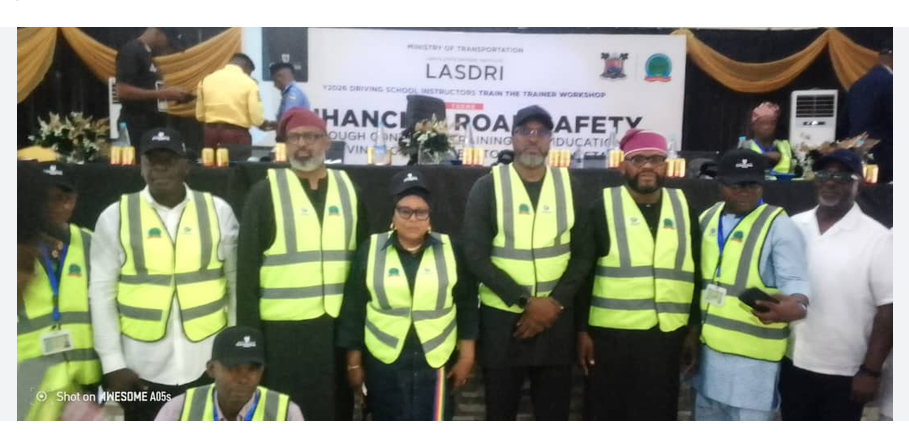
Commissioner for Transportation, Oluwaseun Osiyemi, stated this at the 2026 Driving School Instructors and Operators Train-the-Trainer Workshop, themed “Enhancing Road Safety through Continuous Training and Education.”
He stressed the importance of driving schools in producing responsible and safety-conscious motorists, while calling for stricter instructor certification, standardised curricula, rigorous testing, background checks, periodic re-licensing and continuous professional development.
In March 2026, LASDRI held its fifth annual “Train-the-Trainer” workshop, designed to equip driving instructors with updated knowledge and modern teaching techniques.
The initiative matters in a city where driving is rarely a simple exercise.
A Lagos driver may leave home in the morning and within a few kilometres encounter heavy traffic, impatient motorists, pedestrians crossing busy roads, commercial vehicles stopping unexpectedly and changing road conditions. For professional drivers who spend most of their working lives behind the wheel, those decisions are repeated hundreds of times each day.
That is why LASDRI’s approach increasingly focuses on defensive driving, understanding traffic rules, vehicle handling and developing the right attitude behind the wheel.
The institute’s current programmes include compulsory retraining for professional drivers, executive driver retraining and specialised training for drivers of ambulances, firefighting vehicles and other emergency or security vehicles. It also operates a programme specifically designed to train driving instructors.
The state has also taken the training closer to areas where motorists face some of Lagos’ most demanding driving conditions.
In May 2026, LASDRI opened additional training centres in Oshodi and Apapa, citing the heavy traffic and intense vehicular activity along both corridors. Officials said motorists operating in those areas require specialised training to cope with dense traffic, improve vehicle handling and understand road regulations.
For someone who drives through Oshodi every day, that kind of training is not merely theoretical.
A professional driver navigating the Oshodi interchange or the Apapa port corridor is dealing with buses, articulated trucks, pedestrians and other vehicles competing for limited road space. A mistake can affect not only the driver but passengers, pedestrians and other road users.
The Lagos State Government has previously linked driver education directly to economic development, arguing that road crashes and poor driving practices can cost the city valuable working hours and productivity.
At a 2025 LASDRI workshop, the Commissioner for Transportation, Oluwaseun Osiyemi, described driver education as essential to building a safer transport system and urged driving schools to provide quality training rather than simply preparing people to obtain licences.
The stakes are particularly high because of the sheer volume of movement in Lagos.
State officials have previously cited more than 15 million motorised trips daily, highlighting the enormous number of interactions taking place on Lagos roads every day.
That means improving the behaviour of even a fraction of drivers could have a noticeable effect on the daily experience of commuters.
It could mean fewer sudden lane changes, fewer dangerous overtaking attempts, better respect for pedestrians and traffic signs, and quicker responses when something goes wrong.
Lagos has also been pushing the idea that road safety should begin before someone becomes a professional driver.
The government has advocated for driver education to be introduced into school curricula, with officials arguing that teaching young people about road behaviour early could help develop a stronger safety culture over time.
There is also an economic argument behind the campaign.
A crash does not end with the damaged vehicle. Someone may lose income while recovering from an injury. A commercial vehicle may remain off the road. Passengers may miss work or appointments. Families may face medical expenses, while businesses lose productive hours.
For a city whose economy depends heavily on movement, safer roads therefore mean more than fewer accidents. They mean people getting to work, goods reaching their destinations and businesses operating with fewer disruptions.
The challenge, however, is ensuring that training translates into behaviour on the streets.
Lagos already has institutions responsible for road safety education and traffic management. LASTMA, for example, identifies road safety education, accident response and traffic-law enforcement among its responsibilities.
The next step is ensuring that drivers who complete training actually apply what they have learnt — and that those who repeatedly endanger other road users face appropriate consequences.
For the ordinary Lagosian, the success of the programme will ultimately be measured in very simple terms.
A mother should be able to put her child on a school bus without fear. A commuter should be able to enter a commercial bus without worrying about reckless driving. A pedestrian should be able to cross the road without feeling that one careless driver could change everything.
And a driver should understand that holding a steering wheel means carrying responsibility for more than one life.
That is the human side of Lagos’ road-safety campaign.
The roads may continue to be crowded. The traffic may remain frustrating. The city will continue to grow.
But if better training can make drivers more patient, more skilled and more conscious of the people around them, Lagos could make its roads safer one driver at a time.