What Happened to Lagos BRT After #EndSARS? Here’s What We Know
Kehinde Adeleye
The shortage of Bus Rapid Transit (BRT) buses still being experienced by Lagos commuters has been linked to the aftermath of the 2020 #EndSARS unrest, with the state government saying the rising cost of replacing damaged buses has made it difficult to restore the fleet to its former strength.
Lagos State Deputy Governor, Obafemi Hamzat, disclosed this during an interview on Nigeria Info FM, explaining that the buses purchased before the #EndSARS protests cost about N80 million each, while the replacement cost has now risen to approximately N280 million per bus.
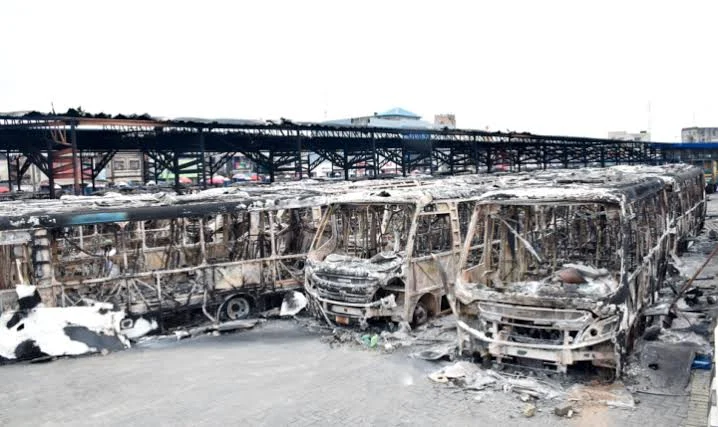
According to Hamzat, about 200 BRT buses were burnt during the unrest, and the state has not been able to replace all of them.
“During #EndSARS, if you recall, 200 of those buses were burnt. We bought those buses at that time for N80 million per bus. Now, it’s about N280 million per one,” Hamzat said.
So, what happened during #EndSARS?
The #EndSARS protests began in October 2020 as a nationwide demonstration against police brutality and the activities of the now-disbanded Special Anti-Robbery Squad, SARS.
In Lagos, the protests later degenerated into widespread violence, with public infrastructure, businesses and government facilities attacked in several parts of the state.
BRT facilities and buses were among the assets affected, including the Oyingbo BRT terminal, where several buses were reportedly set ablaze.
How many buses were actually destroyed?
There is a discrepancy in the figures provided by the Lagos State Government over the years.
While Hamzat recently put the number at 200 buses, the then Commissioner for Information and Strategy, Gbenga Omotoso, said in April 2021 that 80 BRT buses were destroyed during the unrest.
According to the 2021 government figure, 23 large BRT buses were burnt around Ojodu, while 57 medium-sized buses were destroyed at Oyingbo.
The difference between the figures has not been explained in the latest statement, but Hamzat maintained that the scale of the losses has contributed to the current shortage.
Why hasn’t Lagos simply bought replacement buses?
According to Hamzat, the major challenge is the dramatic increase in the cost of acquiring the buses.
A BRT bus that cost approximately N80 million before the #EndSARS crisis now costs about N280 million, meaning replacing a large number of buses would require substantially more public funds.
Hamzat also explained that the government had anticipated that some buses would naturally need to be retired after seven or eight years of operation, but the destruction of buses during the unrest added unexpected pressure to the fleet.
“Unfortunately, you know, we’ve not been able to replace all the 200, and that’s what we are seeing today,” he said.
Is Lagos abandoning BRT? Not exactly.
Rather than relying entirely on government-owned buses, the state is increasingly looking towards private-sector operators to expand public transportation.
Hamzat said private operators could acquire and deploy buses more quickly, while government could provide support through fare subsidies to make transportation more affordable for commuters.
He argued that government does not necessarily have to directly operate buses, saying private operators could be more flexible and responsive to changes in the transportation market.
What other options is Lagos exploring?
The government is also seeking to reduce pressure on road transportation by expanding other modes of public transport.
Hamzat pointed to the development of water transportation and rail services, including the state’s ferry operations and the Lagos rail system.
The idea is to create a more integrated transportation network where commuters have alternatives to road-based buses.
What does this mean for Lagos commuters?
For commuters who continue to experience long queues and overcrowding on BRT routes, the explanation from the government is that the current shortage is partly a consequence of the losses suffered during the #EndSARS unrest, compounded by the sharp rise in the cost of replacing buses.
However, the differing government figures on the number of buses destroyed leave an important question unanswered: how many BRT buses were actually lost, how many have been replaced, and how many more does Lagos need to restore efficient service?
For now, the state says its solution will not depend solely on replacing the old fleet, but on a combination of private-sector participation, rail, waterways and other public transport options to meet Lagos’ growing mobility needs.