
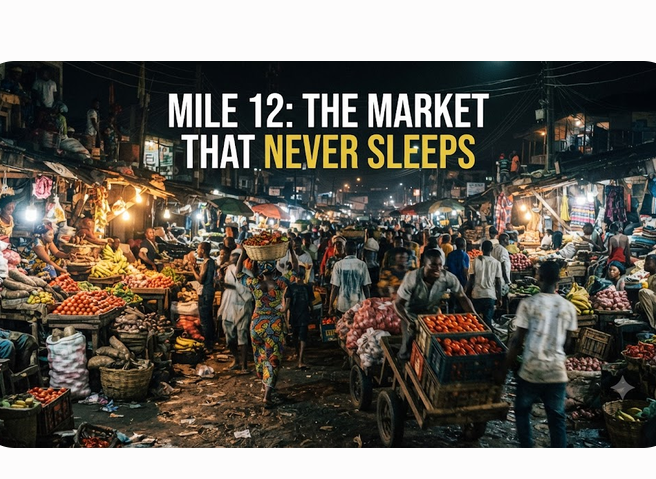
Mile 12: The Market That Never Sleeps
Long before sunrise, the first trucks begin rolling into Mile 12 International Market in Lagos.
Loaded with tomatoes, peppers, onions, yams and other farm produce from northern Nigeria, they arrive after journeys that often last more than 20 hours. By 4 a.m., the market is already alive.
Head porters weave through narrow paths balancing heavy baskets on their heads, traders inspect fresh deliveries under torchlight, transporters negotiate unloading fees, while food vendors prepare steaming bowls of pap, beans and akara for workers who have barely slept.
For thousands of people, this is not just another trading day—it is the daily routine that keeps one of Nigeria’s busiest food markets running.
Located in Kosofe Local Government Area, Mile 12 serves as one of the country’s largest wholesale food distribution hubs, supplying produce to retailers, restaurants and households across Lagos and neighbouring states. Every day, the market connects farmers, truck drivers, wholesalers, retailers and consumers in a vast supply chain that feeds millions.
As daylight breaks, business intensifies.
Wholesalers race to secure the best prices before demand peaks, while retailers from markets across Lagos queue to buy goods in bulk. Wheelbarrow pushers and porters shuttle endlessly between trucks and stalls, earning their income one load at a time.
But beneath the market’s energy lies a growing struggle.
Traders say transportation has become one of their biggest expenses. Rising fuel and diesel prices have increased the cost of moving food from farming communities to Lagos, forcing many sellers to raise prices even as customers’ purchasing power declines. Recent market surveys show that although food inflation has eased compared with its peak in 2024 and 2025, transport and logistics costs continue to drive price increases for staple foods across Mile 12, Mushin, Oyingbo and Daleko markets.
The effect is visible in every transaction.
Instead of buying full baskets, many customers now ask for smaller portions. Traders say shoppers increasingly purchase food in quantities they can afford for just a few days, while some postpone buying altogether until salaries or business income arrive.
Tomato sellers face another challenge, which is time.
Unlike grains, fresh tomatoes and peppers spoil quickly. A delayed truck, heavy rainfall or prolonged traffic can mean significant losses before produce even reaches consumers. To avoid waste, traders often slash prices late in the day rather than watch their stock perish overnight.
For transporters, the pressure is equally intense.
Drivers navigating highways from Kano, Kaduna, Plateau and Benue states contend with poor road conditions, rising maintenance costs and expensive fuel, all of which eventually affect the prices paid by consumers in Lagos. According to the International Monetary Fund, transport costs account for roughly a quarter of retail food prices in Nigeria, making logistics a major driver of food inflation.
By afternoon, the market begins to change pace.
Retail buyers head back to neighbourhood markets, while restaurant owners and food vendors make last-minute purchases. Hawkers weave through the crowds selling water, snacks and work tools to labourers who have spent hours carrying loads under the scorching sun.
Evening offers little respite.
Fresh trucks continue to arrive, unloading produce for the next day’s trading. Some workers sleep inside parked vehicles or makeshift shelters, while others prepare to begin another overnight journey to farming communities.
For many Nigerians, Mile 12 is simply a place to buy food.
For those who work there, however, it is a city within a city—a marketplace powered by traders, transporters, food vendors, cleaners and porters whose labour begins before dawn and often ends well after dark.
In an economy where every naira counts, the market’s greatest commodity may not be tomatoes or onions, but resilience. Every day, thousands of ordinary Nigerians keep the supply chain moving despite rising costs, uncertain profits and relentless pressure.
The market never truly sleeps. It simply prepares for another day.