
Lagos Slips in Nationwide Survey
Lagos Slips in Nationwide Survey
…Sanwo-Olu Promises to Do Better
By Kunle Awosiyan
Lagos State has slipped in the 2026 pSPI Momentum Index, joining 18 states identified as having recorded slower progress in the latest nationwide assessment of subnational performance.
The index, produced by Phillips Consulting (pcl.), measures how effectively states convert available resources into outcomes for citizens, rather than simply ranking states by the size of their revenues or inherited advantages.
Lagos recorded a negative momentum score of -0.08, placing it among the states classified as “slipping” in the 2026 assessment.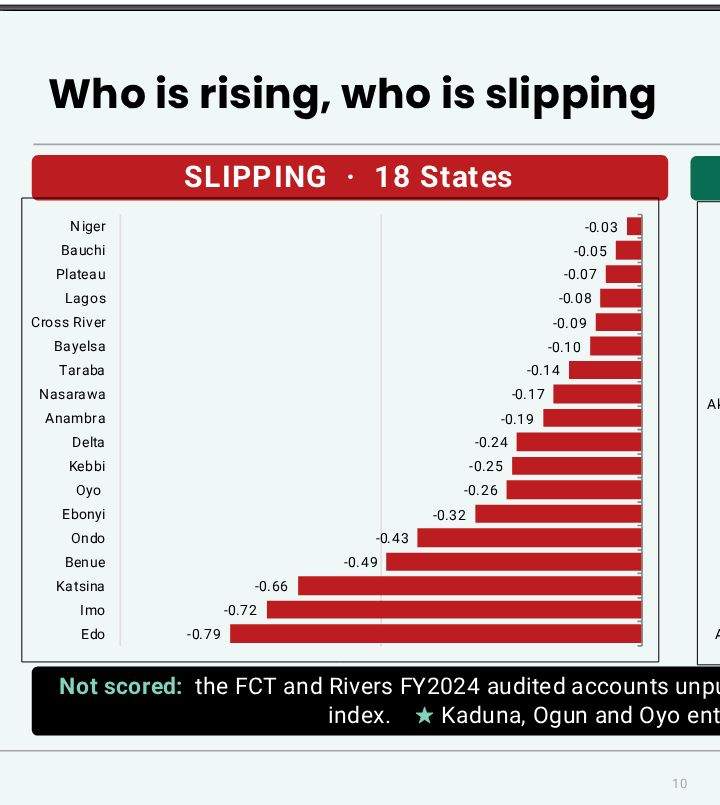
It was listed alongside Edo, Imo, Benue, Ondo, Ebonyi, Oyo, Kebbi, Delta, Anambra, Nasarawa, Taraba, Bayelsa, Cross River, Plateau, Bauchi and Niger.
The development represents a reversal from the 2025 edition, when Lagos emerged as the top-performing state under the methodology then in use.
The 2026 edition has shifted from an absolute league table to a Momentum Index, designed to measure how quickly states are improving relative to the national pace.
A score of 0.00 represents movement at the national pace, while a positive score indicates faster progress and a negative score indicates slower progress.
The index therefore measures a state’s trajectory rather than declaring an outright verdict on its overall quality.
Reacting to the ranking, Lagos State Governor, Babajide Sanwo-Olu, welcomed the assessment and pledged that his administration would improve its performance.
According to the report, Sanwo-Olu promised to “do it a lot better and smarter,” signalling the government’s readiness to respond to the findings of the latest assessment.
The governor’s response comes against the backdrop of Lagos’ unusual position in the index: while the state remains one of Nigeria’s strongest performers in revenue generation and financial self-reliance, its overall momentum has fallen below the national benchmark.
The report identifies Lagos as having the highest revenue self-reliance, with its internally generated revenue equivalent to 369 per cent of its federal allocation. It also records Lagos as having the country’s highest IGR per capita at ₦74,986.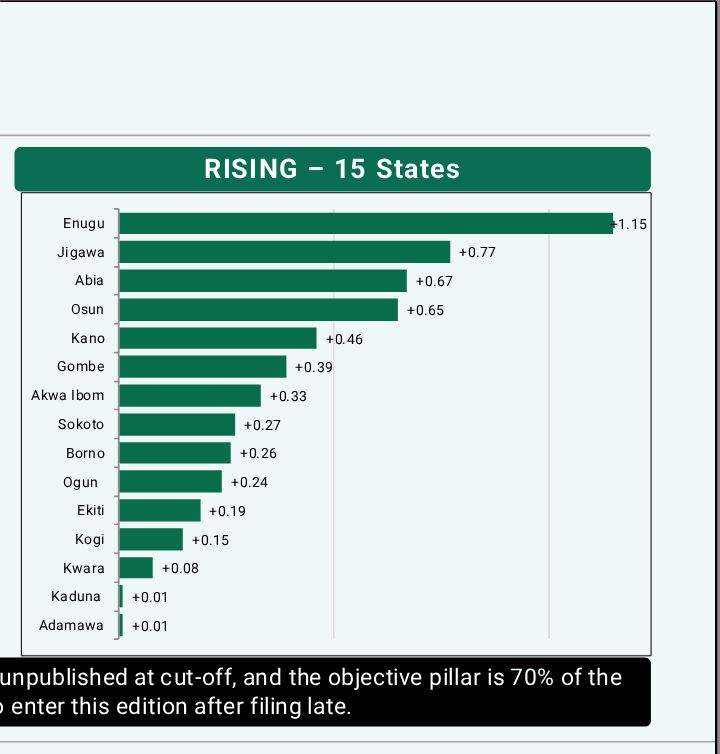
The contrast between Lagos’ financial strength and its negative momentum score is central to the report’s argument that money alone does not automatically translate into improved outcomes for citizens.
The 2026 pSPI found that federal allocations to states increased by 118 per cent between 2022 and 2025, while national citizen satisfaction remained at 2.90 out of five.
Only 18 of the 37 states recorded scores above the 3.0 “waterline.”
The assessment combines objective data with citizens’ perceptions, with objective indicators accounting for 70 per cent of the score and citizen perception contributing 30 per cent.
A total of 37,497 citizens participated in the 2026 survey.
The five major components of the Momentum Index are citizen satisfaction, revenue self-reliance, debt sustainability, revenue growth and transparency.
Nationally, citizens gave their highest rating to education affordability, with a score of 3.52 out of five, followed by roads at 3.19 and publicity of government policies at 3.09.
The weakest areas were finding employment, rated 2.42; clean water, 2.52; and law-enforcement conduct, 2.53.
The report also found that the South-East recorded the strongest average momentum, while the oil-rich South-South performed less strongly, suggesting that governance and deliberate policy choices may matter more than natural endowment in determining the pace of development.
For Lagos, the latest ranking presents a paradox: the state remains financially dominant, but its negative momentum score suggests that its pace of improvement has slowed relative to other states.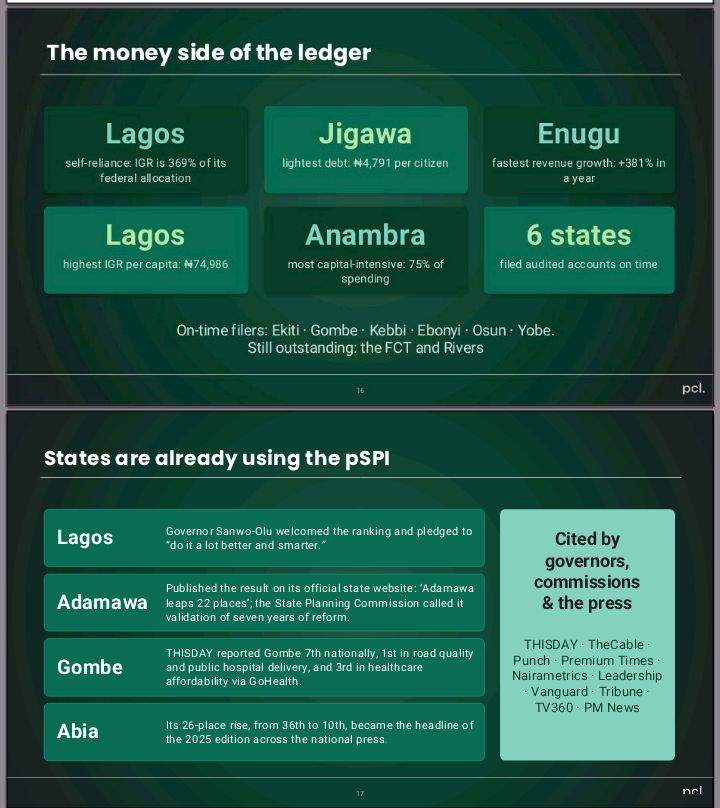
Governor Sanwo-Olu’s promise to “do it a lot better and smarter” therefore provides a political and administrative response to a report that places greater emphasis on what citizens actually experience than on the volume of government spending or projects.
As the pSPI report puts it, the true measure of success is whether citizens’ lives have improved, stressing that “impact matters more than projects.”