
Lagos Beats Global Breastfeeding Target, But Only 14% Start Within First Hour
Lagos State may have surpassed the global exclusive breastfeeding target, but a major gap remains in the period immediately after childbirth, with only 14 per cent of babies reportedly put to the breast within the first hour of birth.
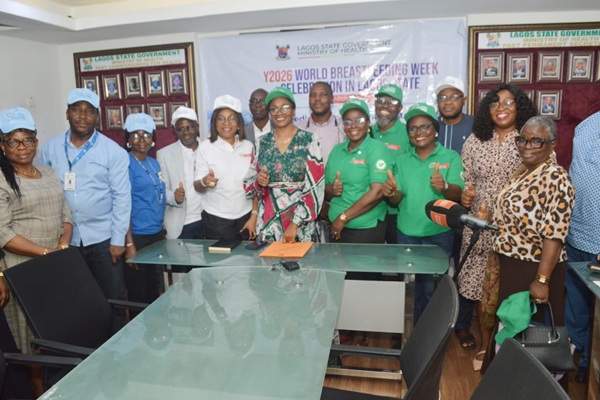
The figure was disclosed by the Special Adviser to the Lagos State Governor on Health, Dr Kemi Ogunyemi, during a press briefing at the Lagos State Ministry of Health in Alausa to mark the 2026 World Breastfeeding Week.
According to the state government, 57.4 per cent of mothers in Lagos practise exclusive breastfeeding, placing the state above the global target of 50 per cent.
But the much lower early initiation rate presents a different picture and could become the next major focus of Lagos’ breastfeeding campaign.
Health authorities recommend that breastfeeding should begin as soon as possible after birth, with the first hour considered particularly important for mother and child.
Ogunyemi said Lagos had made considerable progress in exclusive breastfeeding but needed to do more to ensure that mothers begin breastfeeding immediately after delivery.
She identified misconceptions about colostrum, the first milk produced after childbirth, as one of the factors contributing to the low early initiation rate.
Some mothers and families still hold beliefs that colostrum should be discarded, despite health authorities considering it an important source of nutrients and immune protection for newborns.
The state government is therefore training midwives and other healthcare workers in both public and private facilities to encourage mothers to initiate breastfeeding within the first hour.
Ogunyemi also addressed another persistent misconception, stressing that delivering a baby through Caesarean section is not a reason to delay breastfeeding.
“A Caesarean section is not a barrier to breastfeeding. Whether a mother delivers vaginally or through surgery, breastfeeding should begin as soon as possible, ideally within the first hour after birth,” she said.
Beyond the first hour, Lagos is encouraging mothers to practise exclusive breastfeeding for the first six months before introducing appropriate complementary foods while continuing breastfeeding up to two years and beyond.
The state says breastfeeding remains one of the most affordable strategies for improving child nutrition and survival, particularly at a time when many families are struggling with the rising cost of food and healthcare.
Unlike infant formula, breast milk does not require families to spend additional money on purchase, preparation or transportation, making breastfeeding particularly relevant to households facing economic pressure.
Ogunyemi said successful breastfeeding, however, should not be treated as the responsibility of mothers alone.
She called on fathers, grandparents, employers, healthcare workers, religious leaders, community leaders and other caregivers to provide the support nursing mothers need.
The government is also strengthening its Maternal, Infant and Young Child Nutrition (MIYCN) programme through healthcare-worker training, breastfeeding counselling, nutrition education and enforcement of regulations governing breast-milk substitutes.
According to the state, the programme is being implemented across its 334 primary healthcare centres, 29 secondary healthcare facilities and 1 tertiary health institution, with referral systems connecting the different levels of care.
The figures present an interesting challenge for Lagos.
The state has already crossed the 50 per cent global benchmark for exclusive breastfeeding, suggesting that public health campaigns and support systems are having an impact.
But the 14 per cent early-initiation figure shows that getting mothers to breastfeed exclusively for 6 months is only part of the challenge.
The next question for Lagos is whether it can close the gap between breastfeeding eventually and breastfeeding immediately after birth.
For health officials, that could mean reaching mothers before delivery, educating families about colostrum, improving maternity support and ensuring that healthcare workers encourage early mother-and-child contact regardless of the mode of delivery.
As Lagos marks World Breastfeeding Week under the theme “Breastfeeding for a Sustainable Start in Life: Strengthen What Works,” the state’s 57.4 per cent achievement offers reason for optimism.
But the 14 per cent figure is a reminder that there is still considerable work to do in the first hour of a child’s life.