
Apapa Customs Breaks Revenue Record as July Collection Hits ₦323bn
Every day, ships arrive at Apapa carrying the goods Nigerians need, machinery for factories, raw materials for businesses, vehicles, food products and other imports.
Before many of those goods can leave the port, however, they pass through a system that is increasingly becoming central to the Federal Government’s revenue drive.
That system delivered a new milestone in July, as the Nigeria Customs Service (NCS), Apapa Area Command, collected ₦323 billion in a single month, its highest monthly revenue ever recorded.
The figure surpassed the command’s previous record of ₦304 billion achieved in October 2025, representing an increase of about ₦19 billion, or 6.3 per cent. The latest performance also highlights the growing financial importance of Apapa, Nigeria’s busiest port complex and one of the country’s major gateways for international trade.
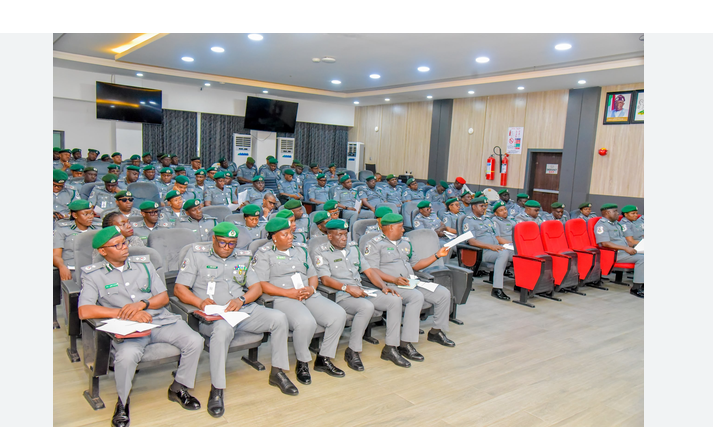
The record was disclosed by the Customs Area Controller of the Apapa Command, Comptroller Emmanuel Oshoba, during the command’s monthly meeting with deputy comptrollers overseeing terminals and unit heads.
For importers and businesses operating around Apapa, the revenue figure is more than another government statistic. It reflects the volume of commercial activity passing through one of Nigeria’s most important trade corridors and the amount of money being collected from goods entering the country.
Oshoba attributed the July performance to a combination of government policy support, improved compliance by importers, operational reforms and greater use of technology in customs processes.
The latest result builds on a strong performance by the command in recent years.
In 2025, Apapa Customs collected ₦2.93 trillion, up by ₦573.2 billion from the ₦2.36 trillion recorded in 2024. That represented a 24.32 per cent increase and reinforced Apapa’s position as one of the NCS’s most important revenue-generating commands.
A major part of the transformation has been the growing use of technology in cargo clearance. Customs officials previously identified the Unified Customs Management System, popularly known as B’Odogwu, as one of the tools helping to improve transparency, accountability and efficiency in processing imports and exports.
But behind the impressive numbers is a more complicated story about doing business at Nigeria’s ports.
Apapa remains a critical economic centre, but businesses operating there have long complained about congestion, logistics costs and delays in moving cargo from the port into Lagos and other parts of the country. The ability to collect more revenue, therefore, is increasingly tied to the question of whether goods can also move through the port more efficiently.
Customs has also had to balance trade facilitation with aggressive enforcement.
In July, the Apapa Command seized 4,143.5 kilogrammes of Cannabis Indica valued at ₦26.5 billion, concealed among imported vehicles in a 40-foot container. The operation was carried out with the National Drug Law Enforcement Agency and followed a physical examination of the container.
The seizure was one of several enforcement actions recorded at the port this year. Earlier in 2026, the command also intercepted cannabis and expired pharmaceutical products with a combined duty-paid value of ₦12.7 billion, while another operation uncovered codeine-based syrup worth about ₦3.4 billion concealed among household items.
For legitimate businesses, the other side of the Customs equation is faster and more predictable clearance.
The Federal Government has increasingly pushed Customs towards a model in which technology, risk management and automation can make it easier for compliant traders to move goods while allowing officers to concentrate enforcement efforts on suspicious consignments.
The July revenue record suggests that the strategy is beginning to translate into stronger collections at Nigeria’s busiest trade gateway.
Yet, the bigger question is what the money means for ordinary Nigerians.
Customs revenue ultimately feeds into government finances at a time when the country is under pressure to fund infrastructure, security, healthcare, education and other public services. Higher collections can therefore provide additional fiscal space—but only if the revenue is efficiently managed and translated into services and infrastructure that citizens can actually feel.
For the trader waiting for a container to clear, the manufacturer depending on imported raw materials, the transporter moving cargo out of Apapa or the consumer ultimately paying for imported goods, the real test will not be the size of Customs’ monthly headline.
It will be whether a more efficient port system can reduce delays and costs while bringing more revenue into government coffers.
For now, however, Apapa Customs has set a new benchmark. Its ₦323 billion July collection shows that the port is not merely a gateway for goods—it remains one of the most important engines of Nigeria’s revenue system.