The Lagos Families Turning Plastic Waste Into Extra Income
For years, the empty water bottle left after a hot afternoon in Lagos was simply rubbish. Today, for some households, that same bottle is worth money.
In homes across the city, families are increasingly separating plastic bottles, soft-drink containers and other recyclable materials from ordinary household waste, storing them in sacks and selling them to collectors or recycling centres. What began as a small way to clear clutter is quietly becoming a source of supplementary income for households struggling with the rising cost of food, transport and other essentials.
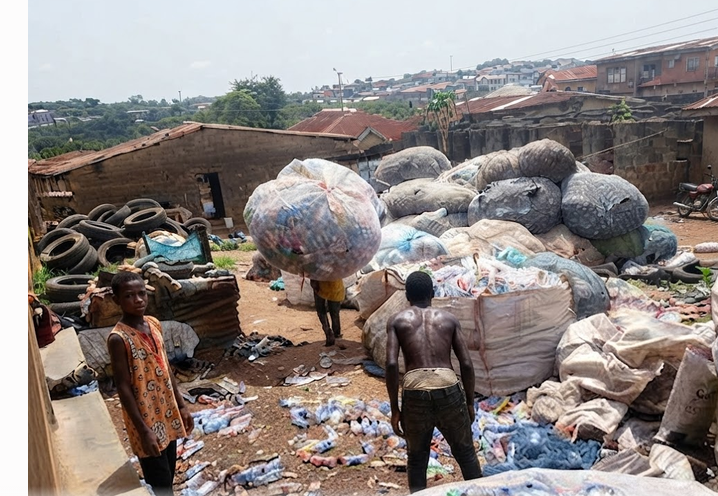
The business is simple: collect, sort, weigh and sell. But behind that routine is a growing recycling economy involving households, street collectors, aggregators, transporters and recycling companies.
For 27-year-old Abdulraheem Yusuf, who was profiled by The Nation in 2025, collecting plastics around the Ikotun market area had become a way to put food on the table. He reportedly earned between ₦5,000 and ₦8,000 a week from bottles picked from gutters and street corners. Another resident, identified as Mama Chidinma, described waste collection as a small family business, with her children helping to gather, wash and package recyclable materials before they were sold.
The figures have become more attractive as demand for recyclable materials grows.
A 2026 investigation by Nairametrics found that some plastic collectors were earning between ₦5,000 and ₦8,000 on weekdays and up to ₦11,000 on some weekends. Some dedicated collectors were reportedly making as much as ₦400,000 a month, depending on location, volume and the type of plastic collected. In Ojo, Lagos, one collector said coloured plastic bottles sold for about ₦200 per kilogramme, while colourless bottles fetched around ₦250.
That means a household that once saw no value in an empty bottle can now look at a full sack differently.
The money may not be enough to pay a family’s rent, but an additional few thousand naira each week can help with groceries, transport fares, school expenses or electricity bills.
And the business does not necessarily require a warehouse or expensive machinery to begin.
A family can start by keeping recyclable materials generated in its own home. A larger operation can involve collecting bottles from neighbours, shops, restaurants, offices, schools and events, then selling them in bulk.
That is where the economics become more interesting.
The value of plastic increases as it moves through the recycling chain. Collectors gather the material, aggregators consolidate it, sorters separate it by type and quality, and recycling companies eventually process it into materials that can be used again.
The informal workers at the beginning of that chain are increasingly becoming recognised as part of a legitimate economic ecosystem.
A 2026 Mongabay report found that recycling companies in Lagos were working with waste pickers through collection programmes, with some collectors earning about ₦35,000 a week. The report also noted that income varies depending on the volume and type of recyclable materials collected.
For someone without a formal salary, that can be a meaningful source of income.
But it is hard-earned money.
Collectors often spend hours pushing carts through neighbourhoods, markets and major roads looking for bottles. They compete with other collectors and must transport their haul to collection points. Some sort through mixed waste with little protective equipment, exposing themselves to sharp objects, contaminated materials and other health risks.
Still, the business is expanding because there is an enormous supply of plastic waiting to be collected.
Lagos’ huge population and high consumption of bottled water, soft drinks and packaged products create a constant stream of recyclable material. Lagos Waste Management Authority, LAWMA, has been promoting waste separation and recycling and has placed recycling bins in markets, schools, malls and other public spaces for materials including PET bottles, aluminium cans and other plastics.
LAWMA also maintains a list of registered recyclers across different parts of Lagos, including locations in Surulere, Lagos Island, Ikoyi-Obalende, Eti-Osa, Ikeja, Mushin, Oshodi, Igando-Ikotun and other areas.
For households, this is significant because it means plastic does not necessarily have to travel far before it can be converted into cash.
A resident in Igando, for example, can collect bottles at home, separate them from food waste and take them to a nearby collection centre or participate in a community buyback programme.
That model was put into practice in June 2026 when the Food and Beverage Recycling Alliance, working with partners including government agencies and recycling organisations, conducted a community buyback exercise in Igando. More than 400 residents participated, and over three tonnes of recyclable waste were recovered.
The development points to a potentially bigger opportunity for households and estates.
Instead of every family selling small quantities individually, residents within an estate or neighbourhood can organise a collection point, pool their bottles and negotiate better prices based on volume.
The idea is already gaining support from industry players.
At a recycling capacity-development seminar in Lagos in June 2026, Polysmart Packaging said estates and residential communities could generate significant financial value by coordinating PET bottle collection. The company also described a technology-driven model that allows households to schedule collection and creates opportunities for young people to work as collection agents.
The opportunity extends beyond collecting bottles.
Someone with more capital can move into aggregation, buying plastics from individual collectors and selling larger quantities to recycling companies. Others can invest in sorting, washing, compacting and processing equipment.
But this is where the business becomes capital-intensive.
Experts at the Polysmart seminar noted that Nigeria consumes roughly one million tonnes of PET annually, while less than 30 per cent is collected. That leaves a substantial gap for businesses involved in collection, sorting and recycling.
The numbers also explain why private companies and entrepreneurs are increasingly paying attention to waste.
Behind the bottle picked from a gutter is a supply chain. Behind the supply chain is employment.
And behind the employment is an industry that can turn an environmental problem into economic value.
For households, however, the first step remains much smaller. It could be a mother telling her children not to throw an empty bottle into the general waste bag. It could be a shop owner keeping the day’s bottles in a separate sack.
It could be a family saving plastic from a weekend party instead of paying someone to haul everything away. Over several weeks, those small decisions can produce a bag heavy enough to sell.
The challenge is that many households still do not see enough immediate financial reward to make sorting a habit. Mongabay reported that some residents quickly lose interest when the money they receive for recyclable materials is lower than they expected. Collectors also face fluctuating prices and the cost of transporting materials.
There is also a danger of romanticising the recycling business.
For many people at the bottom of the chain, it is not an easy path to wealth. The work can be physically demanding, earnings are unstable, and workers often lack the protections available in formal employment.
But that does not diminish the economic potential.
In fact, it makes the case for better organisation stronger.
If households can access reliable buyers, collectors can receive fairer prices, communities can establish organised collection points, and workers can be provided with protective equipment, the recycling chain can become more productive and safer.
There is also a clear environmental dividend.
Every PET bottle recovered from a street, gutter or dumpsite is one less piece of plastic available to clog drainage channels or enter waterways. LAWMA has specifically linked its marine-waste collection efforts to the recovery of PET bottles from Lagos waterways and its broader effort to build a sustainable recycling economy.
That makes the plastic business unusual: the same activity that generates income for one person can also solve part of another person’s environmental problem.
For a Lagos household facing rising expenses, plastic recycling will not suddenly replace a full-time job. But it can provide an additional stream of income from something the household already produces every day.
The bigger opportunity is to move from simply collecting rubbish to treating recyclable waste as a commodity.
One bottle may be worth little. A sack can be worth more. A neighbourhood collection network can become a business.
And when hundreds of households participate, what once looked like Lagos’ rubbish problem begins to resemble a supply chain worth millions.
The next time an empty bottle hits the bottom of a household waste bin, the question may no longer be, “Where do we throw this?”
It may be, “How much is this worth?”