
Small Businesses Surviving Inflation
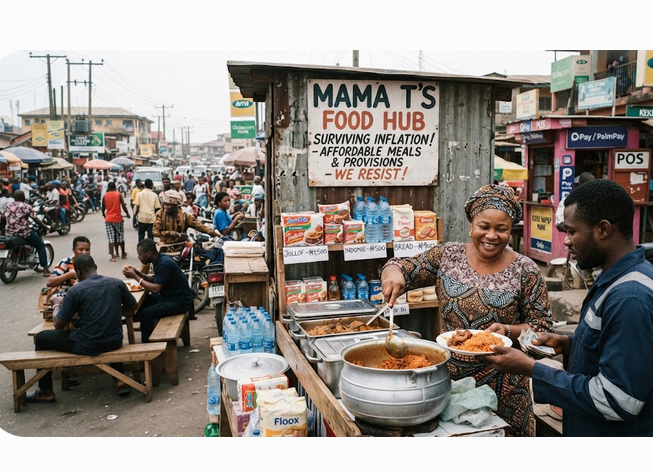
At exactly 5:45 a.m., the aroma of steaming beans and freshly fried akara drifts through a narrow street in Yaba as a handful of customers gather around Funmilayo Akinwale’s roadside food stall.
Commercial bus drivers heading to Ojuelegba, hospital workers finishing the night shift at the Lagos University Teaching Hospital, cleaners, security guards and office workers all stop by before beginning another day.
The conversations are different now.
Instead of asking for a full plate of rice, beans and chicken, many customers stretch out a ₦500 note and quietly ask, “What can this buy?”
Some request half portions. Others buy rice without meat, while a few settle for pap and akara because it is cheaper.
Funmilayo has been running the business for more than twelve years, and she says she has never seen buying habits change this much.
“People are still eating,” she says as she carefully measures rice into takeaway bowls. “They simply calculate every spoon before they spend.”
The story is similar in many parts of Lagos, where inflation has forced both business owners and consumers to adjust almost daily. The National Bureau of Statistics continues to report that food remains one of the biggest drivers of household spending, while rising transport costs, electricity tariffs, cooking gas prices and the cost of imported raw materials have placed enormous pressure on small businesses that form the backbone of Nigeria’s economy.
For Funmilayo, survival has meant abandoning old routines.
She no longer cooks the same quantity of food every morning because unsold meals have become too expensive to waste. Instead, she prepares smaller batches and cooks more only when demand increases. Chicken, once a regular part of many customers’ breakfast, has become an occasional luxury. More people now choose eggs, while others skip protein altogether.
She has also expanded her menu to include yam porridge, pap, akara and beans—meals that require fewer costly ingredients but still fill hungry stomachs.
“I learnt that increasing prices alone doesn’t work,” she says. “When I tried it, people simply stopped coming.”
Across town in Surulere, the sewing machines inside Esther Okon’s tailoring shop begin humming shortly after 9 a.m.
Five years ago, her shop was filled with customers bringing expensive lace fabrics for weddings, birthdays and church celebrations. These days, many walk in carrying old clothes instead.
One customer wants a gown resized.
Another needs a zip replaced.
Someone else asks if a faded Ankara outfit can be redesigned into a modern two-piece set.
“People don’t throw clothes away anymore,” Esther says with a smile. “They ask if I can make them look new again.”
A graduate of Yaba College of Technology, Esther once depended almost entirely on sewing new outfits. Today, clothing alterations, repairs and redesigns account for a significant share of her weekly income.
She has also changed the way she buys fabrics.
Instead of purchasing materials alone, she joins other tailors to buy directly from wholesalers at Balogun Market, reducing costs through bulk purchases. Ready-to-wear outfits displayed on mannequins inside her shop are advertised daily on WhatsApp Status, Instagram and Facebook, where repeat customers place orders without visiting the shop.
She even offers delivery through dispatch riders within parts of Lagos.
“You can’t wait for customers to find you anymore,” she says. “You have to meet them where they already are—on their phones.”
While some businesses struggle with declining sales, others have unexpectedly benefited from changing consumer behaviour.
Inside the crowded lanes of Computer Village in Ikeja, electronics technician Emeka Nwosu barely has enough space on his workbench for the pile of phones waiting to be repaired.
Only a few years ago, many customers replaced damaged phones without much hesitation.
Today, most cannot afford to.
“When a new phone costs several hundred thousand naira, people would rather repair the one they have,” Emeka explains while replacing a damaged charging port on an Android device.
His workshop now repairs everything from cracked screens and faulty charging systems to laptops, tablets and smart televisions.
Business has improved, but so have the challenges.
Nearly all replacement parts are imported, making prices highly sensitive to fluctuations in the exchange rate. Components that cost one amount a few weeks ago can become significantly more expensive before the next shipment arrives.
To avoid losses, Emeka now collects deposits before ordering specialised parts and keeps only fast-moving inventory.
“If I stock too much,” he says, “inflation can wipe out my profit before I even use the parts.”
The same survival instinct can be seen across Lagos.
At Mile 12 Market, food vendors arrive before dawn to buy vegetables directly from wholesalers instead of relying on middlemen. Bakery owners have introduced smaller loaves for customers who cannot afford larger ones. Cosmetics retailers now stock travel-size products because many shoppers prefer buying in smaller quantities. Furniture makers combine deliveries to save fuel, while salon owners encourage customers to book appointments in advance so generators are used only when necessary.
Digital technology has also become an important survival tool.
Many entrepreneurs who once depended entirely on walk-in customers now receive most of their orders through WhatsApp Business, Instagram, Facebook Marketplace and TikTok. A single post showing freshly baked bread, newly tailored outfits or repaired phones can generate enough orders to keep a business running for the day.
Business consultant Adewale Fashina believes inflation has permanently changed consumer behaviour.
“People are no longer asking only, ‘Do I need this?'” he says. “They’re asking, ‘Can I afford it today, and is there a cheaper alternative?’ Businesses that understand that mindset are the ones staying afloat.”
Behind every adjustment lies a personal sacrifice.
Funmilayo has reduced the number of casual workers she hires because wage costs have increased alongside food prices. Esther postpones buying additional sewing machines, choosing instead to repair old ones whenever they develop faults. Emeka carefully records every purchase in a notebook, knowing that one expensive mistake could tie down the capital he needs to keep the business running.
None of them expected entrepreneurship to become this difficult.
Yet none of them is ready to close shop.
As evening settles over Yaba, Funmilayo begins washing the large aluminium pots that have served hundreds of customers since dawn. She counts the day’s earnings slowly before placing the money inside a small cash box.
The profit is thinner than it used to be.
The expenses are higher.
Tomorrow’s market prices remain uncertain.
Still, she locks her stall with quiet determination.
“We’ve survived this far,” she says. “Tomorrow, we’ll open again.”
That determination is echoed in workshops, tailoring shops, food stalls and repair centres across Lagos.
Inflation has changed what people buy, how much they buy and how businesses operate. Customers now stretch every naira. Entrepreneurs negotiate harder, innovate faster and waste less than ever before.
In a city where the cost of doing business seems to rise almost as quickly as the morning sun, survival is no longer about having the biggest shop or the highest prices.
It is about adapting every single day—and finding a way to keep the doors open, no matter how difficult the economy becomes.