Police Fire Teargas at #EndSARS Memorial in Lagos
By Emmanuel Daniji
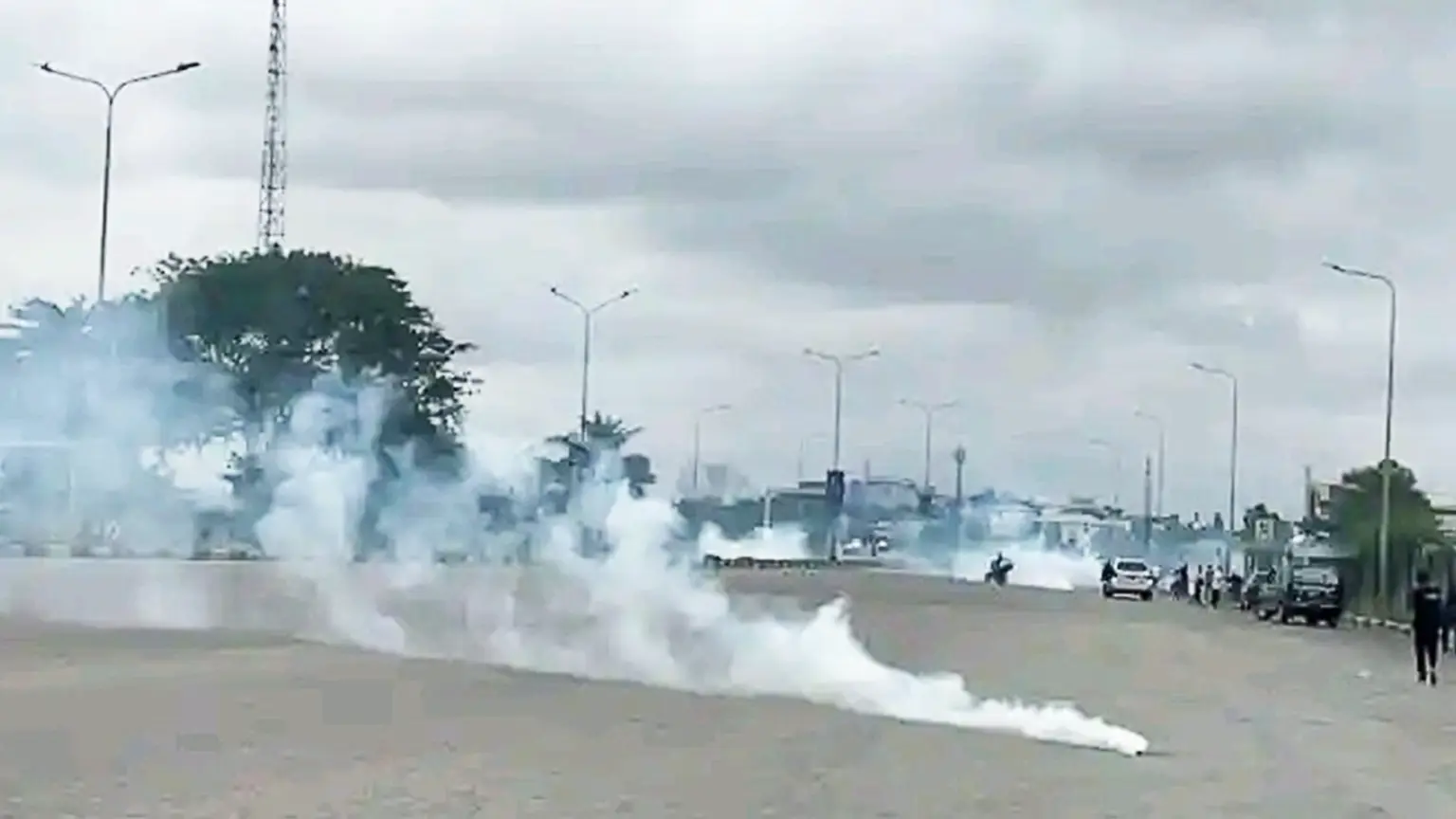
Police officers reportedly fired teargas to disperse participants at a #EndSARS memorial gathering at the Lekki Toll Gate in Lagos on Tuesday, disrupting a planned wreath-laying ceremony held to honour victims of the October 2020 protests.
The incident occurred as families of victims and survivors continued to demand justice, compensation and accountability six years after the Lekki shootings.
Among those reportedly affected by the dispersal were Gbadebo Rhodes-Vivour, the African Democratic Congress (ADC) governorship candidate in Lagos State, and Funso Doherty of the Nigeria Democratic Congress (NDC).
Videos circulating online showed participants scrambling for safety as teargas spread across the area. The circumstances surrounding the reported deployment of the substance were not immediately clear.
The organisers had scheduled the memorial ceremony for 11 a.m. on Tuesday, October 20, to honour those killed, injured or reported missing during the #EndSARS protests. However, reports indicated that police officers arrived at the venue as early as 9:15 a.m., before the organisers became visible.
The planned ceremony included the laying of 15 wreaths: nine for people listed as dead in connection with the Lekki incident, four for those listed as missing and presumed dead, one for journalist Pelumi Onifade and another for other unidentified victims.
The Rule of Law and Accountability Advocacy Centre (RULAAC) condemned the reported use of teargas, describing it as part of a troubling pattern of restrictions on commemorative gatherings.
Its Executive Director, Okechukwu Nwanguma, questioned why force would be used against citizens gathered to honour victims of the 2020 protests. He maintained that peaceful assembly was constitutionally protected.
RULAAC also argued that the disbandment of the Special Anti-Robbery Squad (SARS) had not ended allegations of police brutality, torture, extortion, unlawful detention and extrajudicial killings.
The organisation called on the authorities to enforce the Police Act 2020 and the Anti-Torture Act 2017, investigate allegations of abuse and prosecute officers found culpable. It also urged stronger civilian oversight and called on police officers to facilitate peaceful gatherings rather than disperse participants indiscriminately.
The incident came as Corporate Accountability and Public Participation Africa (CAPPA) renewed calls for justice, reparations and official acknowledgement of the violence surrounding the #EndSARS protests.
In a statement marking the anniversary, CAPPA’s Assistant Executive Director, Zikora Ibeh, urged the Federal and Lagos State governments to tender an unreserved public apology, prosecute officers found responsible for abuses and establish a comprehensive reparations programme for victims across the country.
She said an apology should go beyond words to include an acknowledgement of abuses, acceptance of responsibility and the prosecution of those found culpable through due process.
One of the unresolved cases highlighted by CAPPA is that of Pelumi Onifade, a 20-year-old journalist who was covering protest-related events at the Ministry of Agriculture’s Abattoir Complex in Oko-Oba, Agege, Lagos, on October 24, 2020.
According to accounts cited by the organisation, Onifade was attacked and arrested by personnel of the Lagos State Task Force. CAPPA further alleged that he had filmed political figure Abiodun Bolarinwa firing live rounds at unarmed protesters in Abule-Egba on October 20, four days before his arrest.
CAPPA said an official post-mortem examination established that Onifade died from a gunshot wound to his lower torso. The organisation added that the finding was documented in late 2020 but was not formally presented before the coroner’s court until 2026.
It called for the conclusion of criminal proceedings and the prosecution of any task force personnel or commanding officers found responsible for his death.
The #EndSARS movement began as a nationwide campaign against police brutality, particularly abuses associated with the now-disbanded SARS. Demonstrations intensified in October 2020 as protesters demanded an end to police abuses, accountability and respect for fundamental human rights.
The Lekki Toll Gate shootings became one of the most prominent and contested episodes of the security crackdown. The Lagos State Judicial Panel of Inquiry investigated the incident and other events surrounding the protests. CAPPA cited the panel’s report, which it said described the incident as a “massacre in context” and implicated the Nigerian Army and police in deaths and serious injuries suffered by protesters.
CAPPA accused the Federal Government of rejecting the panel’s conclusions and said the Lagos State Government’s White Paper disputed aspects of its casualty records. It argued that the responses had failed to deliver the accountability demanded by victims and their families.
The organisation also cited a July 2024 judgment of the ECOWAS Community Court of Justice, which it said found Nigeria liable for violating protesters’ rights to freedom of expression, assembly and association, as well as freedom from torture. According to CAPPA, the court ordered compensation for victims and fresh independent investigations.
It urged the Federal Government to implement the judgment fully and publish a transparent account of the steps taken to comply.
Beyond the Lekki incident, CAPPA said the protests had left lasting consequences for families, livelihoods and the emotional well-being of survivors. It called for sustained medical and psychological support, payment of outstanding compensation and prosecution of officers found culpable.
The organisation also urged the government to establish a transparent national programme of acknowledgement, justice and reparations in collaboration with victims’ families, survivors, civil society groups, media-rights organisations and the National Human Rights Commission.
It further called for the Lekki Toll Gate to be designated a national historic memorial site to preserve the memory of those affected by the crackdown.
Six years after the protests, the demands for justice and police reform remain unresolved for many victims’ families and survivors. The reported disruption of the anniversary gathering has renewed concerns about the protection of citizens’ rights to peaceful assembly and the need for accountability in the conduct of law enforcement officers.