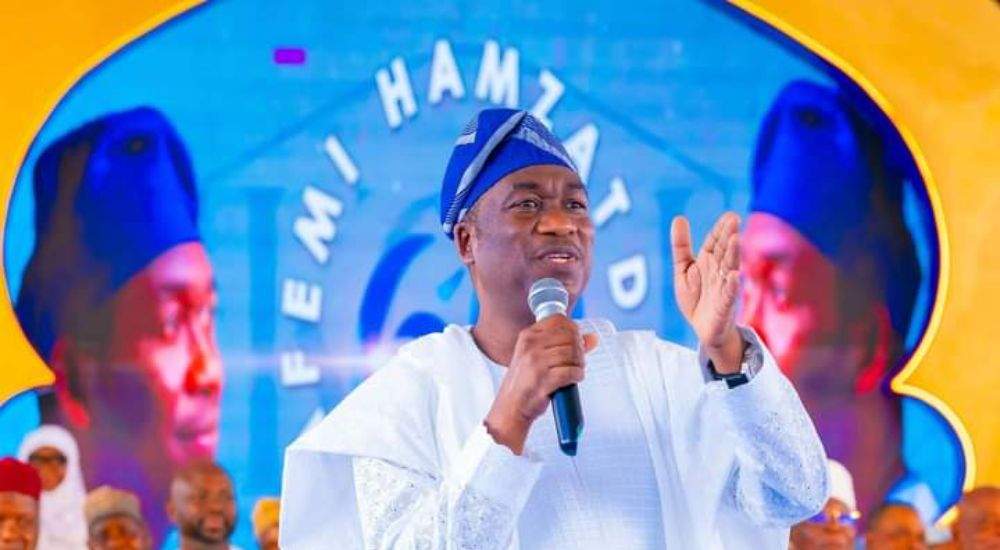
Why Lagos Won’t Borrow to Build Fourth Mainland Bridge, Hamzat Explains
Kehinde Adeleye
Lagos State will depend on private-sector investment to finance the proposed Fourth Mainland Bridge, with motorists’ willingness to pay tolls emerging as a key factor in attracting investors, Deputy Governor Obafemi Hamzat has said.
Hamzat said the state could not finance the bridge entirely from public funds while simultaneously undertaking major railway projects, describing both infrastructure initiatives as financially demanding.
Speaking during an interview on Lagos Television on Tuesday, Hamzat, who is the All Progressives Congress (APC) governorship candidate, disclosed that the government was negotiating with prospective investors from Portugal, China and other countries to secure funding for the bridge.
He said the project’s design had been completed and its cost assessed, while private-sector professionals had been engaged to support discussions with potential investors.
“The Fourth Mainland Bridge is a fantastic project that we must build, but we cannot fund it on our balance sheet and fund rail at the same time. They are both monster projects, so we’ve been talking to investors,” he said.
Why Lagos Is Opting for Public-Private Partnership
The deputy governor explained that the state had chosen a public-private partnership (PPP) model rather than relying on additional borrowing to finance the project.
According to him, the scale of the investment could place considerable pressure on the state’s finances if the government attempted to fund the bridge independently.
“We will build it with partnerships, but it’s also important that we know that it will be expensive and we cannot—we don’t want to borrow to build it because it might be a challenge for us. So that’s why we believe it must be a partnership; it must be a PPP,” Hamzat said.
Under the proposed arrangement, private investors would provide funding for the project and seek to recover their investments through revenue generated by the infrastructure.
However, Hamzat indicated that the success of the financing model would depend partly on whether motorists would accept toll payments as a condition for using the bridge.
Toll Payments at Centre of Investment Concerns
Hamzat said prospective investors had raised concerns about motorists’ reluctance to pay tolls, particularly where toll collection had previously been discontinued.
He argued that investors needed assurances that the project would generate sufficient revenue to recover their capital and deliver returns.
“When we pay tolls on our road, and we stop it, investors are not going to come. How do they get their money? Return on investments. How will they get it?” he asked.
His comments highlight a potential challenge for the proposed bridge: securing private capital may require a clear and credible tolling policy that gives investors confidence in the project’s long-term financial viability.
For investors, the ability to estimate future revenue is an important consideration when assessing whether to commit substantial funds to major infrastructure projects.
Hamzat said the state government was presenting traffic data and other relevant information to prospective investors to demonstrate the expected volume of road users and the bridge’s revenue potential.
He added that the government needed to address investors’ concerns and establish a convincing case for investing in the project.
Fourth Mainland Bridge and Lagos Infrastructure Plans
The proposed Fourth Mainland Bridge is intended to provide an additional transport corridor across Lagos and ease pressure on existing road networks.
The project has featured in the infrastructure plans of successive Lagos administrations, although financing requirements and construction costs have remained significant considerations.
Its proposed delivery through a PPP arrangement reflects the state government’s intention to involve private capital in developing major infrastructure while limiting the immediate financial burden on public funds.
Hamzat’s latest remarks indicate that the state remains committed to the project but does not intend to finance it entirely from its own resources or through additional borrowing.
Instead, the government plans to secure private investment by demonstrating the project’s commercial viability and the potential for investors to recover their capital through toll revenue.
The approach, however, raises important questions about how toll charges would be structured, whether motorists would consider them affordable and what contractual safeguards would govern the partnership.
Ultimately, the state’s ability to attract investors will depend not only on the bridge’s engineering and traffic potential but also on the credibility of its revenue model and the terms under which private capital would be deployed.