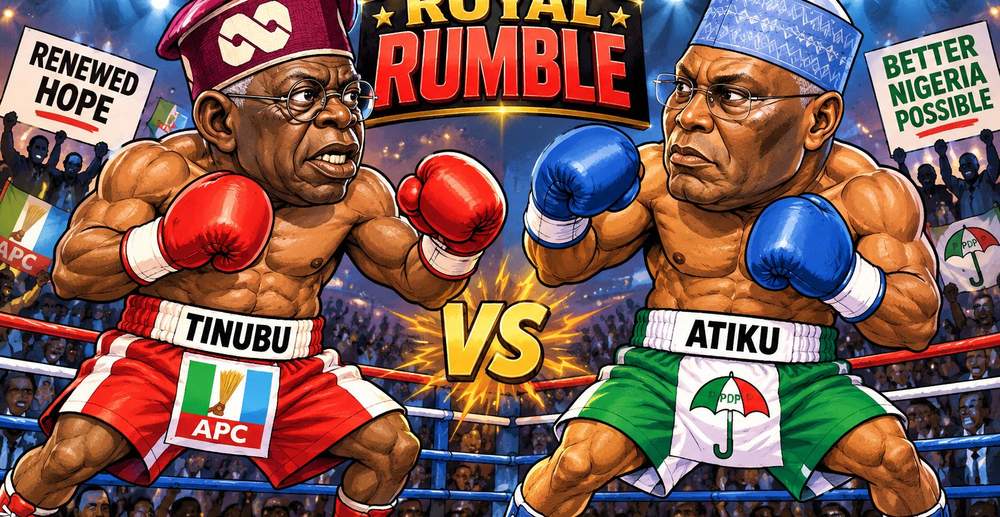
Tinubu vs Atiku: The Political Royal Rumble Begins
Tinubu vs Atiku: The Political Royal Rumble Begins
By Kunle Awosiyan
As preparations for the 2027 presidential election gather momentum, the All Progressives Congress (APC) appears to be concentrating on building its political structure, strengthening alliances and assembling a formidable campaign team.
The opposition parties, particularly the African Democratic Congress (ADC), associated with former Vice President Atiku Abubakar, and the Nigeria Democratic Congress (NDC), associated with former Anambra State Governor Peter Obi, have reasons to pay close attention to the APC’s preparations.
President Bola Ahmed Tinubu appears determined to approach the contest not merely as a popularity contest but as a battle of political organisation, strategic alliances and electoral mobilisation.
While the APC is strengthening its structure and drawing more political heavyweights into its fold, the opposition appears to be relying heavily on public dissatisfaction with the Tinubu administration to galvanise voters ahead of the January 16, 2027 presidential election.
For the ADC and NDC, the argument is straightforward: the election should be a referendum on the economic hardship and suffering Nigerians have experienced under the APC-led government.
Their message is that public discontent could translate into votes against Tinubu.
They may also see an opportunity in the president’s reported approach to campaigning, particularly if he chooses not to embark on extensive nationwide tours. Such an approach could leave room for opposition candidates to intensify their campaigns across the states.
Tinubu, however, appears to be approaching the contest from a different perspective. Rather than making extensive campaign tours the centrepiece of his strategy, he seems more interested in sophisticated political networking, strengthening party structures and recruiting influential political figures into his camp.It is all about strategy.
Elections are not won simply by the volume of noise supporters make from the stands. They are also determined by the organisation, tactics, technical preparation and winning mentality of the teams that take to the field on match day.
During the inauguration of the APC presidential campaign council last week, Tinubu put the question bluntly to members of his political family: “Are you afraid?”
As rhetorical as the question might have sounded, it captured the anxiety among some APC supporters who believe the administration’s reform policies have made the president increasingly unpopular.
But Tinubu’s question was also a call for confidence. He appeared determined to reassure his supporters that the political battle ahead was not one they should approach with fear.
His candour and fighting spirit reminded me of the late boxing legend, Muhammad Ali, who had to rally those around him before his historic encounter with George Foreman in 1974.
Before stepping into the ring for the legendary Rumble in the Jungle in Kinshasa, Zaire, now the Democratic Republic of the Congo, Ali understood that his opponent’s reputation had created considerable anxiety among boxing enthusiasts and those in his corner.
Foreman was younger, physically powerful and widely regarded as a formidable puncher. He had demolished several opponents, including Joe Frazier, and many observers expected him to overwhelm Ali.
Yet Ali refused to allow the prevailing fear to dictate his approach to the fight.
He challenged the anxiety around him and insisted that fear could become a self-fulfilling prophecy if his team allowed it to affect their preparation and confidence.
Ali’s eventual victory over Foreman by an eighth-round knockout remains one of boxing’s most memorable moments.
Through experience, tactical intelligence and the famous rope-a-dope strategy, Ali absorbed Foreman’s attacks, conserved his energy and turned the fight in his favour.
The spectators who had expected Foreman’s power to settle the contest were left stunned.
The lesson is simple: a contest is not always decided by the reputation of the participants or the expectations of the spectators. Sometimes, the decisive factor is the strategy adopted by the competitors.
Football offers similar lessons.At the 2013 Africa Cup of Nations, Nigeria defeated Côte d’Ivoire 2–1 in the quarter-finals on February 3, 2013, at the Royal Bafokeng Stadium in Rustenburg, South Africa.
Before the tournament, the Super Eagles had struggled to convince many observers, and their early performances did little to inspire confidence. Côte d’Ivoire, on the other hand, paraded a star-studded squad and entered the encounter with high expectations.Yet Nigeria prevailed.
Under the late Stephen Keshi, the Super Eagles demonstrated the importance of tactical discipline, determination and collective organisation. They went on to win the tournament, securing Nigeria’s third AFCON title.
The Ivorian side had the names, reputation and individual quality, but Nigeria found a way to overcome them.
Chelsea’s victory over Bayern Munich in the 2012 UEFA Champions League final provides another example.
On May 19, 2012, Chelsea defeated Bayern on penalties at the Allianz Arena in Munich, winning the trophy against the odds.
Bayern dominated much of the encounter and played in front of their home supporters, but Chelsea’s resilience and tactical discipline kept them in the contest. After the match ended 1–1 following extra time, Chelsea won the penalty shootout 4–3.
Roberto Di Matteo’s team demonstrated that a contest could be won even when the opponent enjoyed greater possession and territorial advantage.
These sporting encounters illustrate a principle that also applies to politics: public perception, individual popularity and the apparent strength of a team do not tell the entire story.
Democracy is an evolving process.Political parties must continually adapt to changing circumstances, new electoral rules, emerging voter expectations and the realities of campaign organisation.
Consequently, those who succeed in the 2027 general election will need more than the ability to attract large crowds or generate loud public support. They will need effective organisation, credible messaging, strong grassroots networks and the ability to convert public enthusiasm into votes.
The APC, under Tinubu’s leadership, appears to understand the importance of political alliances and the strategic value of bringing influential figures into its campaign structure.
Tinubu’s efforts to attract opposition governors and other political heavyweights, while encouraging those who remain in their parties to participate in his presidential campaign structure, have become a significant feature of the unfolding political contest.
Such moves can unsettle rival parties because they alter political calculations, reshape alliances and potentially affect the distribution of campaign resources and influence.
Political defections and cross-party alliances are not, in themselves, illegal or undemocratic. They are part of Nigeria’s competitive political environment, provided they comply with the law and democratic principles.
The opposition, therefore, must look beyond complaints about the APC’s political manoeuvres and develop its own effective response.
Rather than relying predominantly on allegations of a plot to rig the election, the ADC and NDC need to demonstrate how they intend to organise their parties, strengthen their grassroots presence, recruit credible candidates, mobilise supporters and protect the integrity of the electoral process.
By now, I would like to see the opposition parties demonstrate their own tactical formations, coordinated campaign strategies and organisational readiness.
If Atiku and Obi are to challenge Tinubu effectively, their parties must show how their respective political strengths can be translated into a compelling national campaign.
The electorate deserves more than political slogans and expressions of frustration. It deserves to see clear policy alternatives, credible leadership teams and practical plans for addressing the country’s economic and social challenges.
In 2023, I remember being concerned as I followed the election results and considered the possibility that Tinubu might lose. He had invested considerable effort in communicating his manifesto and presenting his political vision to Nigerians, but the contest remained uncertain.
Tinubu eventually emerged victorious, securing the presidency after a fiercely contested election.
As we look towards the 2027 presidential polls, there is no denying that the administration’s economic reforms have attracted significant public criticism, particularly over the cost of living and the hardship experienced by many Nigerians.
The critical question is whether the APC can persuade voters that its policies will produce sufficient benefits to justify the sacrifices being demanded of them, and whether the opposition can present a credible alternative capable of winning public confidence.
These are questions that neither political alliances nor campaign slogans can answer on their own. Ultimately, the results of 2027 will not come by how much noise a political party had made but by the science it has used to convince the voters.
I want to see how Tinubu’s political strategy unfolds, how Atiku and the opposition respond, and whether the contest will be determined by political structures, public sentiment or a combination of both.
As in football and boxing, the expectations of spectators do not always determine the final outcome. The real test comes when the contestants enter the field.
January 16, 2027, promises to be a defining moment in Nigeria’s political journey. I can hardly wait for the contest to begin.