Tinubu Vs Adeleke: A Demarcation Between Politics and Humanity
Tinubu Vs Adeleke: A Demarcation Between Politics and Humanity
By Kunle Awosiyan
A good friend of mine recently took exception to my support for Governor Ademola Adeleke of Accord Party ahead of the Osun State governorship election, especially because of my well-known admiration for President Bola Ahmed Tinubu.
He asked a simple question: How could I support Adeleke while loving Tinubu?
My answer was equally simple: love.
I have my reservations about every political party.
But I love Tinubu of the APC and Adeleke of Accord, not merely because of the political platforms they represent, but because of what I perceive as their humanity.
There should always be a clear demarcation between politics and humanity when assessing leadership. Leadership should not be defined solely by the political party a person belongs to, but by the originality of his purpose, the sincerity of his character and the way he connects with the people.
For me, Adeleke, like Tinubu, is not a pretender. Adeleke would not suddenly wear a turban like Rotimj Amaechi simply to appeal to Muslims, even though Osun has one of the largest Muslim populations in the South-West. He would not begin singing “waka” merely to impress the “Eleha.”
He remained himself. He took his own identity, including his familiar “celestial song”, into the campaign.He danced throughout the campaign. He visited his “Oluso” along the route to securing his second term. He shook the hands of traditional rulers and, where the occasion demanded it, he prostrated before them.
He did not need to manufacture moments of humility for the cameras. He did not have to stop by the roadside to buy roasted corn and distribute it among the less privileged merely to manufacture an emotional connection with voters.
He was Adeleke the dancer yesterday. He was Adeleke the dancer during the campaign. And perhaps, he will remain Adeleke the dancer for a long time to come.
For me, that is authenticity. And perhaps, that is one of the things the people of Osun saw when they went to the polls.
Of course, there were reports that the governor had earlier considered defecting to the APC and that President Tinubu was receptive to the idea. But the move reportedly encountered resistance within the Osun APC.
The outcome of Saturday’s election may therefore have exposed more than an electoral defeat. It may have exposed the deep cracks within the APC structure in Osun.
In my assessment, the structure began weakening seriously from the period when Alhaji Gboyega Oyetola became governor.
Politics is ultimately about people. When humanity is disconnected from politics, political structures may survive for a while, but they gradually lose their emotional connection with the electorate.
When Adeleke assumed office, he appeared to understand this dimension of politics. He brought a strong human face to governance and cultivated a political tradition in which accessibility, culture, humility and emotional connection became part of his public identity. Everything is not about his performance but his virtue, which he wears like garment.
I do not intend to make this piece a personal indictment of Oyetola. But political leadership comes with consequences, and political decisions have a way of returning to the ballot box.
Oyetola enjoyed the support of many influential political actors, including former Deputy Governor Iyiola Omisore, whose political influence in Ile-Ife and parts of Osun cannot be dismissed.Yet the relationship eventually deteriorated.
The APC’s decision to settle on Bola Oyebamiji as its candidate, amid the internal disagreements surrounding the party’s leadership and structure, became a major political test. The bitterness that followed did not help the party.
Politics is fundamentally about coalition-building. It requires the ability to accommodate people who may disagree with you today but could become indispensable tomorrow.
If Oyetola had been able to mend fences with Omisore early enough, perhaps the APC might have entered Saturday’s election as a more united house.
The result, particularly the figures from Ile-Ife, appears to suggest that political loyalties cannot simply be transferred by fiat. People have memories. They remember how they were treated, who respected them and who did not.
The word “Omoluabi” remains central to the Osun identity. It speaks to respect for elders, reverence for tradition, good character, dignity and humanity.
For many people in Osun, leadership is therefore more than building of roads, and other physical infrastructure. It is also about “ifomoniyan se”, the quality of being humane.
You need to see among elders in Ile-Ife, they hardly talk, they watch. They want to know whether the person occupying the office is truly an Omoluabi, a decent human being, or merely a political pretender.
Former Governor Bisi Akande, in many respects, reflected some of these traditional virtues of leadership. But some of those who came after him appeared to lose their way, particularly in the language and temperament with which they engaged the people.
Prince Olagunsoye Oyinlola could also have been an enduring example of virtuous leadership, although some of his political speeches and attacks on opponents occasionally carried a bitterness that undermined that image.
Rauf Aregbesola spoke frequently about virtues and the people, but his own carriage and conducts sometimes hardly reflected what he preached.
Oyetola, on the other hand, was often perceived as reserved and restrained, but politics requires more than personal composure. It requires the ability to show remorse, rebuild relationships and acknowledge mistakes when necessary.
This is where humanity becomes important. A politician may win an election through structure, money, influence and strategy but retaining the affection of the people requires something deeper.
It requires connection.That is why I believe Tinubu’s political journey is also worth examining through this lens. Despite the many allegations and criticisms directed at him over the years, there has always been an element of originality in Tinubu’s political personality.
He has remained remarkably consistent in his political instincts, his language and his approach to building relationships.
His intervention over the freezing of Osun State’s accounts by the Economic and Financial Crimes Commission, which he reportedly described as embarrassing, is one example of how he can separate institutional responsibility from political calculations.
His administration’s handling of the Osun election also deserves attention. Despite the tension, killings and threats that preceded the election, the process eventually produced a result that allowed the electorate to make its choice.
That is democracy. And now, perhaps, is the time for Tinubu to take the relationship with Adeleke beyond the boundaries of party politics.
The President has an opportunity to woo Adeleke not necessarily into the APC, but into a broader political relationship ahead of 2027.
Adeleke has just demonstrated that he has a formidable political base in Osun. Tinubu has demonstrated that he remains the most powerful political figure in Nigeria.
The two men need not belong to the same party to find common ground. Politics will always divide people into parties, humanity should bring them back together.
That, ultimately, is the demarcation we must draw. Adeleke’s victory is not necessarily a victory against Tinubu. Neither should Tinubu’s political strength be interpreted as a license to diminish Adeleke.
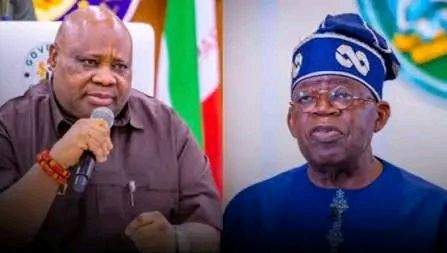
One is a President. The other is a governor. But beyond their offices, they are both human beings navigating the complicated terrain of Nigerian politics.
And perhaps the greatest lesson from Osun is that people may forget your party’s logo, but they rarely forget how you made them feel.
That is the politics of humanity.
And it may yet determine the politics of 2027.