The Men and Women Cleaning Lagos Before Sunrise
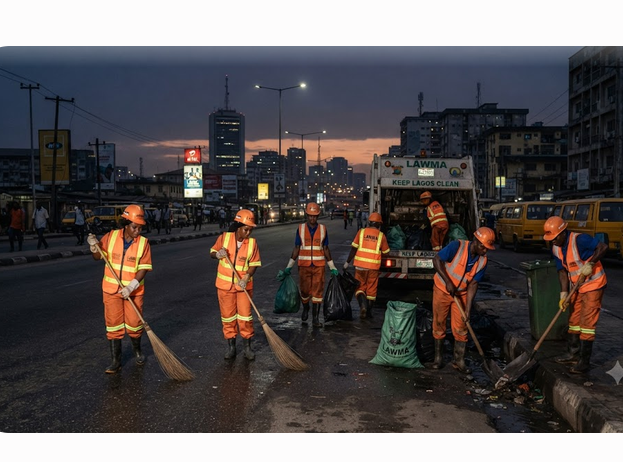
At 4:00 a.m., while most Lagos residents are still asleep, 42-year-old street sweeper Bose Adeyemi ties a reflective jacket around her waist, picks up her broom and heads to her assigned route along the busy Oshodi-Apapa Expressway.
By the time commuters begin filling the roads two hours later, much of the litter left behind from the previous day—plastic bottles, food packs, nylon bags and discarded cartons—has already disappeared.
“It’s dangerous work,” she says, pausing briefly as speeding vehicles race past. “People see clean roads every morning, but they rarely see the people who make that happen.”
Across Lagos, thousands of sanitation workers begin their shifts long before sunrise, quietly carrying out one of the city’s most essential jobs. Working for the Lagos State Waste Management Authority (LAWMA), Private Sector Participant (PSP) operators and private cleaning contractors, these men and women sweep highways, clear drainage channels, empty public bins and remove waste before the city wakes up.
Their work has become even more critical as Lagos, now home to well over 20 million people, continues to grapple with rapid urbanisation and the enormous challenge of managing thousands of tonnes of waste generated every day.
For many sanitation workers, the day starts between 3:30 a.m. and 4:30 a.m. Crews assemble at designated points across the city before dispersing to major roads, bridges, bus stops and markets.
On Lagos Island, sanitation teams work around CMS, Marina and Broad Street before the morning rush begins. In Ikeja, crews clean roads around Computer Village and Allen Avenue, while others sweep corridors leading to Mile 2, Ojota, Lekki, Yaba and Agege.
The work is physically demanding.
Armed with little more than brooms, rakes, wheelbarrows and refuse bags, workers spend hours clearing debris under streetlights and the headlights of passing vehicles. During the rainy season, the job becomes even more difficult as blocked drains filled with plastic waste contribute to flash flooding in several parts of the city.
Thirty-eight-year-old sanitation worker Ibrahim Yusuf says the greatest danger is not the workload but impatient motorists.
“Some drivers don’t slow down when they see us,” he explains. “We’ve had colleagues injured because vehicles came too close while we were sweeping.”
Road safety advocates have repeatedly called for motorists to exercise greater caution around sanitation workers, especially during the early hours when visibility is poor.
Beyond the highways, another army of workers is already active inside some of Lagos’ busiest markets.
Before traders arrive at Mile 12, Oyingbo, Mushin and Balogun markets, cleaners have already collected heaps of vegetable waste, rotten fruits, packaging materials and other refuse generated during the previous day’s business.
The task is endless.
Within hours of completing one round of cleaning, fresh waste begins to accumulate again as commercial activities intensify across the city.
LAWMA has in recent years expanded mechanised street sweeping, introduced waste sorting initiatives and strengthened enforcement against indiscriminate refuse disposal. The agency has also continued public awareness campaigns encouraging residents to bag waste properly, patronise licensed PSP operators and avoid dumping refuse in drainage channels.
Despite these efforts, sanitation workers say careless disposal of waste remains one of their biggest frustrations.
“You clean a place today, and by tomorrow morning someone has dumped refuse there again,” Bose says with a tired smile. “Sometimes people even throw trash from moving vehicles after we’ve finished sweeping.”
Environmental experts warn that poor waste disposal habits contribute to blocked drainage systems, flooding and public health risks, particularly during the rainy season when refuse is washed into canals and lagoons.
For many sanitation workers, the job is not only physically exhausting but emotionally challenging.
Few residents know their names.
Many walk past without acknowledging them. Some even look down on the profession despite its importance to public health.
Yet the workers say they take pride in knowing they help keep one of Africa’s largest cities functioning every day.
“I tell my children that there is dignity in honest work,” says Ibrahim. “Without cleaners, Lagos would be overwhelmed by waste.”
The work also comes with personal sacrifices.
Many leave home while their families are still asleep and return after sunrise, having already completed hours of strenuous labour. Weekends and public holidays often mean little, as refuse continues to accumulate regardless of the calendar.
Environmental advocates argue that sanitation workers deserve greater recognition, improved safety equipment, better welfare packages and stronger public support. They say cleaner cities depend not only on the dedication of those who sweep the streets but also on residents adopting responsible waste disposal habits.
As dawn breaks over Lagos, traffic gradually replaces the silence of the night. Buses begin loading passengers, traders open their shops and office workers hurry to meetings.
Few notice the men and women quietly leaving the roads with their brooms and wheelbarrows.
Their work is already done.
Before most Lagosians begin their day, these sanitation workers have already completed theirs—ensuring millions wake up to cleaner streets, safer roads and a city ready for another day of relentless activity.