
The Costly Trap Lagos Consumers Must Avoid
By Sherif Salau
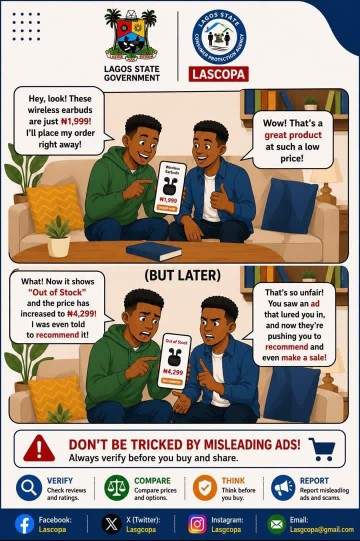
In the bustling markets and digital storefronts of Lagos, an old deception continues to claim new victims. Sellers advertise strikingly low prices on popular goods, only to inform eager customers that the item is “out of stock” and immediately recommend a costlier substitute. This practice, known as bait advertising, is not a harmless sales tactic—it is a calculated form of consumer deception that undermines trust, drains household budgets and weakens the integrity of the marketplace.
The Lagos State Consumer Protection Agency (LASCOPA) has renewed its warning against the practice. According to the agency’s General Manager and Chief Executive Officer, Afolabi Solebo Esq., bait advertising remains one of the most common yet under-reported forms of unfair trading in the state. “Consumers are deliberately lured with attractive offers that were never intended to be fulfilled,” he stated. “When the advertised product is declared unavailable, buyers are steered towards more expensive alternatives, often under pressure and without transparent disclosure.”
Falling for such advertisements carries clear and measurable disadvantages. Shoppers lose time and transport costs travelling to stores or placing online orders that cannot be fulfilled at the promised price. Many end up paying significantly more than they budgeted, sometimes for goods of inferior quality or with less favourable terms. Beyond the immediate financial hit, repeated exposure to these tactics breeds cynicism and fatigue, making consumers less likely to pursue genuine bargains or assert their rights. Over time, the practice distorts price signals in the market, rewards dishonest traders and penalises those who operate transparently.
Equally serious are the risks of remaining silent. When consumers fail to report bait advertising, the offence continues unchecked. Offending sellers face no meaningful consequence, encouraging them—and others—to repeat the tactic on a larger scale. Regulatory agencies are deprived of the evidence needed to investigate patterns of misconduct, impose sanctions or issue public alerts. The result is a cycle in which more households suffer avoidable losses, and public confidence in both physical and online commerce steadily erodes.
LASCOPA has made clear that consumers in Lagos State are not powerless. Those who encounter bait advertising are urged to document the advertisement, retain any correspondence or receipts, and report the incident promptly. Complaints may be lodged through the agency’s toll-free line, 080 0005 2726 (available on weekdays), or by email at lasgcopa@gmail.com. Prompt reporting strengthens enforcement, helps protect other shoppers and reinforces the principle that fair dealing is not optional.
In a state that positions itself as a commercial hub, the message from LASCOPA is unambiguous: consumers who know their rights, protect their interests and speak up remain the strongest defence against deceptive trade practices. In Lagos, consumers are kings—provided they refuse to be treated as prey.