How Lagos Plans to Turn Cart Pushers Into Tricycle Waste Collectors
Kehinde Adeleye
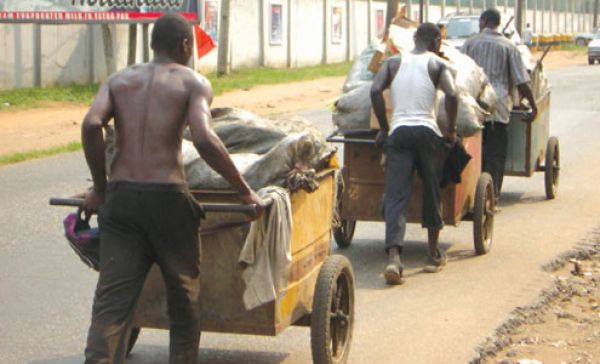
The Lagos State Government is planning to integrate eligible cart pushers into a new waste management system as part of efforts to address refuse collection challenges and create jobs across the metropolis.
The Managing Director of the Lagos Waste Management Authority, LAWMA, Dr Muyiwa Gbadegesin, disclosed this in an interview, saying cart pushers who meet the required standards would be trained, licensed and deployed to operate tricycle collection vehicles.
Gbadegesin said the move formed part of a broader waste management reform involving 150 new compactor trucks, smart bins, tricycle collection, mini Transfer Loading Stations, Material Recovery Facilities and biogas plants.
According to him, Lagos generates between 13,000 and 15,000 tonnes of waste daily, making it necessary to introduce a more efficient system capable of reaching communities where conventional compactor trucks cannot operate.
He explained that some cart pushers would be transitioned from using hand-pushed carts to regulated tricycle collection vehicles.
“They will operate the tricycle. We will put them in uniform, they will have ID cards, they will be regulated, and those are the ones who will be doing all this collection,” he said.
Gbadegesin said the initiative would provide employment opportunities while bringing informal waste collectors into a structured system.
He added that qualified former Private Sector Participation, PSP, operators and other private-sector players could also be allowed to operate some of the planned mini Transfer Loading Stations as businesses.
The LAWMA boss said the state was working with local governments to establish the mini transfer stations, where waste collected by tricycle compactors would be deposited before being evacuated by larger trucks to Transfer Loading Stations or Material Recovery Facilities.
He said the model was already being implemented in parts of Ibeju-Lekki, Lagos Island and Badagry, where residents pay N800 per bag through point-of-sale machines for waste collection.
150 new trucks
Gbadegesin said Lagos expected to receive 150 new compactor trucks by the end of 2026.
He explained that each of the 57 local governments and Local Council Development Areas would receive two trucks, while the state government would procure an additional 36.
The vehicles, he said, would form part of a unified waste management fleet to be jointly managed with local governments, with a long-term target of increasing the fleet to about 2,000 trucks.
Waste to energy
The LAWMA boss also disclosed plans for a five-year project to establish a biogas plant that would convert organic waste into energy.
He said organic waste accounts for about 50 per cent of the waste generated daily in Lagos and could be converted into biogas rather than being buried in landfills.
The project, being developed in partnership with the Lagos Metropolitan Area Transport Authority, LAMATA, is expected to support the state’s energy transition programme.
Gbadegesin said the biogas could eventually be used to power some of the 2,000 CNG buses being introduced through LAMATA.
LAWMA has also begun installing smaller biodigesters at markets that generate large volumes of organic waste, with Ikosi Fruit Market serving as a pilot location.
Similar facilities are planned for markets including Alamutu, Mile 12 and Afolabi Ege to convert organic waste into biofertiliser.
Smart bins, enforcement
Gbadegesin said the state currently has about 80,000 smart bins but was considering distributing them to more households and recovering the cost through small monthly payments.
He also blamed indiscriminate dumping and illegal waste collection for some of the persistent refuse heaps across Lagos.
He cited the Agege Motor Road corridor, where LAWMA clears waste daily but continues to encounter fresh heaps shortly after evacuation.
According to him, investigations uncovered individuals allegedly collecting money from residents for waste disposal before dumping the refuse on the highway for LAWMA to remove.
He said the authority had established a Waste Investigation, Surveillance and Enforcement Unit to identify the sources of illegal dumping and address the causes rather than repeatedly clearing the same locations.
Gbadegesin added that LAWMA was working with local governments to establish Waste Management Task Forces comprising the authority, community representatives, PSP operators and environmental health officials.
He said the task forces would meet regularly to address waste management challenges within their communities.
Over 10,000 people on Badagry corridor
Gbadegesin also disclosed that enforcement operations along the Badagry Expressway identified more than 10,000 people living and conducting commercial activities along the road corridor.
He said LAWMA had been working with the Rapid Response Squad, KAI officials, military personnel and other agencies to clear the area.
He stressed that effective waste management was necessary not only for a cleaner Lagos but also to protect public health, prevent flooding and preserve road infrastructure.