
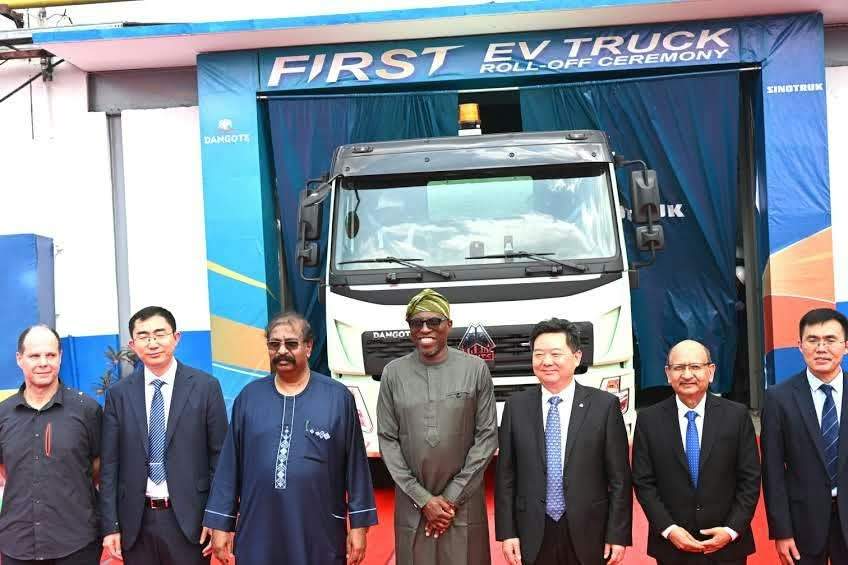
Dangote Unveils Nigeria’s First Locally Assembled Electric Truck In Lagos
By Sherif Salau

Lagos has taken a major leap in Nigeria’s green mobility drive as Dangote Sinotruk West Africa Limited unveils the country’s first locally assembled electric heavy-duty truck at its Ikeja facility, signalling a new era for cleaner transportation and indigenous automotive manufacturing.
Dangote Sinotruk West Africa Limited, the joint venture between the Dangote Group and China’s Sinotruk, presented the vehicle as the country’s first locally assembled electric heavy-duty commercial truck. The ceremony drew senior executives from both companies, Lagos State officials, customers and industry stakeholders.
The partnership dates back more than a decade. Cooperation began around 2010, the joint venture was formalised in 2014, and the first conventional heavy truck left the Lagos line in 2017. More than 8,000 vehicles of various types have since been assembled at the facility. The addition of a welding and e-coating paint line in 2024 further deepened local manufacturing capability. The electric model represents the latest stage in that progression.
Sinotruk Group President Liu Wei captured the significance of the moment. “Today, we gather in the beautiful city of Lagos to witness the official roll-off of the first electric heavy-duty truck from the joint venture,” he said. “More importantly, it represents a substantial step forward for Nigeria and West Africa in driving localised manufacturing and the green transition of new-energy commercial vehicles.”
Devakumar V.G. Edwin, Group Vice-President of Dangote Industries Limited, linked the launch to the company’s earlier work with compressed natural gas trucks. He described the move into electric technology as a response to global shifts toward cleaner commercial transport and a continuation of efforts to expand local skills, employment and industrial capacity. The company said it is preparing charging support, spare parts and technical training to underpin customer adoption.
Precise pricing, production targets and delivery timelines were not disclosed. What the partners emphasised instead was strategic direction: reducing reliance on fully imported units, strengthening domestic manufacturing depth, and offering logistics operators a lower-emission alternative as fuel costs and environmental pressures mount.
Whether the electric truck gains rapid traction will depend on charging infrastructure, real-world operating costs and fleet-owner confidence. For the moment, the achievement rests on a simpler fact: the vehicle was assembled in Nigeria rather than shipped in complete. In an industry long shaped by imports, that distinction carries weight.