Ile-Epo Market Buzzes with Excitement as Kwankwaso, Doherty Connect with Lagos Residents
By Sherif Salau

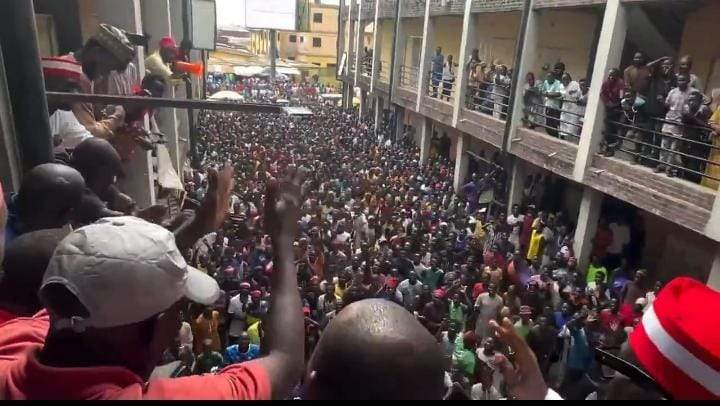
Ile-Epo Market in Alimosho, Lagos, witnessed a wave of political excitement as the Nigeria Democratic Congress (NDC) leaders Rabiu Kwankwaso and Funso Doherty connected with traders and residents, drawing an enthusiastic crowd during their visit. The red caps mixed with the colours of commerce as the two men moved through the crowded lanes of one of Lagos’s busiest food markets, turning a routine trading day into a notable political engagement ahead of the 2027 elections.
Kwankwaso, the NDC vice-presidential candidate on the Obi-Kwankwaso ticket, addressed the gathering directly. “Today, I visited Ile-Epo in Alimosho, Lagos State, to brief our people on the Obi-Kwankwaso ticket,” he said. “In my remarks, I urged them to remain steadfast and to serve as voters, mobilisers, agents, and defenders of the OK (Obi-Kwankwaso) and NDC mandate, whether in their home states or here in Lagos.”
Accompanied by Doherty, the NDC’s Lagos governorship candidate, Kwankwaso expressed appreciation for the reception. “In my company was the Lagos NDC Gubernatorial Candidate, Mr Funso Doherty, and I thank everyone sincerely for their warm support and reception,” he added.
Doherty, who has repeatedly emphasised that politics must centre on ordinary people rather than abstract power, used the market setting to reinforce that message. He has spoken often of the market woman who pays levy after levy yet struggles to see tangible returns from government, and of the need for a state administration that works for those who sustain the city’s daily economy. Standing alongside Kwankwaso, he presented the joint ticket as an opportunity to rebuild trust between citizens and those who seek to lead them.
The visit formed part of broader efforts by the NDC to mobilise support across Lagos communities. For many traders at Ile-Epo, the appearance of the national and state candidates in their workspace carried symbolic weight, signalling that political outreach had reached the places where livelihoods are made rather than remaining confined to formal halls.
The encounter left a clear impression: for a few hours, national ambition and local realities met among the stalls, with both Kwankwaso and Doherty pressing the case that the path to change runs through the active participation of ordinary Lagosians. By the time the visitors departed, the market had begun to resume its familiar rhythm of bargaining and movement.