
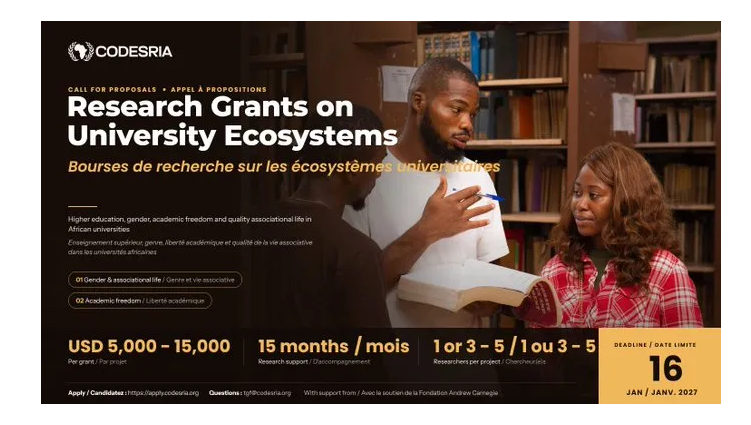
Call for Applications: CODESRIA Research Grants 2027 Offers Up to $15,000
African researchers, academics and social science scholars can apply for the 2027 CODESRIA Research Grants on University Ecosystems.

This is an initiative offering between US$5,000 and US$15,000 to support original research addressing challenges and emerging developments in African higher education institutions.
The programme, organised by the Council for the Development of Social Science Research in Africa (CODESRIA), seeks to strengthen research capacity, promote gender equality, advance academic freedom and improve the quality of university life across the continent.
With funding support from the Andrew Carnegie Foundation, the initiative will provide selected researchers with financial assistance and a 15-month research support programme. Participants will also benefit from knowledge-exchange workshops, peer-learning opportunities and platforms for engaging in policy discussions.
Applications are open to individual researchers and collaborative research teams affiliated with recognised African universities and research institutions. The deadline for submission is January 16, 2027.
About the CODESRIA Research Grants 2027
CODESRIA is a pan-African organisation established in 1973 to promote social science and humanities research across Africa.
Through its Research Grants on University Ecosystems, the organisation aims to support studies that examine the changing realities of African universities, particularly issues relating to institutional governance, gender relations, academic freedom and inclusive intellectual communities.
The initiative recognises universities as important institutions for knowledge production, social transformation and democratic development. It therefore seeks research that can contribute to academic scholarship, institutional reforms and evidence-based policymaking.
The programme is organised around two major research themes: gender and associational life in African universities, and academic and intellectual freedom.
What Does the Grant Offer?
Successful applicants will receive research funding ranging from US$5,000 to US$15,000, depending on their proposed projects and approved budgets.
In addition to the financial support, selected researchers will benefit from:
- Research funding: Financial support to undertake original research and cover approved project expenses.
- 15-month research support: A structured period to conduct investigations, analyse findings and develop research outputs.
- Knowledge exchange: Participation in workshops and peer-learning forums with other researchers.
- Academic publication opportunities: Support for producing scholarly manuscripts suitable for reputable academic publications.
- Policy engagement: Opportunities to contribute research findings to public discussions and policy development across Africa.
Researchers will also be expected to submit periodic progress reports and a final consolidated research output.
Research Areas of Interest
CODESRIA is inviting proposals addressing two interconnected thematic areas.
1. Gender and Associational Life in African Universities
This theme focuses on gender relations, institutional cultures, social inclusion and participation within African universities.
Researchers are encouraged to investigate issues such as:
- Gender inequalities affecting students, academic staff and university administrators.
- Barriers to women’s participation, leadership and career progression in higher education.
- Gender-based violence, campus safety and student wellbeing.
- Institutional governance and its impact on gender equality.
- The experiences of minority groups within university communities.
- The role of student and faculty associations in promoting inclusive academic environments.
2. Academic and Intellectual Freedom
This theme examines the conditions that support or restrict independent research, intellectual expression and academic participation in African universities.
Relevant research areas include:
- Academic freedom and institutional autonomy.
- University governance, accountability and political interference.
- Research funding and its implications for academic independence.
- Digital transformation, artificial intelligence and emerging teaching innovations.
- Research ecosystems, knowledge production and epistemic justice.
- The relationship between gender equality, academic freedom and social justice.
- The influence of globalisation and neoliberalism on university governance.
Proposals that examine the connections between gender, academic freedom and associational life are particularly encouraged.
Who Can Apply?
The opportunity is open to researchers affiliated with recognised African higher education institutions and research organisations.
Applicants are expected to meet the following requirements:
- Be affiliated with a recognised African university or research institution.
- African scholars living in the diaspora may apply in collaboration with colleagues affiliated with an African-based institution.
- Individual and collaborative research proposals are eligible.
- Collaborative research teams must consist of three to five members.
- Interdisciplinary, inter-institutional and multi-country research teams are strongly encouraged.
CODESRIA particularly encourages applications from women scholars, early-career academics and researchers working in less-resourced universities across Africa.
However, applicants with outstanding or pending deliverables from ongoing or previous CODESRIA-funded projects are not encouraged to apply.
Application Requirements
Interested researchers must prepare the following documents:
1. Curriculum Vitae (CV)
Applicants must submit an updated CV highlighting their academic qualifications, research experience and relevant publications. For collaborative applications, CVs of all team members must be included.
2. Research Proposal Synopsis
Applicants must submit a research proposal of no more than 4,000 words outlining:
- The research question or problem statement.
- Relevant literature and existing academic discussions.
- The conceptual or theoretical framework guiding the research.
- Proposed research methodology and work plan.
- Project timelines.
- A draft research budget.
- Expected scholarly and non-scholarly outputs.
3. Proposed Research Budget
Applicants must provide a draft budget ranging from US$5,000 to US$15,000, detailing the estimated financial requirements of their proposed research.
4. Institutional Affiliation Letter
A formal letter of affiliation or endorsement from a recognised higher education or research institution is required.
Programme Duration and Expected Outcomes
Selected researchers will receive support for 15 months to undertake their proposed studies.
During this period, participants will be expected to conduct original research, participate in knowledge-exchange workshops and peer-learning activities, and contribute to public dialogue and policy engagement.
Each selected researcher or research team must produce at least one publishable manuscript, such as an academic journal article and a policy brief or equivalent research output.
The programme ultimately seeks to generate knowledge that can strengthen African universities, improve institutional governance, advance gender equality and protect academic freedom.
Application Deadline
The deadline for submitting applications for the CODESRIA Research Grants on University Ecosystems 2027 is January 16, 2027.
Late applications will not be considered. Interested researchers are therefore encouraged to prepare their proposals and supporting documents ahead of the deadline.
How to Apply
Eligible applicants should visit the official CODESRIA grants and subventions application portal to access the application system.
Applicants must complete the online application process and upload their CVs, research proposal synopses, proposed budgets and institutional affiliation letters.
Application Portal: https://apply.codesria.org/grants-subventions/
For further enquiries about the programme, interested applicants can contact CODESRIA via tgf@codesria.org.
Researchers are encouraged to review the official call for proposals carefully to understand the research priorities, eligibility requirements and submission guidelines before applying.