Lagos Relives Moremi as Crown Troupe Takes Yoruba Heroine to Afrika Shrine
Lagos Relives Moremi as Crown Troupe Takes Yoruba Heroine to Afrika Shrine
Kunle Awosiyan
At the New Afrika Shrine, Crown Troupe of Africa revisited one of Yoruba mythology’s most enduring heroines but this time, Moremi was not merely a queen from the past. She became a mirror of contemporary Nigeria.
There are stories that refuse to die.
They survive wars, political upheavals, changing generations and the relentless march of technology. They are retold because, beneath the costumes and mythology, they continue to speak to the anxieties of the people who tell them.
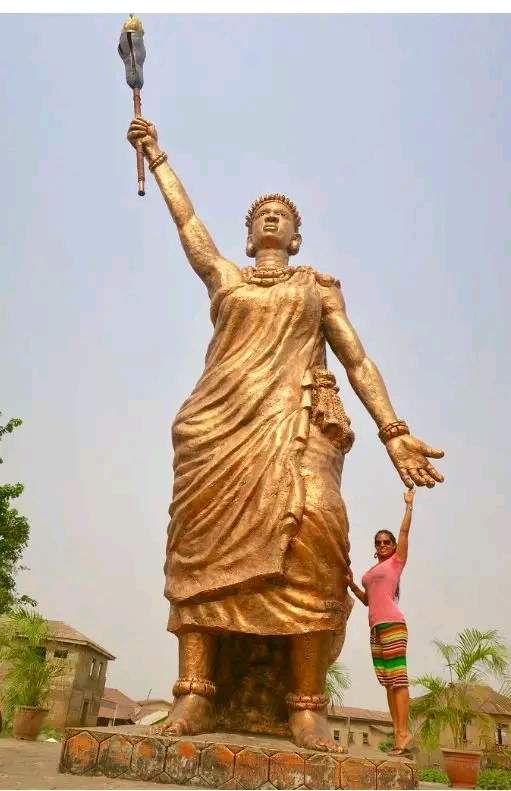
The story of Moremi Ajasoro is one of such stories. On Saturday, October 3, 2026, Crown Troupe of Africa took the legendary Yoruba heroine to an unlikely but symbolically powerful stage, the New Afrika Shrine in Agidingbi, Ikeja in a production titled Moremi: Revised Standard Version (RSV).
Written by Ayodele Arigbabu and directed by Segun Adefila, the production was billed not as a conventional retelling of an ancient legend, but as a bold theatrical interrogation of history, patriarchy, feminism, leadership and the changing meaning of courage.
The choice of the Shrine was significant. The New Afrika Shrine is already associated with music, political consciousness, social commentary and the rebellious spirit of Fela Anikulapo-Kuti.
Bringing a Yoruba epic about a woman who confronted danger, infiltrated an enemy camp and helped save her people into that environment created a meeting point between ancestral memory and contemporary resistance.
And that appears to have been precisely the point. That Moremi was not just a queen but a freedom fighter.
For generations, Moremi has been remembered as the woman who volunteered herself to be captured by invading forces threatening Ile-Ife.
Her mission was not simply an act of bravery. It was an intelligence operation.
She entered the enemy’s world, learned their secret and returned with the knowledge that enabled her people to defeat them.
The traditional account has therefore always contained several stories at once: the story of a woman, a mother, a strategist, a patriot and a society under threat.
But Moremi RSV asks what happens when that old story is stripped of its museum-like presentation and placed directly before a 21st-century Nigerian audience.
Adefila’s answer is provocative. In his play, Ile-Ife becomes Nigeria.
In his director’s note, Adefila says the invasion in the Moremi story reminded him of today’s faceless enemies attacking farms and villages and creating insecurity across communities.
“Arigbabu’s Ife is Nigeria,” he wrote that
single interpretation changes the entire meaning of the production.
Moremi is no longer simply fighting an ancient enemy. She becomes a metaphor for the ordinary Nigerian confronting insecurity, bad leadership and a society struggling to protect itself.
Perhaps the most provocative question at the heart of the production is the old description of women as the “weaker sex”.
Moremi RSV turns that phrase upside down.
At a moment when the men who should defend the kingdom are unable to provide the answer, a woman steps forward.
Moremi does not win by physical strength. She wins through intelligence. She understands that the enemy cannot be defeated until its secret is discovered. She therefore risks her body, her dignity and ultimately the emotional burden of motherhood in order to obtain the information her people need.
The production consequently places female agency at the centre of the legend. But it does not appear to present feminism simply as a modern Western import. Rather, it asks whether African societies have always contained powerful women whose contributions were subsequently overshadowed by male-centred interpretations of history.
That question gives the production its contemporary edge. One of the most striking ideas in Adefila’s interpretation is the treatment of the Ifa priest.
In the traditional world, the priest would consult the oracle through established instruments and ritual. In Moremi RSV, the Babalawo opens a laptop. It is both comic and serious. Technology, in this interpretation, has become the new divination.
Data becomes the new Ifa. The joke therefore carries a deeper message: every generation develops its own tools for understanding uncertainty.
The ancient Yoruba sought answers through divination. Contemporary society searches through computers, databases, phones, algorithms and artificial intelligence. The tools have changed. The human desire to know what lies ahead has not.
The production also takes aim at leadership. Adefila describes his king as a contemporary figure dressed without the traditional paraphernalia of royalty, a deliberate departure from the majestic image audiences might expect.
Behind the modern costume is a helpless leader. Again, the symbolism is difficult to miss. Nigeria’s problem, the production seems to ask, is not always the absence of leaders. Sometimes it is the presence of leadership that lacks the courage or capacity to confront the crisis before the nation.
That makes Moremi’s intervention even more significant. She does not wait for the system to rescue the people.
She acts.
Yet Moremi RSV is not constructed as a solemn historical sermon.Its creators describe it as a near-musical thriller and comedy, drawing inspiration from the operatic tradition associated with the late Duro Ladipo.
Earlier reviews of the production have highlighted its combination of music, dance, satire and drama, including its deliberately irreverent treatment of familiar characters and situations.
That combination is important because Yoruba theatre has historically possessed the ability to make audiences laugh while confronting uncomfortable truths.
The laughter becomes part of the argument. The audience may laugh at the modern Babalawo with his laptop.
They may laugh at the ineffectual king.
They may laugh at the absurdity of ancient characters behaving in recognisably contemporary ways.
But beneath the laughter is a serious question: Have we really changed?
There is another dimension to Moremi RSV that makes the production more complicated than a straightforward feminist celebration.
The traditional Moremi story carries a painful conclusion: after receiving divine assistance in defeating the invaders, Moremi is required to fulfil her promise of sacrifice, leading to the death of her only son, Olurogbo.
The stage adaptation takes a particularly bold liberty with this aspect of the legend by examining the crisis of sacrifice from the child’s perspective.
This changes the moral question. Can the survival of a community justify the sacrifice of an individual?
Can a mother be celebrated as a heroine while society ignores the human cost of her heroism?
And who gets to decide what price a nation should pay for its survival?
These are not questions restricted to ancient Ile-Ife.
They belong to every society that asks individuals to sacrifice for the greater good.
There was also something deeply Lagos about staging Moremi RSV at the Shrine.
Lagos is a city where the ancient and modern exist side by side.
Traditional beliefs coexist with artificial intelligence. Ancient names adorn modern streets. Market women operate sophisticated businesses with smartphones. Religious leaders use social media. Young people negotiate global culture while retaining Yoruba language, music and identity.
The Shrine itself embodies this collision.
So when Crown Troupe brought Moremi into that space, it was not simply moving a historical character from Ile-Ife to Lagos. It was asking Lagos to look at itself through an ancient Yoruba mirror.