The First Public Water Tap in Lagos: How One Standpipe Changed Life in Isale Eko
More than a century ago, Lagosians queued at a single public tap for something many people today take for granted — treated water.
In July 1915, a small but significant event took place in the heart of Isale Eko that would become an important chapter in Lagos’ public health and urban history.
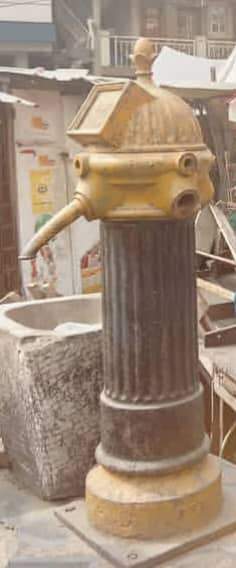
Lord Frederick Lugard, then Governor-General of Nigeria, commissioned what is widely regarded as Lagos’ first public water tap at the busy junction of Church Street and Oju Olobun Market.
The location is today commonly identified with the Enu-Owa/Dosumu Street junction.
The modest standpipe represented a major change in the way ordinary Lagos residents could access water.
For the first time, treated, pipe-borne water was made available to the wider public through a public tap, following the completion of the Iju Waterworks project five years earlier.
But the story of that tap goes beyond a single ceremony.
It was part of a much larger struggle to provide Lagos with a reliable water supply as the city expanded under colonial rule.
Before the Public Tap
In the early 1900s, Lagos was growing rapidly.
The expanding population brought with it serious concerns about sanitation, overcrowding, water supply and the spread of diseases.
Most residents depended on private wells, rainwater or water vendors who moved around the city selling water in buckets and barrels.
For a growing city, the system was becoming increasingly inadequate.
The colonial administration therefore began searching for a dependable source of water that could serve Lagos on a larger scale.
In 1900, colonial engineer Thomas Lydall was assigned to survey possible sources.
After extensive investigations, Iju, a village on the outskirts of Lagos, emerged as the preferred location.
Its proximity to the Ogun River and its elevation made it particularly suitable for supplying water to Lagos, including through gravity-assisted flow.
The Iju Waterworks
Construction of the Iju Waterworks began in 1910.
The project became one of the earliest large-scale water treatment and distribution schemes in Nigeria.
Water was drawn from the Ogun River, treated at Iju and transported through newly constructed cast-iron pipes towards Lagos.
The first beneficiaries of the piped supply included Ikoyi and Obalende, areas where many colonial officials and members of the emerging African elite lived.
The project represented a major technological shift for Lagos.
But not everyone welcomed it.
Oba Eleko’s Opposition
The introduction of the water scheme also became a political issue.
In 1908, the colonial government proposed a £130,000 water project and indicated that residents would be required to pay water rates.
Oba Eshugbayi Eleko Dosunmu, the traditional ruler of Lagos, opposed the proposal.
He argued that Lagosians had relied on wells for generations and questioned why they should bear the cost of a system he believed was primarily designed to serve Europeans.
His position resonated with many Lagosians and contributed to protests and political tension between the traditional authorities and the colonial administration.
Despite the opposition, construction continued.
By 1915, however, access to the new water system was extended beyond private connections.
A public standpipe was installed in Isale Eko and commissioned for general use.
A Tap That Became History
The public tap may have appeared insignificant compared with the large infrastructure that supplied it.
But for ordinary Lagosians, it represented something important: access.
Residents who previously depended on wells, rainwater or water sellers could now obtain treated water from a public source.
The standpipe at Church Street and Oju Olobun Market therefore became more than just a piece of infrastructure.
It was an early symbol of Lagos’ transition from a traditional settlement into a rapidly developing colonial city.
More than 100 years later, the city has grown far beyond the Lagos of 1915.
The population has multiplied, neighbourhoods have expanded and the demand for water has increased enormously.
Yet the story of that first public tap remains a reminder of a time when something as basic as turning on a tap represented a remarkable technological and social change.
Today, the Enu-Owa/Dosumu Street area is a busy part of Lagos Island.
Few people passing through may realise that the area was once the site of a small public water standpipe that helped introduce a new era of public water access to Lagos.
One tap. One junction. One major step in the making of modern Lagos.