The People Behind Local Bread Production
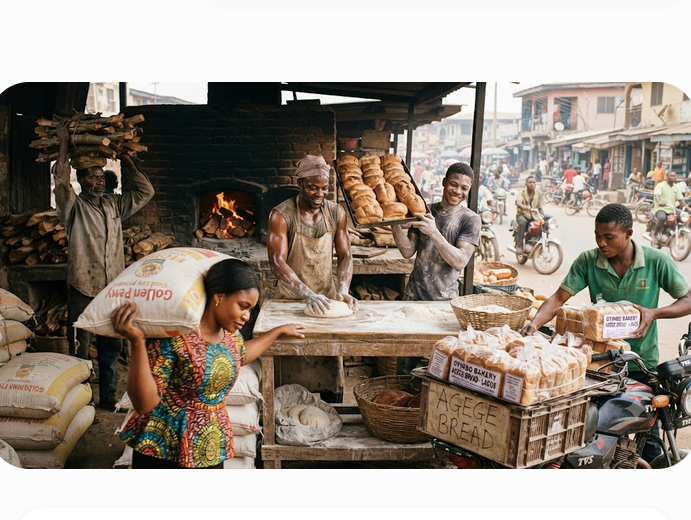
At 2:15 a.m., while most of Lagos is asleep, the lights inside a small bakery in Agege are already blazing.
The first batch of dough has been kneaded. Giant mixers rumble in one corner of the building while workers in flour-covered aprons weigh ingredients with remarkable speed. Bags of flour are stacked against the walls, and the warm smell of yeast fills the air.
Outside, the streets are almost empty except for a few tricycles, buses and motorcycles carrying workers heading to their night shifts. But inside the bakery, the race against sunrise has begun.
By 6 a.m., hundreds of loaves of the soft, slightly sweet bread that has become synonymous with Lagos—Agege bread—must be cooling on metal racks before they are loaded into delivery vans bound for bus stops, kiosks, supermarkets and roadside tables across the city.
For millions of Lagos residents, Agege bread is breakfast.
Few ever think about the long chain of people whose livelihoods begin hours before dawn to make that loaf possible.
The process starts with flour.
Around midnight, a truck reverses into the bakery compound carrying dozens of 50-kilogram bags supplied by one of Nigeria’s major flour distributors. Flour remains the largest cost for most bakers, and every increase in wheat prices or exchange rates is immediately felt inside bakeries.
The storekeeper, Sunday Adewale, carefully counts every bag before signing the delivery note.
“If flour comes late,” he says, “everything else becomes late.”
Alongside flour are deliveries of sugar, yeast, salt, margarine and improvers—the ingredients that give Agege bread its familiar softness and rich texture.
Inside the mixing room, head baker Ibrahim Lawal checks the dough by touch rather than by timer.
He has spent more than 18 years baking bread.
“You don’t just follow measurements,” he says while stretching a handful of dough between his fingers. “You learn to read the dough. The weather changes it. The flour changes it.”
During the rainy season, fermentation takes longer.
On hot days, the dough rises much faster.
Experience, he says, matters as much as any recipe.
Once mixed, the dough is divided into identical portions before workers place each piece into long baking pans.
Another team brushes the surface lightly before the trays disappear into large industrial ovens.
Although many commercial bakeries now use diesel or gas-powered ovens, smaller neighbourhood bakeries still rely partly on firewood-fired ovens because of the high cost of diesel and unreliable electricity.
Before dawn, a pickup loaded with neatly cut hardwood arrives at the bakery.
Thirty-nine-year-old firewood supplier Isiaka Balogun has supplied bakeries around Agege and Dopemu for over a decade.
“People think bread only needs flour,” he laughs while unloading logs.
“They forget someone must also provide the fire.”
The rising cost of diesel has increased demand for firewood among smaller bakeries, although environmental experts continue to encourage cleaner and more efficient energy alternatives.
Inside the oven room, temperatures soar.
Workers use long wooden paddles to move trays through the heat.
Within minutes, the pale dough transforms into golden-brown loaves whose aroma spreads into the surrounding streets.
By 5:30 a.m., the bakery becomes a hive of activity.
Women known locally as bread distributors or resellers begin arriving with large plastic baskets and delivery vans.
Some have bought bread from the same bakery every morning for years.
One of them is 46-year-old Mrs. Esther Akinyemi, who supplies kiosks around Abule Egba and Meiran.
“I’ve been selling this bread for almost 20 years,” she says while arranging fresh loaves in blue baskets lined with cloth.
“My customers know the days I don’t come.”
She sells to roadside tea vendors, food stalls, schools and neighbourhood shops.
Most of her bread is gone before noon.
Outside the bakery gate, delivery drivers work quickly.
Every route has been carefully planned to beat Lagos traffic.
One van heads towards Oshodi.
Another leaves for Yaba.
Others travel to Ikotun, Surulere, Ikorodu and Ajah.
The earlier the bread reaches retailers, the fresher it remains.
Delivery driver Victor Omole says timing is everything.
“If we leave thirty minutes late, traffic can delay us by two hours.”
By sunrise, Agege bread has reached almost every corner of Lagos.
At Ojuelegba, a roadside vendor slices thick loaves into portions for customers buying akara.
In Yaba, office workers pick up bread before boarding BRT buses.
At Mile 12, traders buy loaves for breakfast before opening their stalls.
In schools across the city, children carry sandwiches made from the same bread baked only a few hours earlier.
The popularity of Agege bread extends beyond the Agege community where it earned its name decades ago.
Today, bakeries across Lagos and neighbouring Ogun State produce similar soft, fluffy loaves using techniques perfected over generations.
Some have introduced whole-wheat versions, smaller family-sized loaves and branded packaging, but the traditional long loaf wrapped in transparent nylon remains the city’s favourite.
The industry has, however, become increasingly difficult.
Bakers across Nigeria continue to battle rising production costs driven by increases in wheat prices, fluctuating exchange rates, energy costs and transportation expenses. The price of flour has risen sharply over recent years, while sugar, margarine and yeast have also become significantly more expensive.
Many bakery owners say they now operate on thinner profit margins.
Some have reduced loaf sizes to keep prices affordable.
Others have introduced premium bread alongside regular loaves to cater to different customers.
Yet demand remains remarkably resilient.
Bread remains one of Nigeria’s most affordable and convenient staple foods, especially in cities where many workers leave home before sunrise.
By midday, the bakery has finally fallen quiet.
The mixers have stopped.
The ovens are cooling.
Workers wash trays and prepare ingredients for the next production cycle.
For most Lagos residents, today’s bread has already been eaten.
For the people behind it, tomorrow’s bread is already beginning.
As dusk settles over Agege, another truck carrying flour pulls into the compound.
The cycle starts again.
The flour supplier checks his delivery.
The firewood seller plans another trip.
The bakers tie their aprons.
The delivery drivers prepare their routes.
Long before the city wakes, they will return to work—not for applause or recognition, but to ensure that by sunrise, millions of Lagosians can stop at a roadside kiosk, buy a warm loaf of Agege bread and continue with their day, rarely knowing the hundreds of hands that helped place it there.