
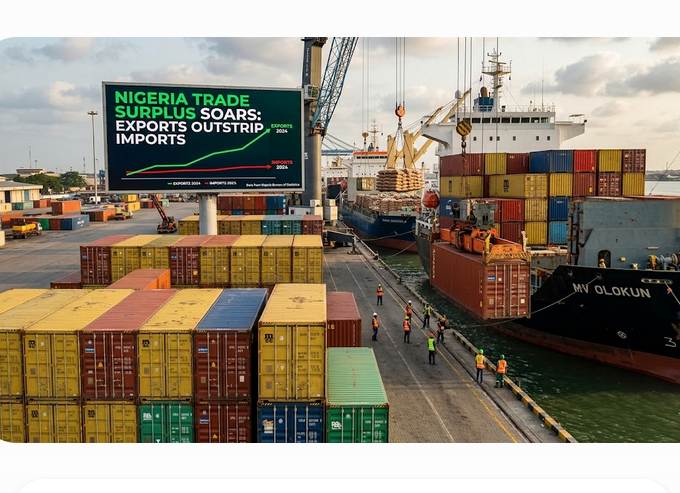
Nigeria’s Trade Surplus Soars as Exports Outstrip Imports
Nigeria’s external trade performance is showing renewed strength, with the country’s trade surplus projected to edge closer to ₦9 trillion as export earnings continue to exceed import spending.
Recent data from the National Bureau of Statistics (NBS) revealed that Nigeria recorded a merchandise trade surplus of ₦7.55 trillion in the first quarter of 2026, representing a significant increase from the ₦1.71 trillion surplus posted in the previous quarter. The improvement was driven by stronger export receipts and a notable decline in imports, particularly petroleum products.
Total trade during the period stood at ₦34.79 trillion, with exports accounting for ₦21.17 trillion, while imports were valued at ₦13.62 trillion. Exports represented more than 60 per cent of total trade activity, highlighting Nigeria’s improving trade position.
Crude oil remained the country’s leading export commodity, contributing over half of total export earnings. However, analysts also point to the growing impact of non-oil exports and the reduction in fuel imports following increased domestic refining capacity as key factors supporting the positive trade balance.
The sharp decline in petroleum product imports has been particularly significant. With more refined products being supplied locally, Nigeria has reduced its dependence on imported fuel, helping conserve foreign exchange and strengthen the country’s trade account.
Economic experts believe that if current trends persist through the remainder of the year, Nigeria’s trade surplus could move closer to the ₦9 trillion mark, bolstered by sustained export growth, improved oil production, and expanding non-oil trade activities.
The positive trade balance is expected to provide additional support for foreign exchange stability, government revenue generation, and broader economic growth as policymakers continue efforts to diversify exports and reduce import dependence.