
The Hidden Faces Behind Nigeria’s Food Supply
Before a basket of tomatoes reaches a kitchen in Lagos, it has already travelled hundreds of kilometres and passed through dozens of hands. The same is true for a bag of rice, a bunch of vegetables or a tuber of yam.
While shoppers bargain over prices in markets, few stop to think about the long chain of people whose daily labour keeps Nigeria fed.
At first light in Kadawa, one of Kano State’s largest irrigation farming communities, tomato farmers are already in their fields. During the dry season, irrigation allows them to produce tomatoes that eventually find their way to markets across the country. Harvesting begins before the sun becomes unbearable. Workers carefully sort the ripe tomatoes into large woven baskets, hoping they survive the journey south.
The farmers know their biggest challenge is not growing tomatoes—it is getting them to consumers before they spoil.
Nigeria loses a significant portion of its fresh produce every year because of poor storage facilities, inadequate cold-chain logistics and rough roads. For highly perishable crops like tomatoes, peppers and vegetables, every extra hour spent in transit increases the risk of waste. Farmers often say that a good harvest does not always translate into good income.
From Kano, the baskets are loaded onto long-haul trucks bound for Lagos, often travelling overnight through Kaduna, Niger and Ogun states. Drivers spend hours navigating bad sections of highways, fuel stations and security checkpoints. Rising diesel prices have made transportation one of the biggest contributors to food costs across Nigeria.
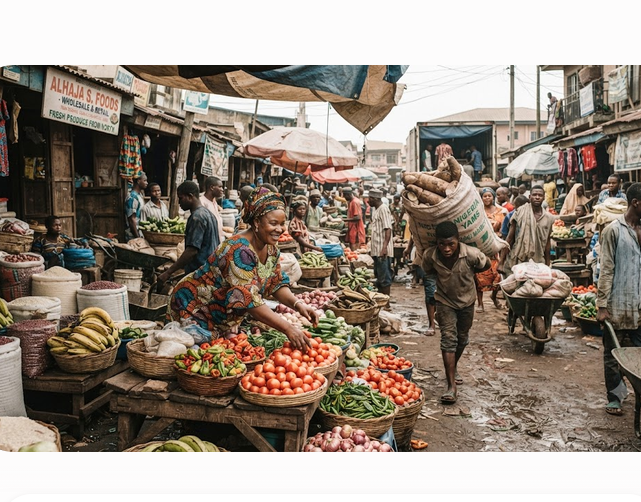
When the trucks finally arrive in Lagos, many head straight to Mile 12 International Market, one of the country’s busiest food distribution hubs. Before dawn, the market is already alive. Porters, popularly known as alabaru, carry baskets of tomatoes, onions and peppers on their heads through narrow walkways crowded with traders and buyers.
Many of these porters are young men who migrated from northern Nigeria in search of work. Paid per load, they make hundreds of trips each day, lifting baskets that can weigh more than 50 kilograms. By midday, their shirts are soaked with sweat, but the work continues because fresh trucks keep arriving.
Wholesale traders inspect every basket before negotiating prices. A damaged load can wipe out much of the profit. The quality of produce often depends on how carefully it was packed and how rough the journey from the farm turned out to be.
From Mile 12, smaller traders purchase quantities they can afford before transporting them to neighbourhood markets such as Oyingbo, Mushin, Ajah, Ketu, Agege and Ikotun. Some hire minibuses, while others rely on tricycles or small delivery vans. Transportation costs are added to the selling price, meaning every increase in fuel or logistics expenses eventually reaches the consumer.
By afternoon, roadside food vendors, restaurant owners and families begin buying what they need for the day’s meals. A bowl of stew prepared in Surulere or Lekki may contain tomatoes harvested in Kano just two or three days earlier. Yet the people who planted, harvested, transported and carried those tomatoes remain invisible to the families gathered around the dining table.
The story is much the same for rice.
In Kebbi, one of Nigeria’s leading rice-producing states, farmers cultivate thousands of hectares every season. After harvesting, the paddy is transported to rice mills where it is processed, bagged and distributed to wholesalers across the country. The Federal Government’s drive to encourage local rice production has increased investment in milling, but producers continue to grapple with rising production costs, climate-related challenges and transportation expenses.
Vegetables tell another story of resilience.
In Plateau State, farmers around Jos supply cabbage, carrots, lettuce, Irish potatoes and other vegetables that feed homes, hotels and restaurants nationwide. Refrigerated transport remains limited, so traders depend largely on speed to preserve freshness during the journey to southern markets.
Every stage of Nigeria’s food chain comes with its own risks. Farmers battle unpredictable rainfall, flooding in some regions and prolonged dry spells in others. Insecurity has forced some communities to abandon farmland, reducing output and increasing pressure on available supplies. Truck drivers contend with poor roads and rising operating costs. Traders absorb losses when produce spoils before it is sold. Retailers face customers whose purchasing power has weakened as food inflation continues to strain household budgets.
Despite these challenges, millions of Nigerians continue working every day to ensure food reaches markets across the country.
The woman arranging tomatoes in neat piles at Mile 12 before sunrise, the porter carrying baskets through crowded market lanes, the truck driver covering more than 1,000 kilometres in a single trip, the rice mill worker in Kebbi, the vegetable farmer in Plateau and the retailer opening a small roadside stall all form part of a supply chain that rarely receives public attention.
Most consumers only see the final price. They seldom see the people behind it.
Every loaf of bread, every bowl of rice and every pot of soup tells a story of countless Nigerians whose livelihoods depend on feeding others. Their work begins long before the markets open and often ends after the last customer has gone home.
They may never appear in headlines or on television, but they remain the hidden faces behind Nigeria’s food supply—ordinary men and women whose determination keeps millions of homes stocked, one harvest and one market day at a time.