Lagos Debt-to-IGR Ratio: How Fashola and Sanwo-Olu Improved on Revenue Performance While Ambode’s Rose
Lagos Debt-to-IGR Ratio: How Fashola and Sanwo-Olu Improved on Revenue
Performance While Ambode’s Rose
Lagos State’s debt-to-Internally Generated Revenue (IGR) ratio declined under the administrations of former governors Babatunde Fashola and Babajide Sanwo-Olu, but increased significantly during the administration of Akinwunmi Ambode, according to figures attributed to the Debt Management Office (DMO), National Bureau of Statistics (NBS).
The figures offer an interesting perspective on how the three administrations managed domestic debt in relation to the state’s internally generated revenue, a key indicator of the government’s capacity to generate revenue against its domestic debt obligations.
An examination of the figures shows that although Lagos’ domestic debt increased under all three administrations, the state’s revenue performance improved at different rates, producing contrasting debt-to-IGR outcomes.
Fashola: Improved Revenue Position Amid Rising Debt
Under former Governor Babatunde Fashola, Lagos’ debt-to-IGR ratio declined from 77.7 per cent in 2011 to 72.6 per cent in 2013.
In 2011, the state generated N202.76 billion in IGR against a domestic debt of N157.54 billion. By 2013, revenue had increased substantially to N384.26 billion, while domestic debt rose to N278.87 billion.
This meant that although domestic debt increased by approximately 77 per cent during the period, IGR grew by about 89 per cent.
The faster growth in revenue helped improve the state’s debt-to-revenue position, reducing the ratio by 5.1 percentage points.
The figures cover Fashola’s second term in office.
Ambode: Debt Growth Outpaced Revenue Generation
The trend was different under former Governor Akinwunmi Ambode, whose administration recorded an increase in the debt-to-IGR ratio from 81.5 per cent in 2015 to 108.8 per cent in 2017.
Lagos generated N268.22 billion in IGR in 2015, compared with domestic debt of N218.54 billion.
By 2017, IGR had risen to N333.97 billion, but domestic debt had climbed more sharply to N363.29 billion.
While revenue increased by approximately 25 per cent, domestic debt grew by about 66 per cent.
Consequently, domestic debt moved from being lower than the state’s annual internally generated revenue to exceeding it, pushing the debt-to-IGR ratio above 100 per cent.
The 27.3-percentage-point increase represents the sharpest deterioration among the three administrations examined.
Sanwo-Olu: Significant Improvement in Debt-to-Revenue Ratio
Under Governor Babajide Sanwo-Olu, Lagos recorded the most substantial decline in its debt-to-IGR ratio among the three administrations.
In 2023, the state generated N815.86 billion in IGR against domestic debt of approximately N1.05 trillion, representing a debt-to-IGR ratio of 128.7 per cent.
By 2025, however, IGR had increased to N1.77 trillion, while domestic debt stood at approximately N1.22 trillion.
This brought the ratio down to 68.9 per cent, representing a significant reduction of 59.8 percentage points.
In percentage terms, IGR grew by approximately 117 per cent between 2023 and 2025, while domestic debt increased by about 16 per cent.
The development suggests that revenue growth substantially outpaced the accumulation of domestic debt during the period under review.
However, the figures cover Sanwo-Olu’s second term and should not be interpreted as a complete assessment of his entire administration.
What the Figures Reveal
A comparative examination of the three administrations reveals three distinct fiscal patterns.
Governor Initial ratio Later ratio Movement
Babatunde Fashola 77.7% 72.6% -5.1 points
Akinwunmi Ambode 81.5% 108.8% +27.3 points
Babajide Sanwo-Olu 128.7% 68.9% -59.8 points.
Debt-to-IGR ratio across the three administrations
Comparison of the starting and ending ratios in each two-year period.
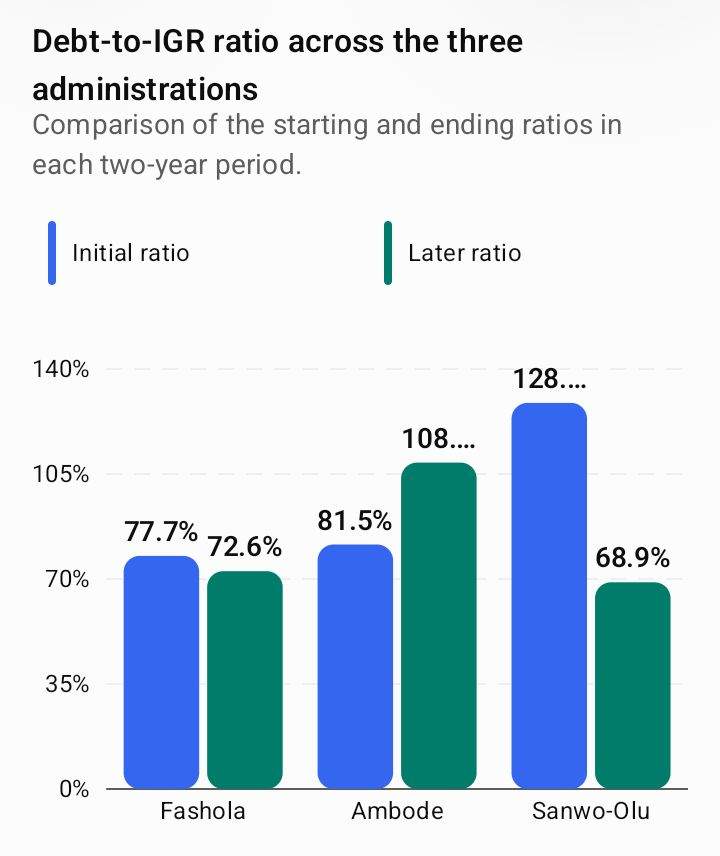
The central lesson from the figures is that rising debt does not automatically translate into a worsening debt-to-revenue position. What matters is the relationship between the rate at which government borrows and the rate at which it expands its revenue base.
Fashola and Sanwo-Olu recorded improvements because IGR grew faster than domestic debt during the periods examined. Ambode’s figures, on the other hand, show that debt accumulated faster than revenue.
The Important Caveat: A Lower Ratio Does Not Necessarily Mean Lower Debt
While the figures present a favourable picture of revenue growth under Fashola and Sanwo-Olu, the debt-to-IGR ratio should not be mistaken for a comprehensive measure of fiscal sustainability.
It does not capture external debt, debt-servicing costs, outstanding contractual obligations, contingent liabilities or the state’s overall expenditure commitments.
Similarly, domestic debt figures represent outstanding debt stocks, while IGR represents annual revenue flows. The ratio is therefore an indicator of debt relative to revenue-generating capacity, not the proportion of annual revenue actually spent on debt repayment.
There is also a need to establish whether the figures use consistent debt definitions and comparable accounting periods.
The comparison suggests that Lagos demonstrated different levels of fiscal performance under the three administrations. Fashola achieved a modest improvement in the state’s debt-to-IGR position, Ambode recorded a deterioration, while Sanwo-Olu presided over a substantial improvement between 2023 and 2025.
The most striking finding is that Lagos’ domestic debt rose from approximately N1.05 trillion to N1.22 trillion under Sanwo-Olu, yet the debt-to-IGR ratio fell from 128.7 per cent to 68.9 per cent.
Ultimately, the figures suggest that the strength of a state’s finances should not be judged by how much it borrows alone, but also by how effectively it expands its capacity to generate revenue.