Isese Day: Clarifying Cultural Identity Across Lagos
By Sherif Salau
As Isese Day approaches, public discussion of Yoruba cultural heritage has intensified across Lagos State. Much of this discourse mixes accurate observation with recurring misconceptions. A clearer, evidence-based understanding is required.
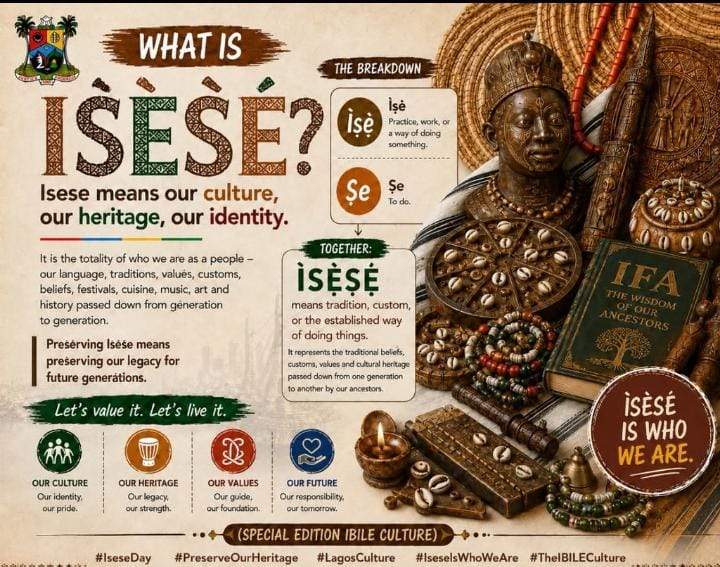
Isese, a Yoruba term that translates as “tradition,” denotes the body of indigenous practices, values, language, social norms, festivals and historical memory associated with Yoruba communities. It encompasses both the traditional religious observances of Orisha and ancestral veneration practised by some adherents and the broader cultural framework shared by Yoruba speakers irrespective of personal faith. Official recognition of Isese Day on 20 August began in Osun State in 2014 and has since been adopted by Lagos and other southwestern states, which routinely declare the date a work-free day for public servants.
*Geographic and Institutional Scope*
The observance holds relevance across the five IBILE divisions of Lagos State—Ikeja, Badagry, Ikorodu, Lagos Island and Epe. Local expressions vary according to historical and administrative context, yet the underlying cultural reference remains consistent. State-level recognition reflects an institutional decision to place indigenous heritage alongside other major communal observances within the public calendar.
*Addressing Persistent Misconceptions*
Two claims frequently appear in public commentary. The first holds that Isese is an outdated residual practice with limited contemporary application. Historical and ethnographic evidence indicates continuous adaptation rather than fossilisation; language use, ethical norms, festival cycles and kinship structures continue to influence social organisation. The second claim characterises Isese as inherently divisive. Available records of official observance and community participation show no structural opposition to other religious or civic frameworks. The day functions as a periodic reaffirmation of shared cultural reference points rather than an exclusive or exclusionary programme.
*Cultural Content*
Isese comprises multiple interrelated elements: linguistic continuity, value systems emphasising respect for elders and communal obligation, calendrical festivals, and everyday social practices. These elements operate independently of any single doctrinal commitment. For traditional practitioners the day includes ritual observance; for the wider population it provides an occasion for cultural education and transmission.
*Institutional Stance*
Lagos State policy treats the date as an opportunity for informed engagement with indigenous heritage. The stated objectives are documentation, intergenerational transmission and accurate public understanding. Citizens are therefore encouraged to replace assumption with verified knowledge of language, historical practice and contemporary expression.
In summary, Isese constitutes a defined and continuing component of Yoruba cultural identity in Lagos. Its formal recognition on 20 August serves administrative and educational purposes. Accurate description of its content and scope remains the prerequisite for any informed public discussion.