Agege Food Hub Set to Transform Local Markets
For many residents of Agege, buying food has long meant navigating crowded markets, dealing with congestion, finding parking and shopping in spaces where storage and sanitation facilities can be inadequate.
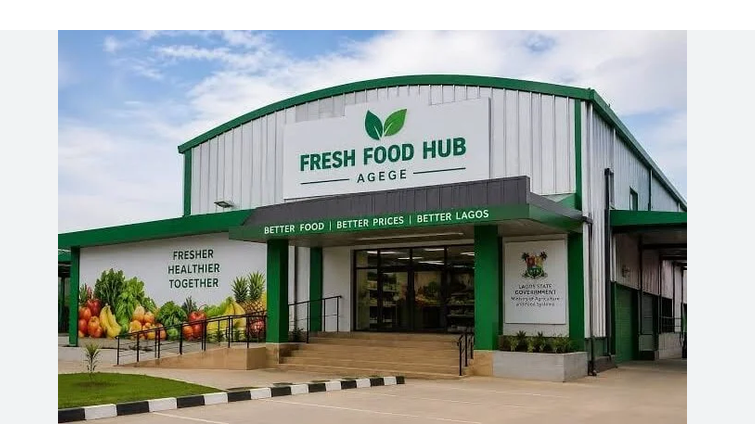
That experience could soon change as the Lagos State Government advances plans to open the new Mid-Level Agroproduce Hub in Agege, a project designed to modernise the way fresh food is traded, stored and distributed across the state.
The facility is being positioned as more than a conventional market. It is expected to provide a more organised environment where traders, farmers, transporters and consumers can connect, with dedicated spaces for trading, storage and logistics.
During an inspection of the facility in July, Lagos State Commissioner for Agriculture and Food Systems, Ruth Olusanya, and other government officials assessed the project ahead of its commissioning.
Agege Local Government Chairman, Abdul-Ganiyu Obasa, said the hub would provide organised trading and storage facilities as well as adequate parking, with the broader goal of improving access to fresh and affordable food.
The project comes at a time when food prices, availability and distribution remain major concerns for households across Lagos.
Rather than leaving food distribution to traditional markets alone, the state government has been developing a network of fresh food hubs intended to bring agricultural produce closer to consumers and improve the movement of food from farms to urban communities.
The model has already shown signs of significant economic activity at the Lagos Fresh Food Hub in Idi-Oro, Mushin.
As of May 2026, the Mushin hub had recorded more than ₦3.8 billion in transactions, with over 850 registered vendors and more than 7,000 direct and indirect jobs linked to activities around trading, logistics and food handling.
For Agege, the figures offer an indication of what a fully operational hub could mean for local traders and residents.
Modern market infrastructure can have an impact beyond the appearance of a facility. Better storage can help reduce damage to perishable goods, while improved access and organised loading and parking areas can make it easier for traders to move products and customers to shop.
These improvements could be particularly relevant in Agege, one of Lagos’ busy commercial areas, where congestion and pressure on existing market infrastructure have remained familiar challenges.
The Agege project is also part of a broader state strategy to develop a network of structured food markets across Lagos.
The government has already commissioned the Mid-Level Agroproduce Hub at Abijo, while projects are also being developed in locations including Opebi, Ikorodu and Bombata. Other locations identified for similar interventions include areas around Apapa, Festac and the Lekki axis.
For consumers, however, the biggest question is whether the investment will eventually make food more accessible and affordable.
A modern market alone cannot determine the price of a bag of rice, tomato, pepper or other food items. But a more efficient supply chain can potentially reduce some of the costs and losses that occur between farms, transporters, traders and consumers.
Lagos has said its food hub programme is aimed at strengthening connections between farmers and markets, improving the handling and storage of produce and reducing post-harvest losses.
The state has also continued to promote better hygiene and food storage practices among traders as part of efforts to improve food safety and build a more organised food system.
For Agege residents, the significance of the new hub may therefore extend beyond having another place to shop.
The project could provide traders with better working conditions and more structured facilities while giving consumers access to a more organised food market closer to home.
Agege’s long-standing role as a commercial centre means the hub could also become an important link between food producers outside Lagos and the millions of consumers who depend on the state’s markets every day.
As the government moves towards commissioning the facility, attention will increasingly shift from construction to performance.
The real test will be whether the Agege hub can attract traders, improve food distribution, reduce losses and ultimately make the everyday experience of buying and selling fresh food safer, easier and more efficient for ordinary Lagosians.