Igbo Leaders Inaugurate Council to Harmonise Cultural Leadership in Lagos
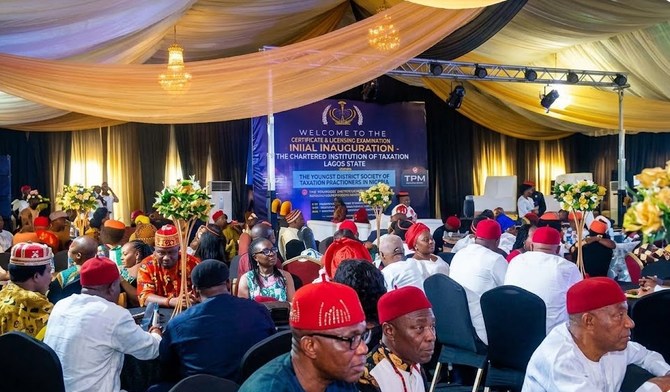
The atmosphere at the grand hall of The Colonnade Hotel on Alfred Rewane Road, Ikoyi, Lagos, was charged with cultural pride and a strong sense of heritage on Saturday, October 3, 2026, as traditional leaders, government officials and distinguished guests gathered for the inauguration of the Council of Ndindu Ndigbo (Certificated Igbo Traditional Leaders) in Lagos State.
The historic ceremony was organised by the Association of Ndindu Ndigbo Nauzoije, Lagos State Chapter, in collaboration with the Committee on Regularisation of Igbo Diaspora Traditional Title and Leadership (CRIDTTL), under the auspices of the South East Council of Traditional Rulers.
The event, which commenced at 1:00 p.m., attracted prominent figures from across Igbo traditional and community leadership circles, with Distinguished Senator John Azuta Mbata, President-General of Ohanaeze Ndigbo Worldwide, as Special Guest of Honour.
The Royal Host was His Royal Majesty Oba Rilwan Babatunde Osuolale Aremu Akiolu, the Oba of Lagos, while Sir (Pharm) Nnamdi Obi, Chairman and Chief Executive Officer of Embassy Pharmaceutical & Chemicals Ltd., chaired the occasion.
Chief Charles Odunukwe OON, Okemmiri Naebudgwe of Orukwu, Chardon, and Chairman of CRIDTTL, served as host of the ceremony.
A major highlight of the gathering was the presence of leading members of the South East Council of Traditional Rulers. Among those in attendance were HRM Eze Dr. Emmanuel Okeke CFR, Eze Imo and Chairman of the South East Council of Traditional Rulers; HRM Igwe Amb. Lawrence Agubuzo OON CFR; HRM Eze Linus Nto Mbah, Chairman of the Abia State Council of Traditional Rulers and incoming Chairman of the South East Council; HRM Igwe Alfred Nnaemeka Achebe CFR, Agbogidi, the Obi of Onitsha; HRM Igwe Chidubem Iweka III, the Obi of Obosi and Chairman of the Anambra State Council of Traditional Rulers; HRM Eze Charles Mkpuma, Chairman of the Ebonyi State Council of Traditional Rulers; and HRM Igwe Samuel I. Asadu, Ogadagidi, Chairman of the Enugu State Council of Traditional Rulers.
Explaining the significance of the ceremony, legal practitioner and member of Ohanaeze Ndigbo, Badagry Chapter, Barnabas Chibuike Okoro, said the initiative was primarily aimed at bringing structure, uniformity and clarity to Igbo cultural leadership across communities in Lagos State.
According to him, the inauguration was not about creating another layer of traditional rulership, but about formally recognising individuals who have been selected and endorsed to provide cultural leadership within their respective Igbo communities in Lagos.
Okoro noted that the initiative was particularly significant against the backdrop of longstanding questions surrounding representation and leadership among Igbo communities in Lagos.
He explained that the exercise was designed to address situations in which individuals could emerge independently and claim leadership of particular Igbo communities without the necessary endorsement from the relevant traditional institutions.
“The essence of this gathering is to formally present the individuals who have been given these leadership titles to the various Igbo communities in Lagos and to make it clear that these are the people approved to provide cultural leadership in their respective communities,” he said.
He added that the individuals being presented had received endorsement from the relevant Council of Traditional Rulers in Igboland and were being introduced to their respective communities in Lagos as recognised cultural leaders.
According to him, the initiative would help harmonise the leadership structure and minimise disputes or confusion over who legitimately represents Igbo communities in different parts of Lagos State.
“We are saying that these specific individuals have been endorsed by the Council of Traditional Rulers and are being presented to their respective communities as their leaders. The objective is to harmonise the leadership structure and avoid confusion over who represents the Igbo people in the various communities,” Okoro said.
He, however, stressed the importance of distinguishing the newly recognised community leaders from statutory traditional rulers, noting that the former should not be addressed with royal titles such as “His Royal Highness” or “His Majesty”.
“Traditional rulership is a different matter and is regulated by law. These positions are essentially about community and cultural leadership, rather than traditional rulership or royalty,” he explained.
He described the inauguration as an important step towards establishing a more coordinated system of Igbo cultural leadership in Lagos, while preserving the authority and distinct roles of recognised traditional institutions.
The organising committee, led by Onyendu John-Greg Okey Ezebuadi, Ogboroagha/Ezeani Ugwudike Ichida and Chairman of the Council of Ndindu Ndigbo Lagos State, worked with General Secretary Onyendu Amb. Remi Anyamele to coordinate the event.
Other members of the organising team included co-hosts Onyendu Uche I.C. Dimgbo, Okpotemba of Igbere; Onyendu High Chief Aloy Obi; Onyendu Dr. Omenife C. Olikaenyi, Ide; and Prince Ubochi C. Ubochi.
Beyond the formal presentation and inauguration of the Council of Ndindu Ndigbo, the ceremony also featured the presentation of the Igbo Traditional Values & Leadership Award 2026 in recognition of individuals who have distinguished themselves in service to the Igbo community and the preservation of its cultural heritage.
Anchored on the theme of Igbo Unity, Culture, Tradition and Progress, the gathering provided a platform for stakeholders to reaffirm their commitment to strengthening cultural identity, promoting organised community leadership and fostering greater unity among Igbo communities across Lagos State.
The inauguration therefore marked a significant milestone in efforts to establish a more structured and coordinated framework for Igbo cultural leadership in Lagos, while strengthening ties between diaspora communities and traditional institutions in the South East.