How Lagos Families Are Coping with Rising School Costs
By 4:45 a.m., while much of Lagos is still asleep, 41-year-old commercial bus driver Ibrahim Salisu is already on the road. His first passengers are airport workers heading to the early shift.
By mid-morning, he has switched to local routes around Oshodi before rushing home to take his daughter to school.
His day does not end until late at night.
“Every extra trip I make has one purpose,” he says. “School fees.”
Across Lagos, countless families are rewriting their daily routines in a desperate effort to keep their children in school. As inflation continues to push up the cost of living, education has become one of the biggest financial burdens for many households. Beyond tuition, parents now contend with rising costs of textbooks, uniforms, transportation, digital learning fees, extracurricular levies and school meals.
Private school operators say they have had little choice but to increase fees as diesel prices, electricity bills, rent, teachers’ salaries and classroom supplies continue to climb. In many schools, tuition has risen significantly over the past two years, forcing parents to rethink how they budget for education.
For many families, paying school fees is no longer a once-a-term responsibility—it has become a daily struggle.
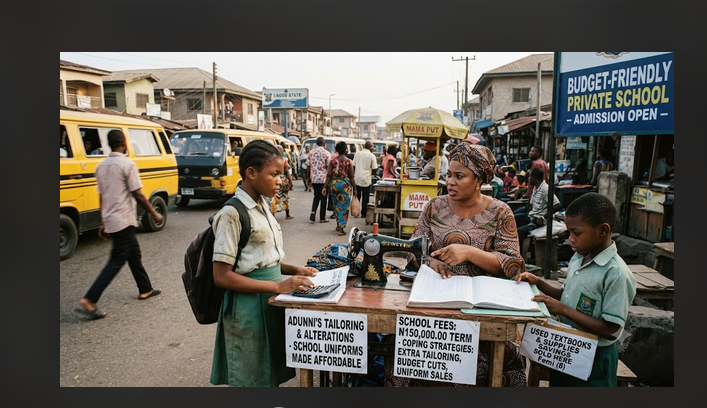
In Ikorodu, 36-year-old tailor and mother of three, Yetunde Akinola, now spends her evenings selling homemade chin chin and pastries through social media after closing her sewing shop.
“My tailoring income pays our rent,” she explains. “The snacks pay for my children’s education.”
Every sale goes into a separate savings account reserved solely for school expenses. She admits there were moments she considered withdrawing her children from their private school after another tuition increase.
“I couldn’t sleep for days,” she recalls. “I kept asking myself how we would survive the next term.”
Instead of leaving, she approached the school management, which agreed to allow her to spread payments across the term.
That arrangement has become increasingly common across Lagos. Faced with growing economic pressure on parents, many private schools now offer flexible payment schedules, monthly instalments, sibling discounts or temporary payment plans to help families avoid withdrawing their children.
School administrators say the alternatives are necessary.
“If we insist on full payment before resumption, many children simply won’t return,” says a school proprietor in Surulere, who requested anonymity.
“We also face rising costs, but we understand what parents are going through. We’d rather receive payments gradually than lose a child entirely.”
Some schools have gone a step further by postponing non-essential levies, reducing optional charges and partnering with education financing firms that enable parents to spread tuition over several months.
The financial pressure is also reshaping childhood itself.
Every weekday after classes, 13-year-old Emmanuel leaves school in Agege and joins his mother at a roadside kiosk where they sell cold drinks, biscuits and bottled water.
He spends about an hour helping customers before returning home to complete his homework.
“I want to become an engineer,” he says with a shy smile. “Helping my mum doesn’t stop me from studying.”
His mother insists education remains non-negotiable.
“We don’t allow him to miss school,” she says. “This is only our way of surviving.”
Across neighbourhoods including Mushin, Ajegunle, Alimosho and Badagry, similar scenes have become familiar. Some children assist their parents after school by selling fruit, bread, snacks or phone accessories. Others help with small family businesses before settling down to study at night.
Child rights advocates caution that children should never be burdened with work that affects their education or wellbeing. But many parents argue that these after-school activities are carefully managed and remain preferable to taking children out of school entirely.
Not every family has found a way to cope.
In Yaba, accountant Abisola Ojo recently transferred her youngest son from a private school to a public school after calculating that her education expenses had almost doubled in three years.
“It broke my heart,” she admits. “But feeding the family and paying rent also matter.”
Education experts say such decisions are becoming increasingly common as household incomes struggle to keep pace with soaring prices.
Others are turning to cooperative societies, rotating savings groups and salary advances to bridge the gap. Religious organisations, extended family members and community associations have also stepped in to provide back-to-school support for struggling households.
For many Lagosians, the start of a new school term now comes with weeks of financial planning rather than excitement.
Outside a primary school in Yaba on a recent afternoon, parents waited patiently as the closing bell rang. Some had just finished overnight shifts. Others had left their market stalls unattended for a few minutes. One father answered work calls while calculating outstanding tuition on his phone.
Their conversations revolved around payment deadlines, textbook costs and transport fares—not holidays or weekend plans.
Despite the mounting pressure, one thing remains constant: parents are refusing to give up on their children’s future.
They are driving longer hours, opening side businesses, working overtime, taking on freelance jobs and making countless unseen sacrifices so that the next generation can remain in the classroom.
In a city where the cost of education keeps climbing, these parents are proving that determination can be just as powerful as income.
For them, every school fee paid is more than another bill settled.
It is another step towards a dream they refuse to abandon.