Turning Waste Into Wealth
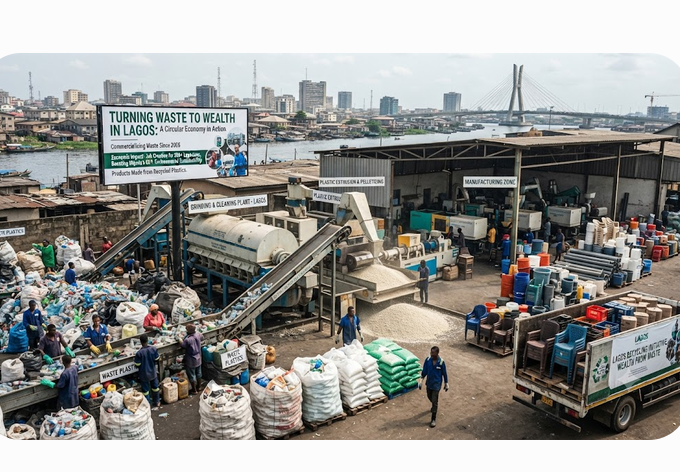
By 6:30 every morning, before traffic clogs the roads leading into Ojota, Lagos, 28-year-old Sodiq Ibrahim has already begun sorting through mountains of discarded plastic bottles stacked inside a modest recycling yard.
The bottles arrive from every corner of the city—picked from drainage channels after rainfall, recovered from markets, collected from residential estates, restaurants, schools and office complexes. Some are still filled with dirty water. Others carry soft drink labels that have faded under the sun.
To many people, they are rubbish.
To Sodiq, they are inventory.
Each bottle is sorted by colour and type before being compressed into large bales destined for recycling plants that will transform the plastic into textile fibre, packaging materials, furniture, buckets and other consumer products.
“People see waste,” he says. “I see raw materials.”
His business reflects a quiet transformation taking place across Nigeria, where thousands of young entrepreneurs are building livelihoods by recovering plastic, scrap metal and electronic waste that would otherwise end up in dumpsites, canals and landfills.
Nigeria generates millions of tonnes of solid waste annually, with Lagos alone producing more than 13,000 tonnes of municipal waste every day, according to estimates by the Lagos State Waste Management Authority (LAWMA). Plastic accounts for a significant share of that waste stream, while the rapid growth in smartphone, computer and household appliance use has also increased electronic waste across the country.
What was once considered the work of informal scavengers has evolved into a growing circular economy involving collectors, aggregators, recyclers, manufacturers and technology startups.
Across Lagos, the business begins long before sunrise.
At Ojota, Ketu and Mile 12, waste collectors push heavily loaded carts through residential streets, recovering plastic bottles, aluminium cans and scrap metal before municipal refuse trucks arrive.
Many of them sell directly to aggregation centres operated by young entrepreneurs.
Thirty-one-year-old Chinyere Okafor manages one such collection hub in the Amuwo-Odofin area.
She never imagined becoming a recycler after graduating with a degree in Business Administration.
“I looked for office work for almost two years,” she says. “Then I realised the waste business had customers every single day.”
She began by purchasing plastic bottles from street collectors with a small loan from relatives. Today, dozens of informal waste pickers supply her yard daily.
“We don’t own the bottles,” she explains. “We buy them, sort them, bale them and sell in bulk.”
The margins are slim, but volume makes the difference.
Every week, trucks leave her yard carrying compressed plastic to recycling factories in Ogun and Lagos States.
The recycling chain has become increasingly organised.
Companies such as Chanja Datti, RecyclePoints, Wecyclers, CAP Plc Recycling Initiative and other private recyclers have helped formalise waste collection by working with households, businesses and community collectors. Digital platforms now allow some collectors to schedule pickups, track volumes and receive electronic payments, bringing greater structure to a sector that was once almost entirely informal.
The business extends well beyond plastic.
In the bustling industrial districts of Apapa and Ijora, young scrap dealers specialise in metals.
Copper wire remains one of the most valuable materials.
Old electrical cables, damaged transformers, abandoned air conditioners and obsolete industrial equipment are dismantled, with copper separated from steel and aluminium before being sold to metal processing companies.
Thirty-four-year-old Abdulrasheed Musa started as a roadside scavenger after leaving secondary school.
Today, he employs fifteen workers at his metal recovery yard.
“We buy from construction companies, demolition sites and electricians,” he says.
Every kilogram matters.
Copper commands premium prices because manufacturers reuse it in electrical wiring and industrial production, while aluminium and steel are melted and returned to manufacturing lines.
The electronic waste business is growing even faster.
In Computer Village, Ikeja, damaged laptops, televisions, printers and mobile phones rarely go straight to the dump.
Technicians first remove components that can be repaired or resold.
The remaining circuit boards, batteries, cables and metals enter another recycling chain.
Some materials are processed locally, while others are exported through licensed recycling companies for specialised recovery.
Environmental experts estimate that Nigeria generates hundreds of thousands of tonnes of electronic waste every year, much of it imported as used electronics. Valuable metals—including gold, silver, copper and palladium—can be recovered from discarded circuit boards, making electronic recycling an increasingly attractive business opportunity.
For 30-year-old electronics technician David Eze, repairing devices naturally led to recycling.
“If I cannot repair a laptop, I can still recover value from its parts,” he says.
Working from a small workshop in Ikeja, he dismantles damaged computers, separating reusable components from recyclable materials.
“Nothing should leave here without checking if it still has value.”
Young entrepreneurs are also using technology to modernise waste collection.
Some startups have developed mobile applications that connect households with collectors, while others reward residents with cash, grocery vouchers or redeemable points for sorting recyclable materials.
These initiatives encourage waste separation at source while creating predictable income for collection agents.
Universities are producing graduates who see waste differently.
Mechanical engineers are designing low-cost plastic shredders.
Chemical engineers are experimenting with converting plastic waste into fuel through pyrolysis.
Industrial designers are producing furniture from recycled plastic.
Fashion entrepreneurs are transforming discarded fabrics and plastic packaging into bags, shoes and home décor.
At the University of Lagos and other institutions, student-led sustainability projects increasingly focus on waste recovery, recycling innovation and circular manufacturing.
Yet the industry faces serious obstacles.
Many small recyclers struggle to access financing for baling machines, shredders and transport vehicles.
Poor waste separation means recyclable materials often arrive contaminated.
Fluctuating global prices for recycled materials affect local profitability.
Operators also complain about rising diesel costs, inconsistent electricity supply and inadequate collection infrastructure.
Environmental advocates warn that unsafe recycling methods remain common in some informal clusters, particularly where electronic waste is dismantled without protective equipment or where insulated wires are burned in the open to recover copper, releasing toxic fumes into surrounding communities.
Government agencies and private organisations have intensified awareness campaigns promoting responsible recycling, while extended producer responsibility programmes encourage manufacturers to participate in collecting and managing post-consumer waste.
For people like Sodiq, however, the business is ultimately about opportunity rather than environmental theory.
As afternoon rain begins to fall over Lagos, another truck loaded with plastic bottles pulls into his recycling yard.
Workers quickly unload hundreds of sacks before the downpour gathers strength.
There is no time to waste.
Every bottle must be sorted.
Every kilogram must be weighed.
Every bale represents another shipment, another payment and another step towards building a business from what the city throws away.
In a country where unemployment remains a challenge and cities continue to produce growing volumes of waste, a new generation of Nigerian entrepreneurs is proving that prosperity can sometimes be found in the least expected places.
Not in boardrooms or corporate offices.
But in discarded bottles floating through drainage canals, abandoned metal lying behind construction sites and broken electronics gathering dust in forgotten storerooms.
For these young Nigerians, yesterday’s waste has become tomorrow’s wealth.