Graduates Who Chose Skilled Trades Instead of Office Jobs
At 7:30 on a Monday morning, while thousands of young graduates in Lagos are refreshing job portals and checking their email inboxes for interview invitations, 29-year-old Oluwatobi Adebayo is already underneath a Toyota Corolla at a busy mechanic village in Ladipo, Mushin.
His white engineering overall is stained with grease, his hands are covered in engine oil, and his phone rings every few minutes with customers asking when their vehicles will be ready.
Five years ago, Tobi graduated with a degree in Mechanical Engineering from a federal university. Like many of his classmates, he dreamed of working in the oil and gas industry. He sent out hundreds of applications, attended recruitment tests and completed the mandatory National Youth Service Corps (NYSC), but the breakthrough never came.
Instead of waiting indefinitely, he returned to a skill he had learned from his uncle during university holidays.
“People thought I had failed because I became a mechanic,” he says. “Today, I employ four people, and during festive periods, I make more than many office workers.”
His story reflects a growing reality in Nigeria, where many graduates are abandoning the traditional pursuit of office jobs in favour of skilled trades that provide quicker and often more reliable income.
Nigeria continues to grapple with one of Africa’s highest youth unemployment rates. According to the National Bureau of Statistics, while unemployment figures have changed under the revised labour methodology, underemployment, informal work and graduate job mismatch remain major concerns. Thousands of graduates leave universities every year, but the formal labour market is unable to absorb them all. As a result, more young Nigerians are turning to vocational skills once considered jobs for people without higher education.
Across Lagos, evidence of this shift is everywhere.
At Computer Village in Ikeja, several phone and laptop technicians hold university degrees in disciplines ranging from Business Administration to Microbiology.
One of them is 31-year-old Chisom Nwafor, who graduated in Biochemistry from a university in the South-East. After nearly three years of unsuccessful job hunting, he enrolled in a six-month phone repair course.
Today, his small workshop repairs premium smartphones, tablets and laptops for corporate clients and walk-in customers.
“I stopped introducing myself as someone looking for work,” he says. “Now people introduce me as the person who can fix almost any phone.”
His income fluctuates, but on good weeks, especially when new phone models develop common faults, he earns considerably more than many entry-level office employees.
Hairdressing and beauty services have become another destination for graduates.
In Lekki, 27-year-old Fatimah Bello runs a beauty studio specialising in wig installation, braiding and bridal styling. She studied Accounting but discovered during the COVID-19 lockdown that her side business earned more than her internship allowance.
She invested in professional training, built an online presence through Instagram and TikTok, and now receives bookings from clients across Lagos.
“My degree taught me how to manage money,” she says. “My skill pays the bills.”
Industry observers say Nigeria’s booming beauty industry has become one of the country’s fastest-growing informal sectors, driven by social media marketing, weddings and a rising demand for premium grooming services.
The trend extends beyond Lagos.
In Aba, Abia State, graduates increasingly join the city’s thriving leather and garment industry. Some design shoes and bags, while others manage digital marketing and exports for family-owned workshops.
The famous Ariaria International Market has evolved beyond traditional craftsmanship, with many young graduates introducing modern branding, online sales and improved product packaging to businesses that once relied solely on walk-in customers.
In Nnewi, Anambra State, university graduates work in automobile spare parts manufacturing and industrial fabrication, applying engineering knowledge directly to local production instead of waiting for multinational companies to recruit them.
Kano has witnessed similar changes. Graduates are entering the city’s long-established leather processing and textile businesses, combining digital marketing with traditional craftsmanship to reach customers nationwide.
Back in Lagos, furniture making is attracting another generation of educated artisans.
Thirty-two-year-old Emmanuel Ojo studied Architecture but now operates a bespoke furniture workshop in the Ojo area.
He designs wardrobes, kitchen cabinets and office furniture using computer-aided design software before his team begins production.
“My degree didn’t go to waste,” he explains. “It helps me communicate better with architects and interior designers.”
His workshop supplies furniture for apartments, restaurants and short-let properties springing up across Lagos.
Digital platforms have made these skilled trades even more attractive.
Mechanics now receive customers through WhatsApp referrals. Carpenters showcase completed projects on Facebook and Instagram. Tailors accept measurements online. Electricians advertise on Google Business profiles. Appliance technicians use TikTok videos to demonstrate their expertise, attracting customers from beyond their immediate neighbourhoods.
The result is that many skilled workers are no longer limited to their local communities.
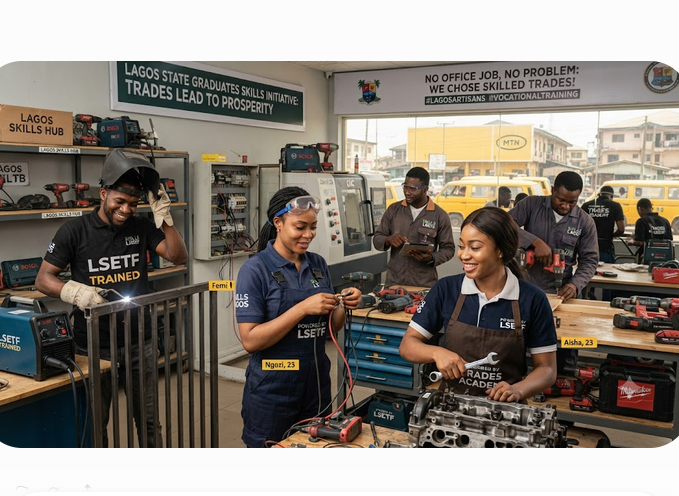
Vocational training centres have also reported increasing interest from graduates.
Across Nigeria, programmes run by the Industrial Training Fund (ITF), the National Directorate of Employment (NDE), state governments and private vocational academies have seen more university graduates enrolling in courses ranging from welding and solar installation to fashion design, plumbing and refrigeration technology.
The demand is being driven partly by opportunities in renewable energy.
With rising electricity costs and persistent power shortages, skilled solar technicians have become highly sought after.
In Abuja, graduate electricians now specialise in solar installation for homes and businesses. Similar businesses are expanding rapidly in Lagos, Port Harcourt and Ibadan as households seek alternatives to unreliable public power supply.
For many graduates, the biggest challenge is not learning the skill but changing public perception.
In many Nigerian homes, parents still equate success with wearing a suit, working in an air-conditioned office and collecting a monthly salary.
Skilled trades rarely receive the same social recognition, even when they generate higher incomes.
Career counsellor and entrepreneur Adebayo Adeyemi believes that mindset is gradually changing.
“There was a time when parents discouraged their children from becoming plumbers or welders,” he says. “Now they see graduates building successful businesses through those same trades.”
Economic realities have accelerated that shift.
The rising cost of living, increased competition for formal jobs and the growth of Nigeria’s digital economy have made entrepreneurship through skilled trades more attractive than waiting years for a government or corporate appointment.
Not every graduate who chooses a trade becomes wealthy overnight.
Many struggle to raise capital for equipment, workshop rent and training. Others face inconsistent electricity supply, inflation and fluctuating material costs.
Yet for thousands, the ability to earn immediately outweighs the uncertainty of endless job applications.
As evening falls in Ladipo, Tobi wipes his hands with an old cloth before handing a repaired vehicle back to its owner.
The customer transfers the payment instantly.
Another car rolls into the workshop before the first one leaves.
He smiles.
“I still have my degree hanging on my wall at home,” he says. “But what built my house wasn’t the certificate. It was the skill I decided to take seriously.”
Across Nigeria, stories like his are quietly redefining success.
For a growing number of graduates, the path to financial independence no longer begins in a corporate office.
It begins in a workshop, a salon, a fabrication yard or a mechanic village—where knowledge meets practical skill, and where dignity is measured not by a job title, but by the value created with one’s own hands.