Life Beneath the Bridges
By 8:00 a.m., the thunder of vehicles rolling across Eko Bridge is relentless. Tankers, buses, private cars and trailers stream overhead without pause, carrying thousands of Lagosians towards the Island.
Yet beneath the concrete pillars, another city is already deep into its workday.
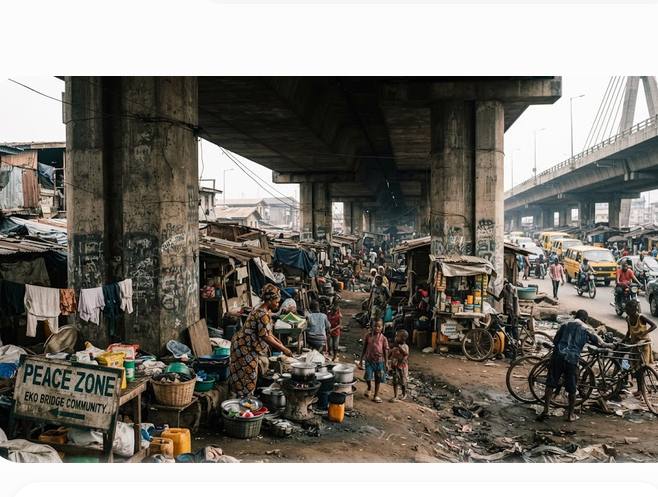
The smell of engine oil mixes with roasted corn, welding sparks, frying bean cakes and burning metal. Hammers strike iron sheets in quick succession while generators hum beside makeshift workshops. Traders arrange their goods on wooden tables. Mechanics crawl beneath buses with grease-blackened hands. Scrap dealers sort aluminium, copper and iron into neat piles that will soon be sold to recycling companies. Under the bridge, there is no silence—only work.
For many Lagos residents, these spaces are invisible. They drive over them every day without realising that hundreds of families earn a living in the shadows of the bridges that connect the city.
At the Costain and Ijora sections beneath Eko Bridge, mechanics repair everything from commercial buses to heavy-duty trucks. Vehicle owners often prefer these workshops because labour charges are lower than those at formal garages. A brake repair that might cost significantly more elsewhere is negotiated on a plastic chair under the bridge, where experience often matters more than appearance.
Forty-eight-year-old mechanic Musa Abdullahi has spent nearly two decades working beneath the bridge.
“When people see this place, they think it is rough,” he says while tightening bolts on a yellow commercial bus. “But this workshop trained many mechanics. Some of my apprentices now own garages in Ogun and Abuja.”
Only a few metres away, welder Chinedu Okafor shapes iron gates for a housing project in Surulere. Every few minutes, bright blue sparks light up the dark space beneath the bridge.
“My office may not have air conditioning,” he jokes, “but customers keep coming because they know the job will be done.”
The informal economy beneath Lagos bridges stretches far beyond vehicle repairs.
Near Iganmu and parts of Ijora, recyclers arrive before sunrise with pushcarts loaded with discarded plastic bottles, old electronics, aluminium cans and metal scraps collected across the city. Every item is sorted carefully because each attracts a different buyer.
Copper earns the highest price. Aluminium comes next. Plastic bottles are compressed into sacks before being transported to recycling plants, where they are processed into raw materials for new products.
Thirty-three-year-old recycler Esther Nwosu says nothing is truly useless in Lagos.
“What somebody throws away is another person’s school fees,” she says while separating wires from old electrical appliances.
The recycling business has expanded as Nigeria’s circular economy grows, with increasing demand for recyclable materials from manufacturing companies. Yet the work remains physically demanding. Workers spend long hours lifting heavy loads under intense heat, often without gloves, protective boots or health insurance.
Around lunchtime, the focus shifts to food.
Mama Bose has operated a roadside kitchen beneath Ojuelegba Bridge for more than twelve years. Her customers include mechanics, bus drivers, welders, dispatch riders, traffic officers and construction workers.
By 1 p.m., every bench is occupied.
“We don’t advertise,” she says, smiling as she serves steaming rice and stew. “People bring people.”
Her daily sales depend entirely on the activity around her. When workshops are busy, business is good. When government enforcement temporarily clears the area, everyone—from mechanics to food vendors—feels the impact immediately.
The bridges also support countless micro-businesses that rarely appear in economic statistics.
A young man repairs mobile phones from a wooden kiosk powered by a small solar panel. Beside him, a woman sells second-hand work boots and reflective jackets to construction workers. Another trader specialises in truck batteries. Nearby, vulcanisers patch worn tyres while carpenters build market shelves ordered by traders across Lagos.
Each business survives because another depends on it.
The mechanic buys lunch from the food vendor. The welder repairs the trader’s iron shelves. The recycler sells scrap to a middleman, who supplies manufacturers. Money circulates continuously beneath the bridge, creating a small but interconnected economy.
Yet life here exists under constant uncertainty.
Successive administrations in Lagos have repeatedly announced crackdowns on illegal structures beneath bridges, arguing that commercial activities, open fires and indiscriminate waste disposal threaten critical infrastructure and public safety. Following fire incidents around the Eko Bridge corridor, authorities intensified efforts to remove traders and workshops from sensitive sections, warning that activities such as welding, scrap burning and storage of flammable materials could damage bridge structures or obstruct maintenance work. Despite repeated eviction notices, many artisans and traders eventually return because they have few affordable alternatives for their businesses.
For workers like Musa, the fear is not simply losing a workshop.
“It is losing customers,” he explains. “If they move us somewhere people cannot find us, many mechanics will start from zero.”
Urban planners acknowledge the dilemma. Lagos depends heavily on its informal economy, which provides livelihoods for millions of people who cannot easily access formal employment or commercial spaces. At the same time, engineers warn that unregulated activities beneath bridges—including burning scrap metal, illegal structures and poor waste management—can threaten public infrastructure and safety. Finding a balance between protecting critical assets and preserving livelihoods remains one of the city’s toughest challenges.
As evening approaches, business refuses to slow down.
Commercial buses returning from Lagos Island pull in for quick repairs before the next day’s rush hour. Recyclers weigh the day’s collections on rusted scales. Welders complete final jobs before darkness. Food vendors prepare another batch of soup for customers who will continue working long after sunset.
Above them, thousands of commuters cross the bridges without ever looking down.
They see only concrete, traffic and endless queues of vehicles.
What they rarely notice is the hidden workforce beneath their tyres, a community of mechanics keeping buses on the road, artisans building homes and shops, recyclers giving waste a second life, and traders feeding the people who keep Lagos moving.
In a city famous for its hustle, the bridges do more than connect the mainland to the island.
For thousands of Lagosians, they connect hard work to survival.