Lagos NLC Boss Backs Ecowas Free Border Movement
By Saheed Afolabi
The chairman of the Nigeria Labour Congress (NLC) Lagos State branch, Comrade Sesi Funmi has thrown her weight behind the free movement of member countries of the Economic Community Of West Africa States (ECOWAS) across borders.
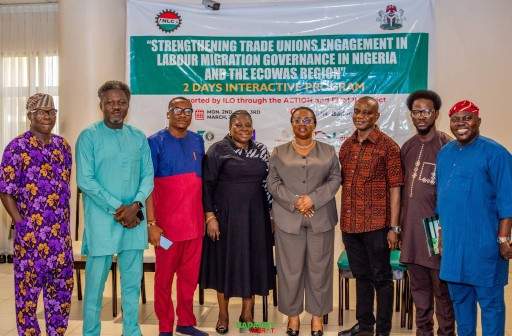
The Nigeria Labour Congress (NLC) partnering with the International Labour Organization (ILO) recently hosted a two-day sensitization workshop in Badagry, a key border community in Lagos State. The event focused on bolstering migration governance and encouraging safer, more informed cross-border movement in line with the ECOWAS Free Movement Protocol.
The workshop drew a diverse group of participants, including trade union leaders, migrant workers, journalists, youth representatives, traditional rulers, and other community stakeholders. Discussions centered on the challenges and vulnerabilities often encountered in border areas.
Funmi explained that the programme aimed to empower not only union members and migrants but also local residents and key figures in Badagry. Participants gained a clearer understanding of their rights and obligations under the regional framework.
“The ECOWAS Free Movement Protocol serves as a vital tool for regional integration and economic advancement. Communities along borders like Badagry need proper awareness to fully harness its advantages while minimising potential risks.”
Dr. Mrs Funke Adepoju, Director-General of the Administrative Staff College of Nigeria (ASCON) where the event took place praised the NLC for organising such a relevant initiative in a strategic location. She opined that the importance of ongoing public education, better coordination among agencies, and regular training for security personnel to make the protocol’s implementation fair, orderly, and advantageous for individuals and the wider region.
The Baale of Gbaji voiced local concerns, describing instances where security operatives harassed indigenous residents, sometimes demanding international passports from people in their own communities. He also criticised the lack of respect shown to traditional leaders at checkpoints and urged greater professionalism and cultural awareness from enforcement officers.
Attendees pinpointed several persistent issues, limited awareness, extortion, corruption, inadequate documentation, language barriers, discrimination, and reliance on irregular migration paths.
Among the proposed solutions were ongoing community education efforts, closer partnerships with Community-Based Organisations (CBOs) and government bodies, formal training programmes for law enforcement, the adoption of digital travel documents, and the development of unified biometric systems throughout the ECOWAS region.
Comrade Eustace James, who facilitated the sessions belief in long-term collaboration among stakeholders to foster safe, legal, and well-regulated migration across West Africa.
Adopted in 1979, the ECOWAS Free Movement Protocol enables citizens of member states to travel visa-free within the region for up to 90 days, while also providing options for longer residence and business establishment.