Nigeria’s Digital Health Plan Targets Seamless Access To Medical Records
By Sherif Salau
Lagos State could witness a significant transformation in healthcare delivery as Nigeria advances its digital health plan, designed to make patients medical histories accessible across different healthcare facilities.
The initiative is expected to reduce delays in treatment, improve coordination among healthcare professionals, eliminate repeated medical tests and strengthen continuity of care, offering Lagos residents easier access to efficient, technology-driven healthcare services.
The Federal Government’s Nigeria Digital in Health Initiative, anchored by the Nigeria Digital Health Architecture, is designed to create a single, interoperable system in which every Nigerian’s medical record can travel with them. The goal is straightforward yet transformative: one patient, one longitudinal health record, accessible with consent wherever care is sought. Minister of State for Health and Social Welfare Dr Iziaq Salako has set a clear horizon of 2027 for a fully interoperable national system that ends the era of patients ferrying folders from one facility to another.
For Lagos, the country’s densest and most complex health ecosystem, the national framework arrives as a natural complement to work already under way. The state’s Smart Health Information Platform, known as SHIP, is steadily connecting primary health centres, secondary and tertiary hospitals, laboratories, pharmacies and private providers. Built on open standards such as Health Level Seven International (HL7) Fast Healthcare Interoperability Resources (FHIR), the platform is intended to give clinicians a unified view of a patient’s history while placing control of access firmly in the hands of the individual.
Professor Akin Abayomi, Lagos State Commissioner for Health, has described high-quality, linked data as the foundation for everything from everyday continuity of care to precision medicine and artificial-intelligence-supported research. At recent stakeholder gatherings, including the Eko Health Convention, he and Special Adviser on Health Dr Kemi Ogunyemi stressed that digital transformation must serve people rather than gadgets. The platform, they noted, will support emergency access to critical information, electronic referrals, e-prescriptions and better resource planning across a population of more than 20 million.
Patients are expected to notice the difference in practical ways. A resident who begins treatment at a primary health centre in Alimosho and later needs specialist care at a tertiary hospital in Ikeja should no longer face delays while records are reconstructed from memory or incomplete paper trails. Laboratory results, previous diagnoses and medication histories will sit in a shared space, reducing duplication of tests and the risk of medical error. For a megacity that has repeatedly confronted outbreaks and the daily pressure of high patient volumes, the ability to move information securely and quickly is more than an administrative upgrade; it is a public-health necessity.
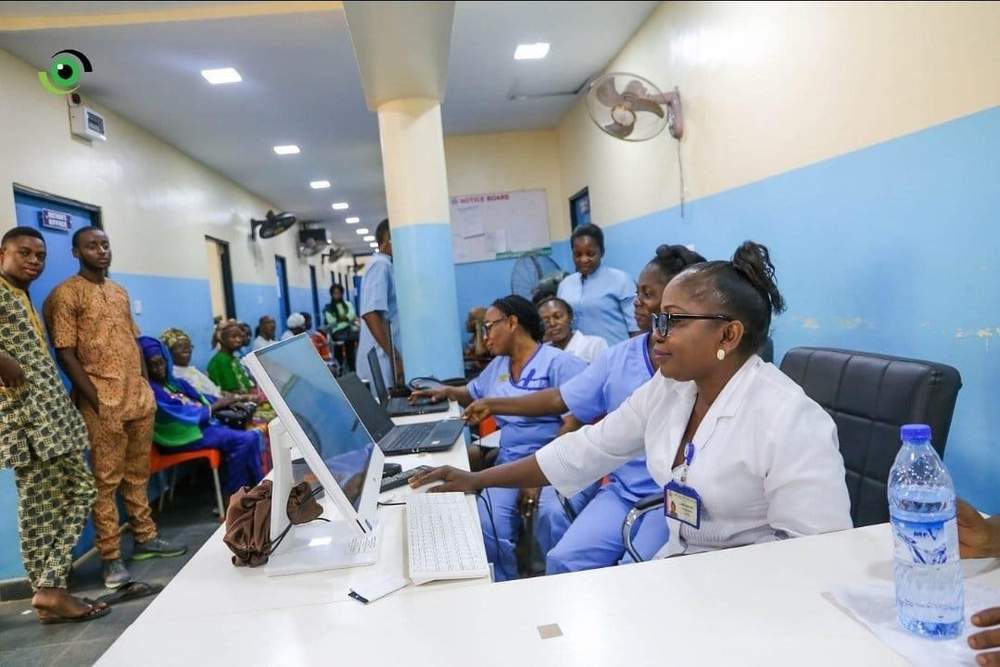
The national architecture emphasises consent-based access and a shared health record that aggregates encounters across public and private facilities. Lagos’s SHIP aligns with this vision by linking its own electronic medical record deployments—already live in a substantial number of primary health centres and expanding—to a central platform that can eventually feed into and draw from the broader national system. Partnerships with technology firms have accelerated the technical work, while the state continues to press for stronger collaboration across government, private providers and development partners.
Challenges remain. Reliable power and connectivity are uneven, digital literacy varies, and the sheer scale of Nigeria’s health sector demands sustained investment and careful change management. Yet the direction of travel is clear. Federal officials speak of digitising the remaining federal tertiary institutions and encouraging states to plug into the same interoperable backbone. Lagos, already further along the road with SHIP and its primary-care digitisation programme, is positioned to demonstrate what seamless access can look like in practice.
In the end, the measure of success will not be the number of systems connected or the sophistication of the technology. It will be whether a patient in Lagos or anywhere else in the country can walk into a clinic and find that their story is already known, accurately recorded and ready to support better care. That is the quiet revolution Nigeria’s digital health plan is trying to deliver, and Lagos is among the first places where its benefits are expected to be felt.