Meet Young Nigerians Choosing Agriculture Over White-Collar Jobs
Agriculture is no longer seen by many young Nigerians as a last resort or a profession reserved for rural communities. Faced with a competitive job market, rising unemployment and a growing demand for fresh food, an increasing number of university graduates and skilled professionals are choosing to build careers in poultry, fish farming, greenhouse cultivation and vegetable production.
From the outskirts of Lagos to neighbouring Ogun State, these young entrepreneurs are proving that modern farming can be both profitable and innovative. Armed with technology, business skills and determination, they are transforming agriculture into a thriving enterprise while creating jobs, improving food supply and redefining what success looks like for a new generation.
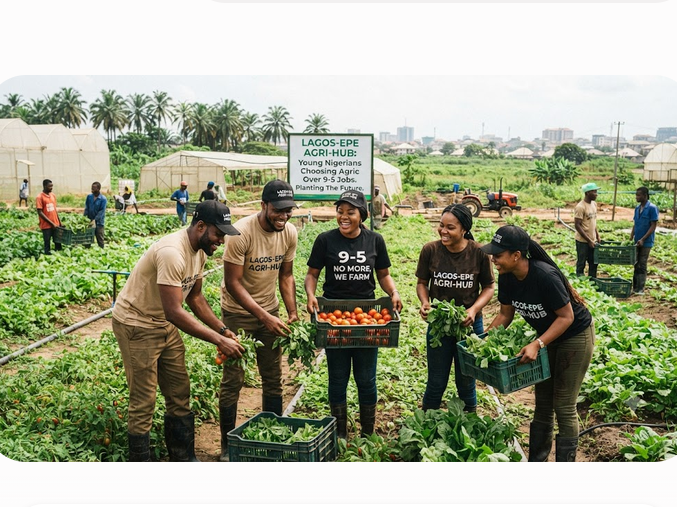
At 6:30 a.m., before traffic builds along the Lagos-Ibadan Expressway, 31-year-old Chinedu Okafor is already checking the temperature inside his greenhouse on the outskirts of Epe.
Rows of lettuce, tomatoes, sweet peppers and cucumbers stretch neatly beneath the transparent roof. He records moisture levels on his phone, inspects the drip irrigation lines and removes a few damaged leaves before workers arrive.
Five years ago, Chinedu spent his mornings in a Lagos office wearing a shirt and tie as a sales executive.
Today, he wears rubber boots.
“I never imagined agriculture would become my career,” he says. “But after months of job hunting during the economic slowdown, I realised I could either keep waiting for employment or create one.”
He is part of a growing number of educated young Nigerians who are returning to agriculture—not because farming has suddenly become easy, but because it offers an opportunity to build businesses at a time when formal employment remains difficult to secure.
Across Lagos, Ogun, Oyo and other parts of southwest Nigeria, university graduates are investing in poultry, fish farming, vegetable cultivation, snail farming and greenhouse agriculture. Many are supplying supermarkets, restaurants, hotels and online grocery stores, turning farming into a modern enterprise driven as much by technology as by hard work.
In Lagos, where available farmland is limited, many young farmers have shifted to intensive farming methods that maximise small spaces. Greenhouses, hydroponics, raised-bed vegetable farming and catfish production have become increasingly popular around Epe, Badagry, Ikorodu and Ibeju-Lekki, where access to land is relatively easier than in the city’s commercial centre.
Twenty-nine-year-old Adebimpe Hassan never planned to become a poultry farmer.
After studying Business Administration, she worked briefly in customer service before deciding to join her father’s small poultry operation in Ikorodu.
What began with fewer than 500 birds has grown into a business that now supplies eggs to neighbourhood supermarkets, bakeries and restaurants.
“My friends thought I had failed because I left an office job,” she says with a smile. “Today, they ask me how to start poultry farming.”
Her biggest challenge is no longer attracting customers.
It is feeding the birds.
The cost of maize and soybean—the two major ingredients in poultry feed—has risen sharply over the past two years, squeezing profit margins for farmers across the country. Electricity costs, diesel prices, vaccines and transportation have also increased, making poultry one of the most capital-intensive agricultural businesses.
“Some weeks, the price of feed changes before you’ve even finished selling your eggs,” she says.
Fish farmer Emmanuel Ojo faces similar pressures.
On his small catfish farm in Epe, thousands of fingerlings swim in concrete ponds powered by solar pumps and backup generators.
Every morning, he checks water quality before feeding the fish.
“It looks simple from outside,” he says. “But one mistake with water or feeding can wipe out months of investment.”
He studied Mechanical Engineering but struggled to find stable employment after graduation.
Instead of waiting indefinitely, he enrolled in an aquaculture training programme and gradually built his farm.
Today, he supplies smoked and live catfish to restaurants in Lekki, Ajah and Victoria Island.
Demand, he says, has never been the problem.
“The challenge is managing production costs.”
Agricultural experts say Nigeria’s rapidly growing population and rising food demand are encouraging more young entrepreneurs to see farming as a business rather than a subsistence occupation. Government agencies, agricultural institutes and private organisations now regularly organise training programmes on greenhouse farming, aquaculture, poultry management and agribusiness, while digital platforms connect farmers directly with buyers, reducing dependence on middlemen.
Technology has also transformed the way many young farmers work.
Instead of relying solely on experience, they use mobile apps to monitor weather conditions, advertise produce on social media, receive customer orders through WhatsApp Business and accept digital payments.
Some have built loyal customer bases by delivering fresh vegetables directly to homes every week through subscription services.
On a one-acre vegetable farm near Ibeju-Lekki, 27-year-old Esther Afolabi harvests spinach, ugu, scent leaves and lettuce before sunrise.
By 9 a.m., most of the vegetables are already on their way to restaurants, fruit markets and residential estates.
“We can’t wait until afternoon,” she explains. “Freshness is everything.”
She employs eight workers during peak harvest periods and hopes to expand into greenhouse tomato production within the next two years.
Yet farming remains a business of constant uncertainty.
Heavy rainfall, flooding, disease outbreaks, fluctuating feed prices and poor road networks continue to threaten profitability. Access to affordable credit is another major obstacle, with many young farmers relying on personal savings, cooperative societies or family support to finance expansion.
Despite the risks, few of them express regret.
“People think farming is only about planting crops,” Esther says.
“It is marketing, accounting, logistics, customer service and technology combined.”
As evening falls over Epe, workers begin loading freshly harvested vegetables into insulated delivery vans headed for supermarkets across Lagos.
Elsewhere, poultry farmers collect thousands of eggs before nightfall, while fish farmers prepare early-morning deliveries to local markets and hotels.
For these young entrepreneurs, agriculture is no longer the occupation many once associated with retirement or rural life.
It has become a modern business built on innovation, resilience and careful planning.
In a country where graduate unemployment and underemployment remain significant challenges, a growing number of educated Nigerians are discovering that opportunity is not always found in an office tower.
Sometimes, it begins in a greenhouse, beside a fish pond or inside a poultry house—where every harvest, every crate of eggs and every successful sale represents not just income, but proof that farming can be a viable career for a new generation.