Inside Nigeria’s Night Economy: The Businesses That Come Alive After Dark
At 11:45 p.m., the traffic around Oshodi has thinned, but Lagos is nowhere near asleep.
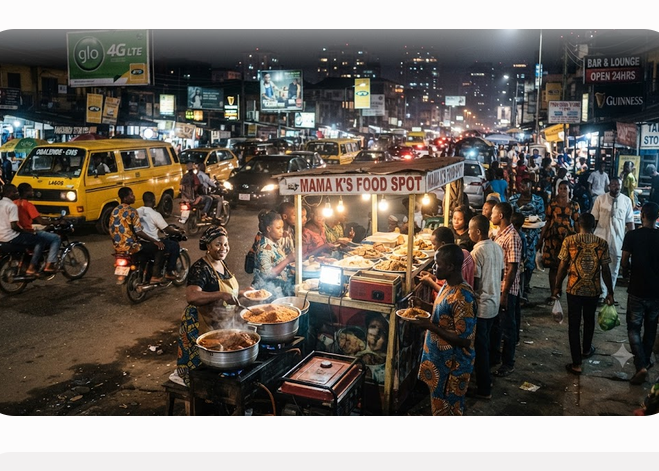
Outside the bus terminal, steaming pots of jollof rice, beans and pepper soup attract commercial drivers preparing for overnight journeys to Benin, Enugu, Onitsha and Abuja. Nearby, a POS operator is still processing cash withdrawals for passengers who arrive without enough money. Across the road, dispatch riders collect food orders, while mechanics work beneath the glow of rechargeable lamps to return broken-down buses to the road before dawn.
For many Nigerians, midnight signals the end of the day. For thousands of others, it marks the beginning of another shift.
From Lagos to Abuja, Port Harcourt, Kano and Onitsha, a vast night-time economy keeps the country moving. It is powered by people whose work is rarely seen but whose services millions depend on every morning.
Every night, airport workers, nurses, security guards, truck drivers, food vendors, cleaners, logistics riders, market labourers, fuel station attendants and emergency responders clock in while the rest of the country sleeps.
Their workplaces may be different, but they share one reality: Nigeria never truly closes.
One of the busiest places after dark is Murtala Muhammed International Airport in Lagos. International flights often arrive deep into the night, triggering a chain of activity involving immigration officers, customs officials, aviation security personnel, baggage handlers, taxi drivers, hotel shuttle operators and airport cleaners.
For every aircraft that lands after midnight, hundreds of workers are already on duty to keep operations running smoothly.
Several kilometres away in Apapa, another workforce is battling time instead of passengers.
Truck drivers transporting containers from the Lagos ports often prefer travelling at night when roads are relatively freer. Some spend days waiting to access the ports, sleeping inside their trucks before finally moving cargo that supplies supermarkets, factories and warehouses across Nigeria.
Without these overnight journeys, businesses in cities hundreds of kilometres away would struggle to restock their shelves.
The country’s healthcare system also depends heavily on workers who rarely see normal sleeping hours.
At hospitals including Lagos University Teaching Hospital (LUTH), Lagos State University Teaching Hospital (LASUTH) and the National Hospital Abuja, doctors, nurses, laboratory scientists, pharmacists and emergency personnel remain on duty around the clock.
Road accidents, complicated childbirths, cardiac emergencies and other life-threatening cases do not wait until daylight.
“A lot of people think hospitals become quiet at night,” says a senior nurse at a government hospital in Lagos. “In reality, that’s when many emergency cases come in. We have nights when there isn’t even time to sit down.”
Away from hospitals, another group of workers keeps Nigerian roads functioning.
Officials of the Lagos State Ambulance Service (LASAMBUS), Lagos State Traffic Management Authority (LASTMA), the Federal Road Safety Corps (FRSC), police officers and firefighters remain on standby throughout the night, responding to road crashes, fires, flooding and other emergencies.
Their work often unfolds while most residents are asleep, yet it is crucial to keeping cities safe.
The informal economy is equally alive after sunset.
In areas such as Ojuelegba, Berger, Ojota, Mile 2, Obalende and Jibowu, roadside food vendors record some of their highest sales between 9:00 p.m. and 3:00 a.m.
Their customers are not only travellers. They include journalists working late shifts, factory employees, security guards, hospital workers, entertainers, interstate drivers, dispatch riders and market porters.
Forty-year-old food vendor Bose Johnson says nighttime has become her most profitable period.
“If I close by 8 p.m., I lose almost half my income,” she says while serving hot amala to customers near Ojota. “The people working overnight still need to eat.”
Digital technology has reshaped the night economy in recent years.
Ride-hailing platforms including Uber, Bolt, inDrive and LagRide record increased demand around airports, hotels, restaurants and entertainment districts during the night.
For many drivers, overnight trips offer higher earnings because of surge pricing, but the risks are equally higher.
“You don’t know who you’re picking up,” says Lagos driver Abdul Kareem. “Before accepting a ride, you check the location carefully. Safety is something every night driver thinks about.”
The boom in e-commerce has created another layer of overnight activity.
Inside warehouses operated by logistics companies, workers sort thousands of parcels while dispatch riders prepare routes before sunrise. By the time customers receive packages later in the day, much of the work has already been completed overnight.
Nigeria’s nightlife industry also supports thousands of jobs.
Restaurants, lounges, hotels and entertainment hubs in Victoria Island, Lekki, Ikeja GRA, Wuse in Abuja and GRA Port Harcourt depend on bartenders, chefs, DJs, event planners, photographers, cleaners, bouncers, waiters and taxi drivers whose busiest hours begin after sunset.
Every concert, comedy show and weekend event creates temporary employment for dozens of people working behind the scenes.
Yet the night economy has its costs.
Long-term night shifts have been linked by health experts to fatigue, disrupted sleep patterns and increased risks of chronic illnesses. Many workers also struggle to balance family responsibilities because they sleep through much of the day while loved ones are at work or school.
Security remains another major concern.
Although police patrols have increased in many commercial areas, workers say they remain vulnerable to robbery, harassment and traffic accidents during the early hours of the morning. Female workers, in particular, often take extra precautions by travelling in groups, sharing their live locations with relatives or relying on trusted transport providers.
Economists believe Nigeria’s night economy will continue expanding as digital commerce, 24-hour logistics, online food delivery, fintech services and around-the-clock healthcare become more integrated into daily life.
Urban development experts argue that improving street lighting, strengthening security, expanding public transport and investing in better infrastructure could unlock even greater economic opportunities after dark, just as cities such as London, New York and Amsterdam have successfully done through structured night-time economic policies.
As first light breaks across Lagos, the city begins another busy day.
Passengers board BRT buses. Office workers leave home. Markets open their gates. Schoolchildren head to class.
But for another group of Nigerians, the workday has already ended.
The cleaner sweeping the airport terminal clocks out. The nurse leaves the emergency ward after a 12-hour shift. The truck driver finally parks after an overnight journey. The food vendor counts the night’s earnings before heading home to sleep.
Their names may never make headlines, but their labour keeps Nigeria moving.
Before the first commuter catches a bus or the first office opens its doors, the country’s night workers have already done their part—proving that while most Nigerians sleep, an invisible workforce is busy powering the nation’s economy, one shift at a time.