Lagos Dispatch Riders: Survival on Two Wheels
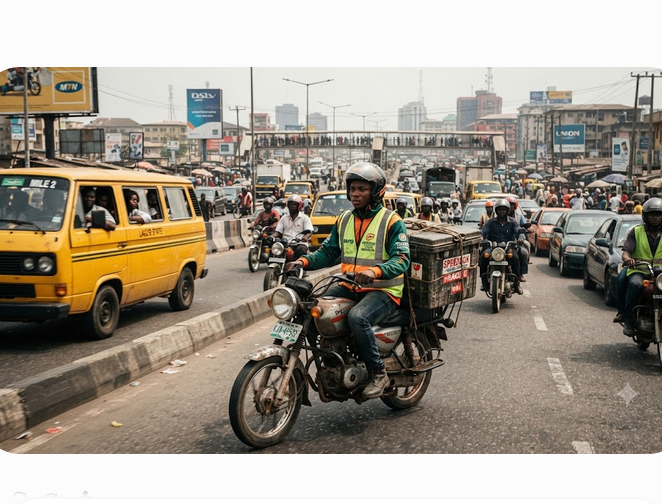
At about 6:30 every morning, dozens of dispatch riders gather outside restaurants, supermarkets, pharmacies and logistics hubs across Yaba, Lekki, Ikeja and Victoria Island, waiting for the first notification to appear on their phones.
Before most office workers begin their commute, these young men have already mapped out their routes, topped up their fuel tanks and prepared for another day that could stretch well into the night.
For many of them, dispatch riding was never part of the plan.
Some are university graduates who have spent years searching for white-collar jobs. Others dropped out of school because their families could no longer afford tuition. A growing number are using the job to support themselves while learning a trade or saving money to start a business. In a city where the cost of living continues to rise, the motorcycle has become more than a means of transportation—it has become a source of survival.
The rapid growth of online shopping, food delivery services and social media businesses has made dispatch riders indispensable to Lagos’ economy. Every day, they transport meals, medicines, fashion items, electronics, legal documents and business supplies across one of Africa’s busiest cities. What customers often see as a quick delivery is the result of hours spent navigating traffic, poor roads and unpredictable weather.
Most riders begin work before 7 a.m. and remain on the road until late evening. Their earnings often depend on how many deliveries they complete, meaning every delay caused by gridlock, heavy rain or a motorcycle fault directly affects what they take home. Many say working 12 to 16 hours has become normal because stopping early means earning less.
Despite spending most of the day on the road, many riders admit that their income has become increasingly difficult to stretch. Fuel remains one of their biggest expenses, followed closely by motorcycle maintenance. Tyres wear out quickly on rough roads, while routine servicing, engine repairs, brake replacements and licensing fees consume a significant portion of their earnings. Riders who lease motorcycles from logistics companies or private owners also make daily remittances before they can keep any profit for themselves.
Beyond the financial pressure lies an even greater challenge—staying alive on Lagos roads.
Dispatch riders are among the most vulnerable road users in the city. They navigate around potholes, speeding commercial buses, impatient motorists and heavy-duty trucks, often while racing against delivery deadlines. Many have survived crashes that left them with injuries and damaged motorcycles, while others have lost colleagues in fatal accidents. Some say they have become accustomed to seeing fellow riders injured on major roads such as Ikorodu Road, the Third Mainland Bridge and the Lekki-Epe Expressway.
The pressure to deliver quickly can create difficult choices. Customers expect their orders on time, businesses demand efficiency and traffic rarely cooperates. Riders say they constantly balance speed with safety, knowing that one mistake could cost them both their income and their lives.
Away from the roads, many are carrying responsibilities that extend far beyond themselves. Some are paying university fees for younger siblings, caring for ageing parents or providing for wives and children. Others send money home every month to support relatives in different parts of the country. For these riders, every successful delivery represents food on the table, school fees paid or rent settled.
Yet very few see dispatch riding as a lifelong career.
Many are pursuing professional courses online after work. Some are learning coding, graphic design, photography or digital marketing. Others hope to establish logistics companies of their own after years of understanding the business from the ground up. Several riders also dream of returning to school or securing jobs in banking, engineering, media or public service if the opportunity comes.
Their phones tell the story of those ambitions as much as they do their daily work. Alongside delivery applications are educational platforms, business ideas, savings apps and online courses—small reminders that they see the motorcycle as a stepping stone rather than a destination.
As Lagos continues to embrace e-commerce and same-day delivery services, the demand for dispatch riders is unlikely to slow. They have become the invisible workforce powering thousands of small businesses that rely on speed to satisfy customers. Every meal delivered, prescription fulfilled or online order received depends on young people willing to spend long hours navigating one of the world’s busiest cities.
Behind every rider weaving through traffic is someone chasing more than the next delivery. He may be funding a younger sibling’s education, saving to launch a business, paying off a motorcycle, or hoping that today’s earnings will eventually open the door to a different future. For Lagos’ new generation of dispatch riders, the journey is not simply about getting packages from one destination to another. It is about keeping hope alive in a city where every kilometre travelled is another step toward a better life.