After the Bulldozers: Families Fighting to Rebuild
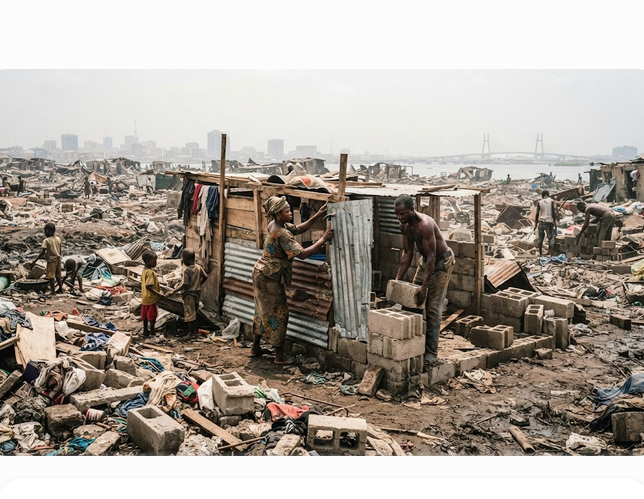
At dawn, the sound of bulldozers shattered the quiet in Ilaje-Otumara, a waterfront community in Lagos Mainland.
Within hours, homes that had stood for decades were reduced to piles of broken concrete, twisted roofing sheets and splintered wood.
Families scrambled to salvage mattresses, school uniforms, cooking pots and family photographs before the machines reached them.
For many residents, it was the day life changed forever.
Months later, the dust has settled, but the struggle to rebuild continues.
Across Lagos and other rapidly expanding Nigerian cities, thousands of families displaced by demolition exercises are trying to start over. While governments argue that many demolitions are necessary for urban renewal, infrastructure projects, environmental protection and the removal of illegal structures, the people left behind are grappling with a different reality—finding shelter, restoring livelihoods and keeping hope alive after losing almost everything.
For 45-year-old fish trader Esther Ojo, the demolition not only destroyed the one-room apartment she rented with her children; it also wiped out the small smoking kiln behind her house that had supported her family for years.
“I didn’t just lose my home,” she says. “I lost my business, my customers and the little savings I had invested.”
Today, Esther rents a single room in Agege while commuting long distances to continue her trade. Transport costs have doubled, profits have fallen, and feeding her family has become increasingly difficult.
Her story mirrors those of countless residents displaced from communities affected by demolition exercises across Lagos in recent years.
For many families, rebuilding begins with borrowing.
Some move into overcrowded homes shared with relatives, while others seek cheaper accommodation in communities on the outskirts of Lagos such as Ikorodu, Badagry and neighbouring Ogun State towns. Many spend months in temporary shelters while trying to save enough money for rent, which landlords often demand one or two years in advance.
Children are among the hardest hit.
Parents who once lived close to schools now struggle with longer journeys and higher transport costs. Some students have transferred to public schools after their parents could no longer afford private education, while others temporarily dropped out as families focused on finding food and shelter.
“We had to choose between paying rent and paying school fees,” says one father. “That is not a choice any parent should make.”
In many low-income communities, homes also serve as workplaces.
Hairdressers convert living rooms into salons. Tailors sew from front verandas. Mechanics repair vehicles beside their homes. Food vendors cook from makeshift kitchens.
When these homes disappear, so do the businesses that sustain entire families.
Many traders say they lost equipment, inventory and loyal customers overnight. Without insurance or compensation, restarting requires fresh capital that few possess.
Some have turned to roadside trading, while others now work as labourers or ride-hailing drivers simply to survive.
The impact of forced evictions remains visible in several Lagos communities.
Residents affected by demolition exercises in areas including Ilaje-Otumara and Baba Ijora continue to call for compensation, resettlement and greater consultation before future redevelopment projects. Community leaders argue that many families received little time to prepare for displacement and have yet to recover economically.
Similar concerns have also been raised in Makoko, where demolition activities affecting parts of the waterfront have repeatedly sparked debates over housing rights, environmental management and urban planning. Human rights organisations continue to urge authorities to ensure redevelopment projects comply with legal standards that protect vulnerable communities from homelessness.
The Lagos State Government maintains that many demolition exercises are carried out in the public interest, citing flood control, infrastructure development, environmental safety and the removal of structures built on government land or within designated setbacks.
Urban planners say the greatest loss is often invisible.
When communities are broken apart, neighbours who once shared childcare, lent money during difficult times or supported local businesses become scattered across different parts of the city. Long-standing social networks disappear almost overnight.
For workers, relocation often means spending four or five hours commuting each day. For elderly residents, it means leaving familiar environments where they once relied on neighbours for support. For children, it can mean losing friends, changing schools and adjusting to unfamiliar neighbourhoods.
Despite the setbacks, many displaced families are slowly rebuilding.
Some women have joined cooperative societies to access small business loans. Churches, mosques and community organisations have provided food, clothing and temporary accommodation. Young entrepreneurs are using social media to reconnect with customers and restart businesses from rented rooms or roadside stalls.
Housing experts believe Nigeria’s growing urban population and housing deficit demand more than demolition exercises. They argue that sustainable urban development should include affordable housing, meaningful engagement with affected communities, proper notice before relocation and practical resettlement plans that minimise hardship.
For families rebuilding after forced evictions, recovery is measured not by the number of new houses constructed but by the ability to restore dignity, stability and a sense of belonging.
Every new shop reopened, every child returned to school and every rented room secured represents another step forward after devastating loss.
Standing beside the small kiosk she recently opened, Esther looks ahead with cautious optimism.
“They took our homes,” she says, arranging fresh fish for customers. “But they didn’t take our determination. We may be starting from nothing, but we’re starting again.”
Across Lagos, that quiet resilience has become the true story of families determined to rebuild—not just their houses, but their lives.