
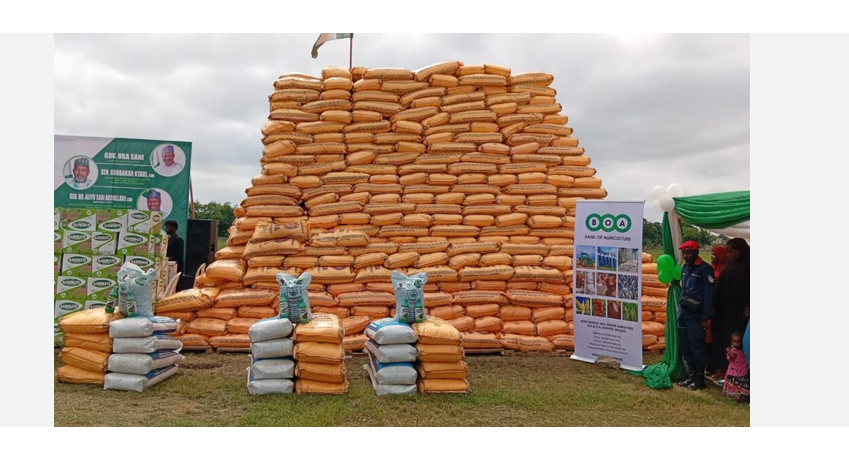
FG Flags Off 10m Fertiliser Bag Distribution
The Federal Government has commenced the nationwide distribution of more than 10 million bags of fertiliser to farmers as part of a broader initiative aimed at increasing agricultural productivity, strengthening food security and protecting smallholder farmers from market shocks.
The programme was officially flagged off in Zaria, Kaduna State, by the Minister of Agriculture and Food Security, Senator Abubakar Kyari, under the Renewed Hope Smallholder Support and Value Chain Fund (RH-SVCF).
Beyond supplying fertiliser, the initiative introduces a Guaranteed Minimum Price (GMP) model designed to benefit two million smallholder farmers across the country. The scheme seeks to ensure that farmers not only receive quality farm inputs at the right time but also have access to structured markets where their produce can be sold at government-backed minimum prices.
Speaking at the launch, Kyari described the programme as a major shift from previous agricultural interventions, noting that farmers will now receive support throughout the entire farming cycle—from land preparation and input supply to harvesting and market access.
Under the new framework, each participating farmer will be linked to a Farmer Aggregation Company, which will provide certified seeds, fertiliser, extension services and guaranteed off-take of harvested produce. The minister said this approach is intended to eliminate the long-standing challenges of poor market access and exploitative pricing faced by many farmers.
Kyari stressed the importance of delivering fertiliser during the peak planting season, noting that timely access to inputs is essential for improving yields. He added that about one-third of the programme’s beneficiaries are women, reflecting the government’s commitment to inclusive agricultural development.
The Managing Director and Chief Executive Officer of the Bank of Agriculture (BOA), Ayodeji Sotinrin, said the intervention is expected to reach two million farmers nationwide, with nearly 300,000 farmers already enrolled.
According to him, over 1.1 million bags of fertiliser and 16,470 metric tonnes of improved seeds are already being deployed through 20 Farmer Aggregation Companies operating in more than 20 states, supported by 15 accredited input suppliers.
Sotinrin explained that the initiative goes beyond input distribution by integrating financing, mechanisation, aggregation systems and structured market access to create a more sustainable agricultural ecosystem that improves farmers’ incomes and boosts rural economies.
Also speaking, the Group Managing Director of Arzikin Noma Africa, Adeoluwa Michael Adeshola, said the company has expanded its network from fewer than 3,000 farmers to more than 400,000, with plans to reach one million farmers by 2030. He emphasised that meaningful agricultural transformation would require sustained collaboration between government, financial institutions, development partners and the private sector.
The Federal Government said the fertiliser distribution and guaranteed pricing initiative forms part of its broader strategy to improve food production, reduce farmers’ exposure to market risks, strengthen agricultural value chains and enhance Nigeria’s long-term food security.
The programme was officially flagged off in Zaria, Kaduna State, by the Minister of Agriculture and Food Security, Senator Abubakar Kyari, under the Renewed Hope Smallholder Support and Value Chain Fund (RH-SVCF).
Beyond supplying fertiliser, the initiative introduces a Guaranteed Minimum Price (GMP) model designed to benefit two million smallholder farmers across the country. The scheme seeks to ensure that farmers not only receive quality farm inputs at the right time but also have access to structured markets where their produce can be sold at government-backed minimum prices.
Speaking at the launch, Kyari described the programme as a major shift from previous agricultural interventions, noting that farmers will now receive support throughout the entire farming cycle—from land preparation and input supply to harvesting and market access.
Under the new framework, each participating farmer will be linked to a Farmer Aggregation Company, which will provide certified seeds, fertiliser, extension services and guaranteed off-take of harvested produce. The minister said this approach is intended to eliminate the long-standing challenges of poor market access and exploitative pricing faced by many farmers.
Kyari stressed the importance of delivering fertiliser during the peak planting season, noting that timely access to inputs is essential for improving yields. He added that about one-third of the programme’s beneficiaries are women, reflecting the government’s commitment to inclusive agricultural development.
The Managing Director and Chief Executive Officer of the Bank of Agriculture (BOA), Ayodeji Sotinrin, said the intervention is expected to reach two million farmers nationwide, with nearly 300,000 farmers already enrolled.
According to him, over 1.1 million bags of fertiliser and 16,470 metric tonnes of improved seeds are already being deployed through 20 Farmer Aggregation Companies operating in more than 20 states, supported by 15 accredited input suppliers.
Sotinrin explained that the initiative goes beyond input distribution by integrating financing, mechanisation, aggregation systems and structured market access to create a more sustainable agricultural ecosystem that improves farmers’ incomes and boosts rural economies.
Also speaking, the Group Managing Director of Arzikin Noma Africa, Adeoluwa Michael Adeshola, said the company has expanded its network from fewer than 3,000 farmers to more than 400,000, with plans to reach one million farmers by 2030. He emphasised that meaningful agricultural transformation would require sustained collaboration between government, financial institutions, development partners and the private sector.
The Federal Government said the fertiliser distribution and guaranteed pricing initiative forms part of its broader strategy to improve food production, reduce farmers’ exposure to market risks, strengthen agricultural value chains and enhance Nigeria’s long-term food security.