Lagos Schools Admission: More Pupils Rush for Fewer Spaces
By Motolani AbdulGafar
Pressure on spaces in public primary and secondary schools in Lagos State is not likely to ease going by the experience of parents and school administrators in the current admission season.
The state implements the 6-3-3-4 system under which a child spends six sessions moving from primary 1 to six in primary school, three years each in junior and secondary school and four years in a tertiary institution.
This session’s admission process began with the announcement that the Lagos State Common Entrance and placement test for students seeking secondary education in the public schools will hold on Saturday, July 23, 2022.
The results were out in August, this year paving the way for parents and guardians to embark on the next phase: getting their wards into the state’s 350 junior secondary schools.
Parents whose children passed the National Common Entrance Examination and could afford to pay the mandatory N25,000 fees applied for places in five model colleges run by the government.
The period also opened the window for parents wishing to transfer their wards to second year in junior secondary schools or first year in senior secondary schools.
For this purpose, JSS2 candidates were asked to submit their second and third term results and SS1 candidates advised to submit JSS3 first and second term results
The rule also requires the tax clearance certificate, copy of treasury receipts on payment of N5,000 for forms.
With the announcement of Monday, September 5 as the resumption date, all seems set for the 2022/23 session of three terms.
The first term is expected to end on Thursday October 21, 2022 making a total of 68 days. The students will spend 59 days in schools in the second term, expected to run from January 9 to April 6, 2023. They will resume for the third term on April 25 and close on July 21, this year.
For pupils with technical orientation, the state’s vocational examination board is where to go.
Parents are trying to maximise the opportunities to put their children in the best of the available schools.
But many are disturbed by the conditions of the schools.
The story of overcrowded public schools in Lagos State begins with the government’s commitment to put over 2million out of school children through the educational system to deliver the high literacy needed to function in Africa’s fifth largest economy.
Hon. Wahab Alawiye-King, chairman of the Lagos State State Universal Basic Education Board, concluded a school enrollment campaign last month with an appeal to parents to register their children to learn.
He made the appeal against the backdrop of figures which bother parents. 2022 figures are not available partly because the Annual Public Schools Census published by the Ministry of Education is yet to leave the press.
However, as at 2019, there were 62,399 pupils in classes 1 to 3 in public primary schools. The figures of the other levels are kindergarten/nursery, 65,133; primary 4 to 6, 84,916; Junior Secondary Schools, 101,897; Senior Secondary Schools, 46,676.
These pupils use 10,085 classrooms in 350 junior and 322 senior secondary schools to receice knowledge. The result is that there are not enough classrooms to accommodate them.
Yet new schools are not being established to cope. Between 2015 and 2019, data sourced from.the Annual Public Schools Census 2019 indicate that only one school was added as the state began with 1,014 schools in 2015 and closed woth 1,015 schools in 2019.
This inadequacy seems to be causing more pupils to drop out of school. According to data of the Lagos State government, enrolment in secondary schools opened with 248,339 in 2015 and closed in 2019 with 234,611 implying that 13,728 dropped out over the five-year period.
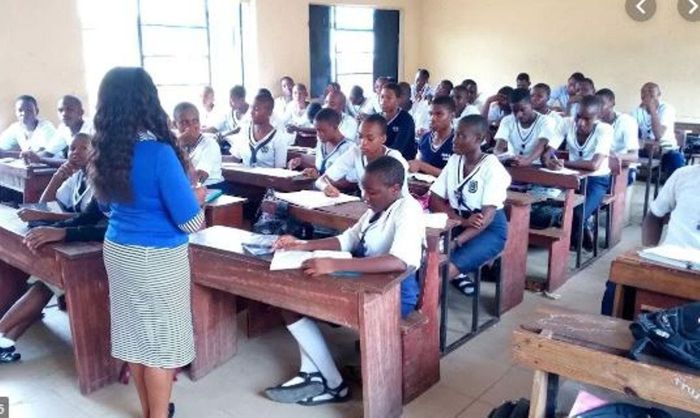
A visit to some Senior and Junior schools in Oshodi-Isolo, Ojokoro and Ikeja areas of the state indicated the situation.
Class size is critical to learning and teaching, according to experts. Teachers in government schools in Nigeria routinely work (minus extra lesson) six hours daily.
The Head of Department, Educational Foundations, University of Lagos, Professor Ngozi Osarenren, said it would be difficult for effective learning and teaching to take place in an overcrowded classroom.
So, lack of space coupled with overwork for the teachers make gaining entrance into schools especially in Lagos cumbersome.
A former English Language teacher at the Adeniran Ogunsanya College of Education (AOCOED), Otto\Ijanikin, Lagos State, Mr Francis Jegede, said no teacher could perform magic if the condition is not conducive because teaching and learning is a feedback mechanism from teacher to students and vice versa.
According to him, part of the learning process is for teachers to ensure that learning has actually taken place after a teaching session.
“Teaching is not all about dishing out information. It is a two-way communication between the teacher and the student. A teacher must be able to identify students according to their abilities to assimilate in order to further help those who may be deficient in one area or the other and this can only be effective in schools with reasonable sizes of students to classes,” he emphasised.
But where all these are lacking, he added, there would be problems and the problems would manifest in the science laboratories, libraries, dormitories, and even in toilets.
Interestingly, some Lagos public school teachers opened up on this. They disclosed on the condition of anonymity that they only give their students home work to fulfil all righteousness because they would not bother to mark many of their scripts, much less assess their performances for possible corrections.
One of them, a female, said: “I cannot kill myself. How many scripts will I mark when I’m not a machine? I have more than 85 students in one class and we have eight arms, which means, I have about 680 students in all to attend to almost every day.”
The implication of this scenario for this particular teacher is that spending only five minutes with a student per day on paperwork (outside the actual teaching hours) will take four hours and seven minutes per week out of her schedules. While it takes only a very passionate and hardworking teacher to sacrifice such valuable time, the quality of the learning that is expected to take place within such a time frame will be very minimal.
“That is why what I do in most cases is to ask the students to exchange their scripts among themselves and mark, or I don’t bother at all. It is only during examination that I know marking of scripts is a must for score grading,” the teacher added.
She also shared a recent experience which was occasioned by the huge student population in her school. “I ran into a male student who came to empty his bowel in the teachers’ toilet because the students’ toilets were all occupied at the time. Although I warned him against using the teachers’ toilet again no matter the level of his discomfort, I knew in my mind that the shortage of toilets caused his action.”
It was gathered that the infrastructure is too small to accommodate the large number of students who seek admission.
This has continued to restrict admission quota in the public schools in Lagos, make the process a tough competition.
A community health expert at the Lagos State University Teaching Hospital (LASUTH), Ikeja, who spoke on the condition of anonymity as he was not authorised to speak to the press, said students in congested classrooms, like in every other crowded place, are prone to respiratory and other infectious diseases like tuberculosis and skin rashes.
According to the medical personnel, overcrowded environment reduces the quality of air individuals breathe by limiting the availability of oxygen and also increases the chances of body contact and these can badly affect an individual’s health.
Huge classroom population contributes to the lack of discipline displayed by students of public schools.
It makes proper monitoring of their movements and other activities difficult for teachers.
Although the government makes class attendance mandatory for every student, it was gathered that most schools don’t mark students register every day any longer. They do so once cumulatively, on a weekly basis. Little wonder then why many students are still on the streets or at best hanging around school premises at 9.00 or 9.30 a.m., while some don’t even report in school at all, whereas their first lesson begins officially at 8.15 a.m.
“That is why a moderate classroom is desirable,” Professor Osarenren, emphasised.
The Data Centre of UNESCO Institute for Statistics, in its 2008 report, stated that of all the 189 countries around the world, Nigeria was among the four that had the most overcrowded classrooms in its secondary schools. Other countries in this category were Pakistan, Eritrea and Malawi.
The actual number of students recommended by UNESCO for a single classroom is between 30 and 35 and any classroom that has an extra student is considered to be overcrowded and not good for learning and teaching.
A former Nigeria’s Representative to UNESCO and Emeritus Professor at the University of Ibadan, Michael Omolewa, shed more light on the global agency’s position on benchmark. He said a small classroom would give learners the opportunity to be reached at the individual level by their teachers, who would monitor their performance in both learning and character development.
Through that, he added, teachers would quickly identify the challenges posed by learning, as slow learners could be encouraged to catch up with the school work without negatively affecting the performance of more capable learners.
“And we can only achieve this in a moderate classroom,” the professor of education history insisted.
But in Lagos (with over 20 million population, according to the state census), only in private schools does this recommendation seem to have a meaning. Even in private schools, findings have shown that the situation is not a way of compliance to the directive but because of their fewer enrolments when compared to public schools and the economic hardship which compelled many parents to move their children to public schools where they pay almost nothing.
The former chairman of the National Association of Proprietors of Private Schools (NAPPS), Lagos State chapter, Alhaji Akande Kamaldeen, confirmed this assertion.
He said hardly could any private school, as of today in the state, boast 30 students in a class.
“This is an unfortunate scenario as we cannot help the situation because we will have to pay salaries, rent, utility charges and various forms of levies to the government,” he stressed.
Before now in the state, many parents preferred sending their children to private primary schools for reasons ranging from quality teaching to closeness to homes (as public schools are always located far away) and later, to public secondary and tertiary schools as they grew older.
Meanwhile, a parent, Mr. Gafar Olafimihan who enrolled his ward to Eko Junior Grammar School, Ilasamaja, told ECHONEWS that the process was seamless.
“The processing wasn’t as stressful as we thought it would be and I think that was because we got it right from the beginning. While registering for the common entrance exam, we chose public school as our preferred choice for his secondary education and as it seems now, he will be resuming with them.
“What we have to do is to tender tax clearance and perfect some processing. It’s not stressful, the previous rigmarole that characterizes the process has been eliminated.”
However, ECHONEWS gathered that the complication arises when students are transiting from Junior Secondary to Senior Secondary level.
Speaking to ECHONEWS, the principal of AMCA private school at Igando/Isuti Close, Mr Faesol Thanni said students in public schools face some challenges as many of them sometimes encounter issues like name misplacement which can be sometimes troublesome for parents as their children might not be fully settled in a class after the resumption.
Thanni, therefore, noted that in rear cases some students might be delayed concerning their failure in the Junior Secondary School West African Examination Council’s evaluation as most schools indulge in malpractices without considering the children’s future.
Meanwhile, the state and local governments have been expanding the infrastructure to accommodate the increasing population of students in Lagos State. An example is the new primary school built by the Ejigbo LCDA, while renovation of other schools are going on across the state.
The state government has also embraced private schools as partners in providing education.
Commissioner for Education, Folasade Adefisayo announced that as at 2020, the number of private schools registered in Lagos State moved from 729 in 2019 to 1,660 even though there are over 20,000 illegal schools.
“Despite the fact that the number of schools in Lagos, especially in the private sector has increased tremendously, the yawning gap between demand and supply clearly shows that more schools are needed to meet our educational target. We need more private schools to come on board for us to be able to cater to the ever increasing educational needs of a fast growing metropolis like Lagos.”