
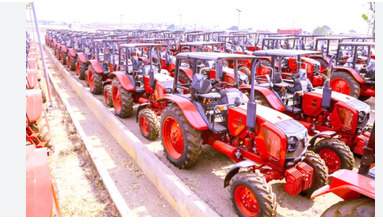
FG Ignites Farm Mechanisation Drive with 2,000-Tractor Rollout
Atume Terfa
Nigeria’s push to modernise agriculture has roared to life with the launch of a sweeping mechanisation programme aimed at transforming productivity across the country’s farmlands.
At Sheda in Abuja, Abubakar Kyari, Minister of Agriculture and Food Security, flagged off the first phase of the initiative, describing it as the beginning of a full-scale agricultural productivity revolution. According to him, the deployment of 2,000 tractors and thousands of farming implements is about far more than machinery — it is a strategic intervention to restore Nigeria’s agricultural strength, reinforce food security, and revitalise rural economies.
The rollout will occur in phases across the six geopolitical zones, beginning with 600 tractors, followed by 750 and 650 units in subsequent batches.
Rather than distributing tractors to individuals, the Federal Government is adopting a service-based model. Certified mechanisation service providers will manage the equipment, ensuring wider access for smallholder farmers while maximising operational efficiency.
Each tractor is projected to cultivate up to 600 hectares annually, a significant boost for regions where farming has long relied on manual labour. To sustain performance, the programme includes two years of maintenance support, 36 mobile workshops, and plans for seven mega mechanisation service centres nationwide.
Mechanisation is being matched with financial firepower. The government has introduced a ₦50 billion catalytic seed fund in partnership with the Bank of Industry, alongside ₦250 billion in agricultural financing targeted at smallholder farmers during the wet season.
Officials say this blended approach, combining equipment, credit access, and technical support, is designed to unlock agro-industrial growth and dismantle persistent production bottlenecks.
In a forward-looking move, authorities are also planning a domestic tractor assembly plant capable of producing between 2,000 and 4,000 units annually. The goal is clear: reduce dependence on imports while building local manufacturing capacity.
The initiative is expected to support over 1.2 million farmers cultivating more than 1.5 million hectares each year. By reducing reliance on manual labour, shortening planting cycles, and curbing post-harvest losses, officials believe the programme could significantly improve yields and stabilise food supply.
As the tractors begin to till fields across the country, expectations are high that this mechanisation drive will mark a decisive turning point, shifting Nigerian agriculture from subsistence constraints toward competitive, technology-driven production.