
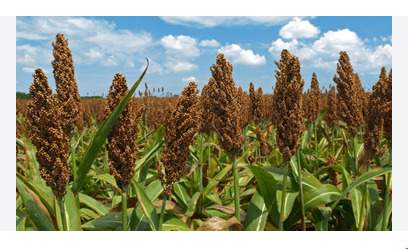
Nigeria’s Sorghum Sector Set For Major Growth
Atume Terfa
Nigeria’s sorghum industry is set for a breakthrough as innovative research, growing industrial demand, and renewed government support converge, creating what experts are calling a potential “sorghum windfall” for farmers nationwide.
Researchers at the Institute for Agricultural Research (IAR) at Ahmadu Bello University (ABU) have developed new sorghum varieties — SAMSORG 52, 53, and 54 — that promise higher yields while maintaining shorter plant heights, a key feature for farmers in Northern Nigeria, where taller crops can present security challenges. These early-maturing, bio-fortified varieties, enriched with iron, are designed to boost nutrition, improve crop resilience, and outpace older strains.
Farmers working with the new seeds are already reporting remarkable results. Leveraging the Farm and Community-Managed Seed System (FCMSS), smallholder farmers are harvesting as much as four tonnes per hectare — a dramatic increase compared to traditional yields. The combination of better seeds and community-driven distribution is transforming local production, enabling farmers to capitalise on the crop’s rising value.
Industry demand is surging alongside these innovations. Nigeria’s milling and brewing sectors are increasingly turning to sorghum not just for traditional foods, but also for animal feed, flour, and industrial processing. Analysts note that demand for sorghum for food, seed, industrial use, and feed has jumped significantly in 2024, with projections indicating continued growth.
Private-sector initiatives are also fueling the crop’s potential. A partnership between IDH Nigeria and agritech firm Zowasel is modernising the sorghum value chain, promoting regenerative farming practices, streamlining seed-to-market systems, and expanding financial access for smallholders — with a particular focus on empowering women and youth.
According to the 2025 Agricultural Performance Survey, staple crop output is rising across the country, with sorghum among the top performers despite challenges such as erratic rainfall, rising input costs, and limited mechanisation.
Taken together, these developments suggest a turning point for Nigeria’s sorghum sector. No longer merely a subsistence crop, sorghum is emerging as a strategic commodity with vast potential for food security, agro-industrial growth, and rural livelihoods. With the new research, improved seeds, and growing market opportunities, the long-underestimated crop is finally claiming its place as a cornerstone of Nigeria’s agricultural future.